Large Gap Between Awareness and Implementation
Hunet recently announced the results of a survey on "Corporate Education Status and Perception" conducted on the 24th, targeting education managers of 546 small and medium-sized enterprises and mid-sized companies.
According to the survey results, more than nine out of ten small and mid-sized companies recognize the importance of employee education. However, they are experiencing difficulties in implementation due to practical constraints such as budget, manpower, and time.
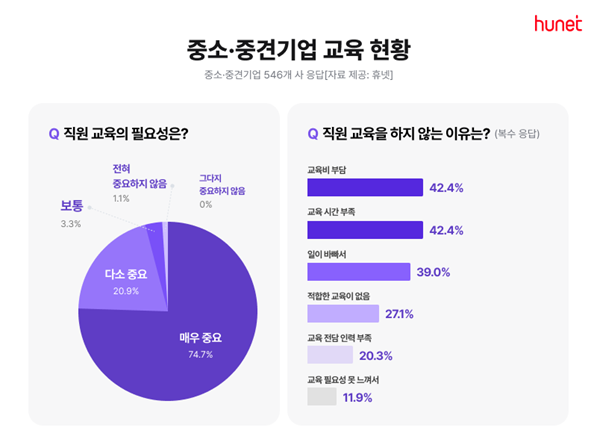 Hunet recently announced the results of a survey on "Corporate Education Status and Perception" conducted on the 24th, targeting education managers of 546 small and medium-sized enterprises and mid-sized companies. Hunet
First, in response to the question about the "necessity of employee education," the average score was 4.7 out of 5. When combining those who answered "very important" (74.7%) and "important" (20.9%), 95.6% of respondents recognized the need for education. The item "I consider employee education as a welfare benefit" also recorded an average score of 4.4, indicating a tendency to perceive education not only as a means to enhance job competency but also as part of company welfare.
Regarding the "areas where employee education is most needed" (multiple responses allowed), "common job skills (such as Excel, report writing, etc.)" accounted for 67.0%, and "individual specialized job skills (such as planning, HR, etc.)" accounted for 61.5%. The average appropriate annual education cost per employee was found to be 322,000 won. For this year, the most common response regarding the education budget was "frozen," at 42.9%.
For the question "Does AI help resolve manpower shortages in small and mid-sized companies?" the average score was 3.6. However, there was a significant gap between companies in terms of actual implementation of education. Only 19.8% of companies provided training to all employees, while 27.5% were training only some employees, and 20.9% planned to train only some employees. The percentage of companies with no education plans at all reached 23.1%.
A Hunet representative stated, "This survey shows that while small and mid-sized companies place high importance on employee education, they face difficulties in implementation due to practical constraints," and added, "A subscription-based education model that can provide necessary training to companies and their employees within a set budget could be a practical alternative."
© The Asia Business Daily(www.asiae.co.kr). All rights reserved.
![Clutching a Stolen Dior Bag, Saying "I Hate Being Poor but Real"... The Grotesque Con of a "Human Knockoff" [Slate]](https://cwcontent.asiae.co.kr/asiaresize/183/2026021902243444107_1771435474.jpg)















