Accelerating New Material Development with Data-Driven Structure Prediction Algorithm
Three New ZIFs Synthesized for Carbon Neutrality Applications
Published in JACS Au
Although theoretically there are millions of possible structures, only 50 of these materials have been synthesized over the past 20 years.
Now, three new types of this material have been created using a data-driven structural prediction algorithm.
On April 24, a team led by Professor Wonyoung Choi from the Department of Chemistry at UNIST, in collaboration with Professor Hyuncheol Oh and Dr. Junghoon Lee's team from the Korea Institute of Science and Technology (KIST), announced that they have successfully synthesized three new zeolite-mimicking MOFs using a data-driven structural prediction algorithm.
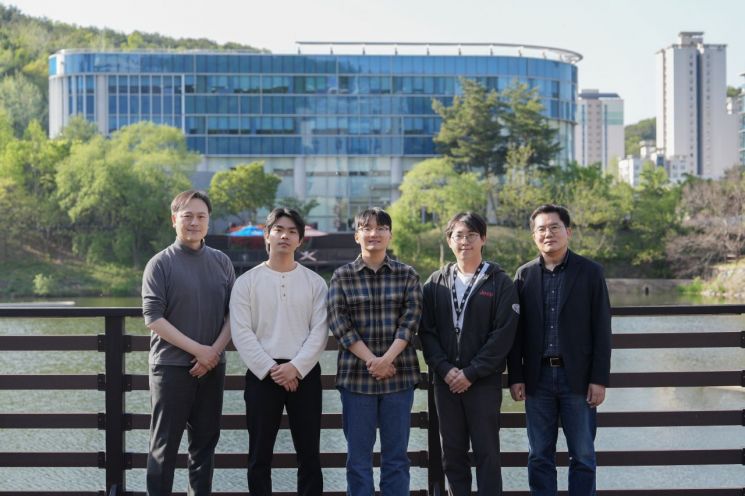 Research team (from right) Professor Wonyoung Choi, Researcher Seongyeop Jeong, Dr. Juhan Nam, Researcher Eunchan Jo, Professor Hyuncheol Oh. Provided by UNIST
MOFs, or metal-organic frameworks, are materials in which metals and organic compounds are chemically bonded to form a porous structure at the nanometer scale. Among these, ZIFs (zeolitic imidazolate frameworks), which resemble the structure of natural zeolites, are considered promising for applications such as catalysis and gas storage and separation due to their excellent chemical stability and flexible pore design.
However, the gap between theoretically possible structures and those that can actually be synthesized?often referred to as the "zeolite conundrum"?has been a major obstacle in the development of new ZIF materials. In theory, millions of new ZIFs could be created by varying the combinations of metals and organic compounds, but since the first ZIF was synthesized in 2006, only about 50 new ZIFs have actually been synthesized.
Professor Choi's team developed a new algorithm that quantifies the intuition of chemists, enabling the selection of synthesizable structures from among millions of virtual candidates. This algorithm quantifies factors such as the bond angles between atoms, the number of ring structures through which an atom connects to others, and the regularity of these connections.
Using this algorithm, the research team narrowed down 4,450,797 candidate structures to 420, then further filtered them based on energy stability to identify 90 top-priority candidates (Tier 1).
Experimental testing of some of these candidates led to the successful synthesis of three previously unreported ZIFs: UZIF-31, UZIF-32, and UZIF-33. All three ZIFs are high-performance materials capable of selectively separating carbon dioxide and methane. In particular, UZIF-33 demonstrated a selective adsorption of carbon dioxide over methane by more than a factor of 10, indicating significant potential for greenhouse gas separation and purification.
Professor Wonyoung Choi stated, "This study is a case where we precisely selected only the structures that can actually be synthesized and then succeeded in experimental synthesis, demonstrating that digital predictions can lead to experimental results. If combined with automated synthesis technology, the pace of new ZIF material development will accelerate significantly, making it possible to develop high-performance materials with desired properties."
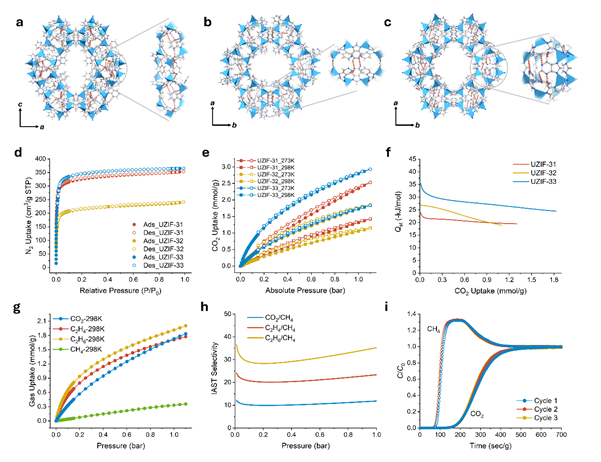
The results of this study were selected as a supplementary cover article in the world-renowned chemistry journal JACS Au and published on March 24.
The research was supported by the Ministry of Science and ICT, the Institute for Information & Communications Technology Planning & Evaluation (IITP), the National Research Foundation of Korea (NRF), the Korea Institute of Science and Technology (KIST), and the UNIST Carbon Neutrality Convergence Institute research program.
© The Asia Business Daily(www.asiae.co.kr). All rights reserved.
![Clutching a Stolen Dior Bag, Saying "I Hate Being Poor but Real"... The Grotesque Con of a "Human Knockoff" [Slate]](https://cwcontent.asiae.co.kr/asiaresize/183/2026021902243444107_1771435474.jpg)
















