Annual Burden Reduced by 3.8 Billion KRW Through Lower Unpaid Penalties
8.3 Billion KRW in Win-Win Initiatives to Be Supported Over Three Years
The four major convenience store chains, which have been under investigation by the Korea Fair Trade Commission (KFTC) for alleged unfair practices against suppliers, have proposed a corrective measure that includes reducing unpaid penalty rates by up to 3.8 billion KRW annually and supporting a total of 8.3 billion KRW in win-win initiatives over the next three years, instead of facing sanctions.
On April 24, the KFTC announced that it had finalized a consent decision regarding the alleged violations of the Large-Scale Retail Business Act by the four convenience store chains: GS25, CU, 7-Eleven, and Emart24.
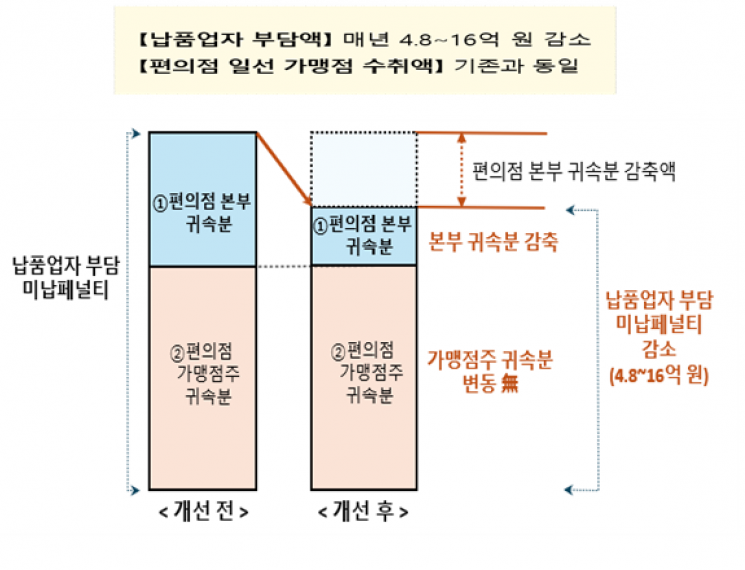 Profit and Loss Changes by Entity Before and After the Reduction of Unpaid Penalty Rates for the Four Convenience Store Chains (Source: Korea Fair Trade Commission)
This consent decision includes reducing the rate of unpaid penalties, which are damages for late deliveries, to 6-10%, a level similar to that of large supermarkets and other retailers. As a result, the unpaid penalties borne by suppliers are expected to decrease by approximately 480 million to 1.6 billion KRW annually. The total reduction across the four convenience store chains is estimated to be about 3.8 billion KRW per year.
The criteria for new product entry incentives will also be improved, changing from "products released within six months at each convenience store" to "products released within six months for the first time in the domestic market."
In addition, over the next three years, a win-win cooperation fund totaling 3 billion KRW will be contributed to the Foundation for Large and Small Business Cooperation and the Korea Foundation for Cooperation between Large and Small Businesses, Rural and Urban Areas, to support private joint projects aimed at technological development and productivity improvement for suppliers. Other win-win measures have also been confirmed, including providing advertising and information services (worth about 5.3 billion KRW), which are currently paid services, free of charge. As a result, the four convenience store chains will support a total of 8.3 billion KRW in win-win initiatives over three years.
The four convenience store chains had been under investigation for excessively imposing damages on suppliers who failed to deliver products on time and for applying unfair criteria for new products to receive new product entry incentives. They applied for a consent decision from the KFTC during the investigation.
A consent decision is a system in which a business operator proposes reasonable corrective measures, such as restoration or compensation for damages, and the KFTC, after gathering opinions from interested parties, recognizes the validity of those measures and swiftly concludes the case without determining the legality of the conduct.
In the large-scale retail sector, the legal basis for this system was established with the amendment of the Large-Scale Retail Business Act in July 2022, and this is the first time it has been applied.
The KFTC stated, "We decided to approve the consent decision, considering that the corrective measures strike a balance with the expected level of sanctions if a violation were determined, that prompt implementation of these measures will provide substantial benefits to suppliers, and that it also serves the public interest by improving transaction practices."
© The Asia Business Daily(www.asiae.co.kr). All rights reserved.
![Clutching a Stolen Dior Bag, Saying "I Hate Being Poor but Real"... The Grotesque Con of a "Human Knockoff" [Slate]](https://cwcontent.asiae.co.kr/asiaresize/183/2026021902243444107_1771435474.jpg)















