Main Negotiations Between Labor and Management Break Down...
Mediation Begins on the 23rd
Strike Possible if Deadline Passes on the 29th
The main wage and collective bargaining negotiations between the Seoul city bus labor union and management have broken down again this year, leading to the start of mediation procedures. With disagreements over various issues, including the wage increase rate, if an agreement is not reached by the 29th, a 'bus strike' could take place on the 30th.
According to an Asia Economy report on April 25, the Seoul City Bus Labor Union and the Seoul City Bus Transportation Business Association have held nine rounds of main negotiations since December last year. However, talks broke down on April 3, prompting the start of mediation procedures. The first mediation session by the Seoul Regional Labor Relations Commission was held on April 23, and the second session is scheduled for 5 p.m. on April 29, with the mediation deadline set at midnight that day. If no agreement is reached by then, the union can legally begin a strike from midnight on the 30th. The union also plans to hold a strike authorization vote on the 28th.
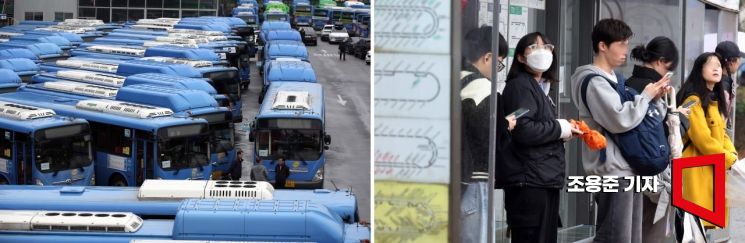 On March 28, 2024, when the Seoul city bus union went on a general strike for the first time in 12 years, buses were parked at a bus garage in Eunpyeong District, Seoul (left), and commuters were waiting for buses that did not arrive. Photo by Jo Yongjun
The union and management are at odds over several issues, including the wage increase rate. The union has proposed an 8.2% wage increase to reflect the rise in the cost of living, while management is insisting on a wage freeze. In addition, the union is demanding that the current retirement age of 63 be raised to 65, as is the case in neighboring Gyeonggi Province, but management is refusing this demand.
Another point of contention is whether regular bonuses should be included in the ordinary wage calculation. In December 2023, the Supreme Court's Grand Bench ruled that regular bonuses can be recognized as part of ordinary wages. If regular bonuses are included in the ordinary wage, this would impact other allowances and payments, such as annual leave allowances and severance pay. The issue is whether this matter can be discussed at the level of the collective agreement. In a statement, the union said, "Management unilaterally submitted the agenda item of 'excluding regular bonuses from ordinary wages,' which has never been discussed during negotiations, to the Labor Relations Commission," and accused management of "driving a malicious wedge between civil society and bus workers." The union also added, "Even though the ordinary wage issue is not subject to mediation under the Trade Union and Labor Relations Adjustment Act, management is attempting illegal actions while thoroughly excluding the union's intentions."
A Seoul city official commented on the ordinary wage issue, stating, "We have only reviewed it in terms of analyzing its impact on the city's finances," and added, "During a city council Q&A session, we mentioned that if existing bonuses are included in the ordinary wage, holiday and overtime allowances could increase, resulting in wages rising by about 15%."
If the union goes on strike again this year, it would mark the second consecutive year that Seoul city buses come to a halt. Last year, when negotiations broke down, Seoul city buses stopped running for the first time in 12 years. About 97% of buses in Seoul ceased operations from the first service of the day, causing chaos during the morning commute. However, an agreement was reached on the first day of the strike, and normal operations resumed from 3 p.m.
© The Asia Business Daily(www.asiae.co.kr). All rights reserved.
![Clutching a Stolen Dior Bag, Saying "I Hate Being Poor but Real"... The Grotesque Con of a "Human Knockoff" [Slate]](https://cwcontent.asiae.co.kr/asiaresize/183/2026021902243444107_1771435474.jpg)















