Rahul Anand, Head of IMF Korea Mission Team,
Explains Outlook Background in Written Response
"IMF Expects Tariff Impact to Continue Through Next Year"
The recent decision by the International Monetary Fund (IMF) to sharply lower its economic growth forecast for South Korea this year from 2.0% to 1.0% within just three months was driven by the impact of U.S. tariffs and ongoing political uncertainty following the December 12·3 state of emergency last year. Notably, the IMF did not factor in the domestic political situation's effect on the Korean economy in its January forecast, but the inclusion of these factors this time resulted in a significant downward revision.
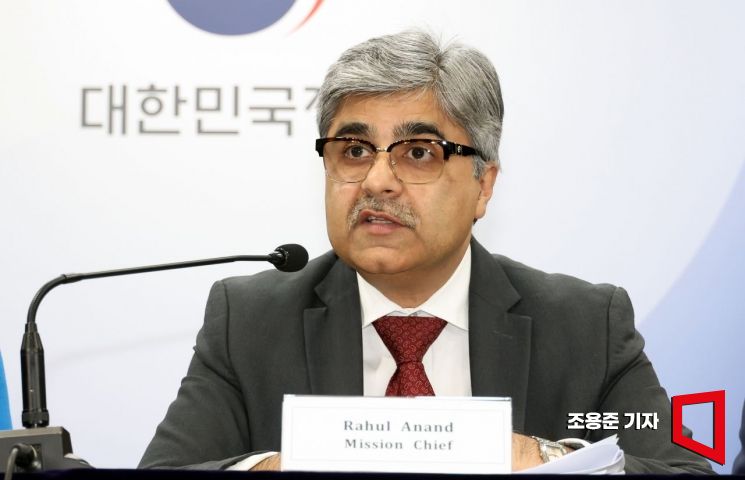
Rahul Anand, Head of the International Monetary Fund (IMF) Korea Mission Team, explained in a written response from Washington, D.C. on the 23rd (local time) that the IMF's decision to lower its growth outlook for South Korea this month reflected "not only the recent tariff measures but also changes in the domestic situation since the end of last year."
Anand stated, "In the January update, we acknowledged that downside risks arising from the political situation had increased," but added, "Due to limited data, we were unable to reflect the impact of political uncertainty caused by the December state of emergency on the short-term macroeconomy."
The IMF releases its World Economic Outlook for all member countries every April and October, and provides revised forecasts for the 30 major economies in January and July. In the April economic outlook released on the 22nd, the IMF projected South Korea's growth rate for this year at 1.0%. This is 1.0 percentage point lower than the forecast announced in January.
Kim Sungwook, IMF Executive Director, met with reporters accompanying the Group of 20 (G20) finance ministers' meeting in Washington, D.C. on this day and said, "The IMF projected Korea's growth rate at 2.0% last October. This time, we reflected the changes in the domestic situation and the impact of political uncertainty on the real economy and financial markets that have occurred since then," adding, "When you combine this with the tariff measures announced by the Donald Trump administration in the U.S. this month, the overall downward revision appears significant."
When asked whether the effects of U.S. tariffs and domestic politics could be separated, he replied, "(The IMF) does not provide a breakdown," and added, "The figure for Korea is a composite of these factors." Regarding how long the impact of U.S. tariffs would last, he said, "The IMF expects the effects to continue through next year." He also explained, "When uncertainty is high, it affects investment as well," and "We believe the impact will persist for a considerable period."
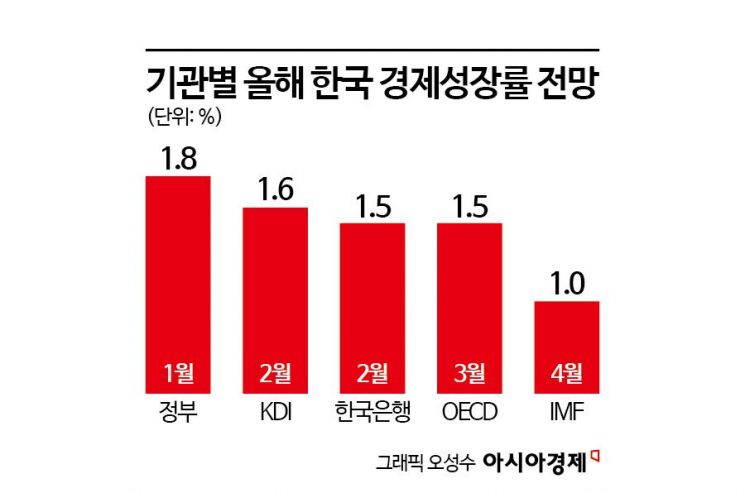
The IMF's latest growth forecast for South Korea is the lowest among projections released by major domestic and international institutions. The government forecasts growth at 1.8% this year, while the Korea Development Institute (KDI) projects 1.6%. The Bank of Korea and the Organisation for Economic Co-operation and Development (OECD) have both forecast 1.5%. Meanwhile, the Bank of Korea announced on this day that South Korea's real gross domestic product (GDP) growth rate for the first quarter of this year fell by 0.2% compared to the previous quarter.
© The Asia Business Daily(www.asiae.co.kr). All rights reserved.
![Clutching a Stolen Dior Bag, Saying "I Hate Being Poor but Real"... The Grotesque Con of a "Human Knockoff" [Slate]](https://cwcontent.asiae.co.kr/asiaresize/183/2026021902243444107_1771435474.jpg)
















