Korea-U.S. 2+2 Trade Talks
Will Do Our Best to Protect National Interests
No Meeting Scheduled with Trump Yet
On April 23 (local time), Minister of Trade, Industry and Energy Ahn Dukgeun stated that eliminating reciprocal tariffs on Korea and reducing automobile tariffs would be top priorities in negotiations.
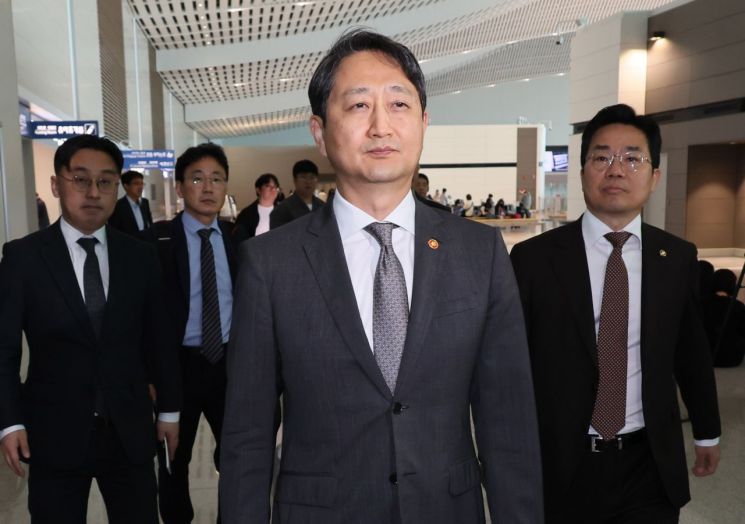
Upon arriving at Dulles International Airport in Washington, DC, Minister Ahn told reporters that the so-called "2+2" trade consultations with the United States are "basically aimed at abolishing reciprocal tariffs."
Regarding tariffs on specific items, he said, "Currently, a 25% tariff is imposed on automobiles, which is causing significant problems in trade with the United States. We plan to negotiate so that we can resolve this issue as quickly as possible."
He added, "We will discuss various industrial cooperation plans and make every effort to prevent such tariff issues from arising between the two countries in order to ensure smooth economic and industrial relations in the future. We are committed to doing our utmost to protect our national interests and industries."
When asked whether the U.S. side had shown any willingness to negotiate on automobile tariffs, he replied, "There has not been any particular indication of that yet," but emphasized, "Automobiles are the most important part of Korea-U.S. trade."
He continued, "In the case of Hyundai Motor, there have been recent announcements of large-scale investment plans. We will actively discuss such matters to find ways to resolve the issues smoothly."
When asked whether the Korean government had submitted a proposal for tariff negotiations to the U.S. side, he answered, "No," and added, "We plan to discuss this together going forward."
He further explained, "We have sent fact sheets (reference materials) to clarify any misinformation that has emerged at the high level, but there have been no specific negotiation plans exchanged."
Regarding the schedule for consultations after the 2+2 trade talks, Minister Ahn said, "Once we officially begin discussions tomorrow, the scope, content, and schedule of future consultations will be determined," and added, "Based on that, we will establish the overall framework for the talks and proceed with negotiations."
Asked whether the government's negotiation strategy would change in response to the U.S. government's somewhat more conciliatory statements on tariffs, he said, "This is what we anticipated," and added, "We will negotiate with the U.S. side based on what we have prepared so far."
Regarding cooperation with Korean companies in relation to negotiations with the U.S., he stated, "The public and private sectors are currently making joint efforts in various ways," but also said, "We have not specifically requested support from companies."
On the possibility that the issue of defense cost-sharing (Korea's share of the cost of stationing U.S. forces in Korea) would be raised during the 2+2 talks, he said, "Such matters are not included in the content of the 2+2 consultations."
When asked about a meeting with President Donald Trump, he said, "There is nothing scheduled yet."
On April 24, Minister of Economy and Finance Choi Sangmok, who arrived in the U.S. the previous day, and Minister Ahn are scheduled to hold 2+2 trade consultations at the U.S. Department of the Treasury with U.S. Treasury Secretary Scott Besant and U.S. Trade Representative (USTR) Jamieson Greer regarding U.S. tariff measures.
© The Asia Business Daily(www.asiae.co.kr). All rights reserved.
![Clutching a Stolen Dior Bag, Saying "I Hate Being Poor but Real"... The Grotesque Con of a "Human Knockoff" [Slate]](https://cwcontent.asiae.co.kr/asiaresize/183/2026021902243444107_1771435474.jpg)















