Fed Releases 'Beige Book' Economic Report
Companies Delay Hiring and Shorten Product Pricing Cycles
Consumers Stockpile Automobiles and Durable Goods
The U.S. Federal Reserve has reported that uncertainty surrounding President Donald Trump’s tariff policies is causing companies to hesitate in hiring and to shorten their product pricing cycles. Businesses are also increasingly expecting inflation to rise. There has also been evidence of consumers stockpiling goods, particularly automobiles, ahead of the full implementation of tariffs.
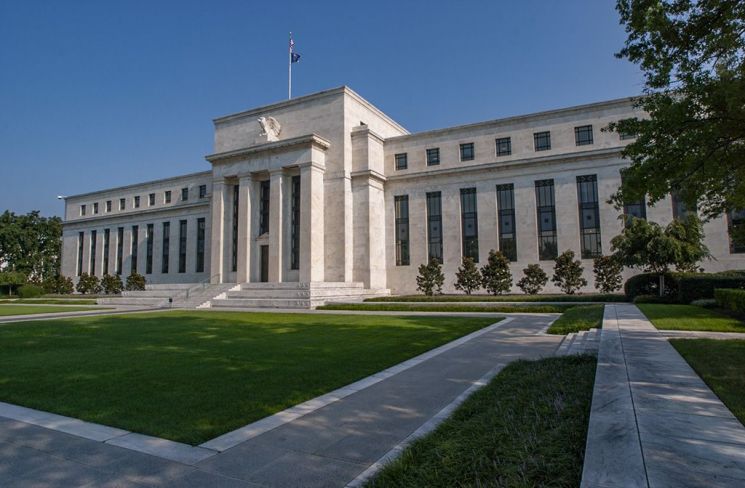
On April 23 (local time), the Fed released its economic conditions report, the “Beige Book,” stating, “Uncertainty over international trade policy was pervasive throughout the report.” The report noted, “There has been little change in economic activity since the previous report,” and diagnosed that “as economic uncertainty over tariffs has grown, the outlook in several regions has significantly deteriorated.”
According to an analysis by Bloomberg News, the newly released Beige Book mentioned “tariffs” 107 times and referred to “uncertainty” 89 times. This is roughly double the number of mentions in the previous report (49 and 47 times, respectively).
It was found that companies are postponing new hiring due to tariff uncertainty.
The report stated, “In several regions, companies were reported to be taking a wait-and-see approach to hiring,” and wrote, “They are halting or slowing recruitment until clearer information on economic conditions emerges.” It also added, “There were sporadic reports of companies preparing for layoffs.”
Concerns about tariff-driven inflation were also highlighted. The majority of companies reported increased cost burdens due to tariffs and said they plan to pass these costs on to consumers.
The report stated, “Many companies have already been notified of cost increases by their suppliers,” and wrote, “Reflecting uncertain trade policy, they either absorbed additional tariff charges or shortened their (consumer) pricing periods.” It further explained, “Most companies expected to pass on the extra costs to their customers.”
In particular, consumer-facing companies complained that, amid already weak demand, rising costs are further squeezing their profit margins.
There was also a marked trend of stockpiling goods in anticipation of the “tariff bomb” taking effect. The report analyzed that while consumer spending generally declined in non-automotive sectors, in most regions, spending on automobiles and certain durable goods either increased moderately or remained strong. The diagnosis is that consumers are bringing forward purchases before companies reflect tariff-related cost increases in product prices. In the case of automobiles, the U.S. imposed a 25% tariff on imported cars starting April 2, and is set to implement a 25% tariff on imported auto parts beginning May 3, which is expected to drive prices higher.
Previously, Austan Goolsbee, President of the Federal Reserve Bank of Chicago, commented on this trend, saying, “Companies are proactively stockpiling inventory sufficient to last 60 or 90 days,” and diagnosed that this is artificially boosting the economy. He warned that once this inventory accumulation effect disappears, economic activity could slow down around this summer.
Additionally, the report reflected the impact of President Trump’s federal workforce and cost restructuring. The report noted that employment has decreased, particularly in federal government agencies and organizations receiving government subsidies. Service sectors in various regions that have operated with federal support have also experienced disruptions.
There has been little change in economic activity since the March report. Of the 12 Federal Reserve districts, five reported slight economic growth, three reported stagnation, and four reported modest declines. This is not significantly different from the previous report, in which four regions saw modest growth and eight regions experienced stagnation or contraction.
The Beige Book is a report assessing recent economic trends in the 12 Federal Reserve districts. It will be used as reference material for the Federal Open Market Committee (FOMC) regular meeting scheduled for May 6-7.
© The Asia Business Daily(www.asiae.co.kr). All rights reserved.
![Clutching a Stolen Dior Bag, Saying "I Hate Being Poor but Real"... The Grotesque Con of a "Human Knockoff" [Slate]](https://cwcontent.asiae.co.kr/asiaresize/183/2026021902243444107_1771435474.jpg)















