WSJ: White House Considers Cutting China Tariffs to 50-65%
Differentiated Tariffs by Product Also Under Review
Trump Says "China Tariffs Will Come Down Significantly"
Breakthrough Hopes Rise for Stalled U.S.-China Trade Talks
U.S. President Donald Trump is considering a plan to significantly reduce the additional tariffs on China that he imposed during his second term, lowering them from the previous 145% to as low as 50%. Following his expression of willingness to cut tariffs on China the previous day, if he actually implements measures to ease tariffs, some observers predict that the long-stalled U.S.-China trade negotiations, which had been deadlocked due to a "hardline versus hardline" standoff, could find a breakthrough. However, even if the tariff rate is lowered to 50%, it would still be extremely high, and it appears unlikely that the current near-complete halt in trade between the two countries will be resolved easily until a "big deal" is reached between the U.S. and China.
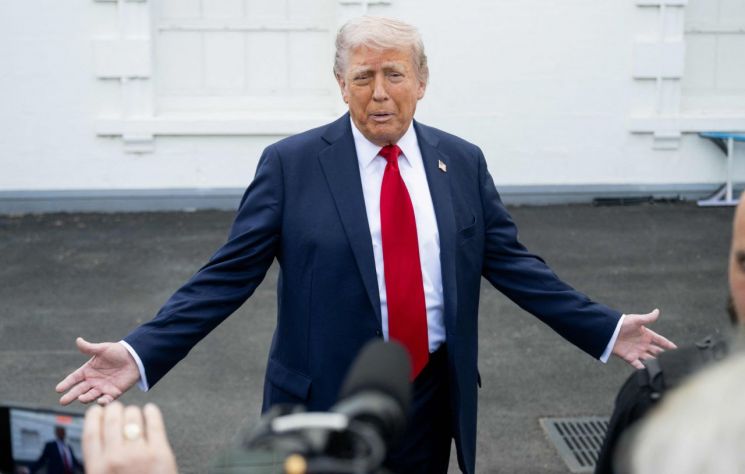
On the 23rd (local time), the Wall Street Journal (WSJ), citing White House sources, reported that there is a high possibility President Trump will reduce tariffs on China to between 50% and 65%.
The sources said that President Trump has not yet made a final decision and is considering several options.
Previously, President Trump imposed a total tariff of 145% on China, consisting of a 20% fentanyl tariff and a 125% reciprocal tariff. The reciprocal tariff on China was initially set at 50%, but after Beijing imposed retaliatory tariffs, President Trump responded with further retaliation, ultimately raising the rate to 125%. According to the WSJ report, the new tariffs on China imposed during Trump’s second term, which currently total 145%, could be reduced to less than half, or as little as one-third of the current level.
President Trump is also considering imposing differentiated tariffs on Chinese goods depending on the product. This approach is similar to the one proposed late last year by the bipartisan "House Select Committee on the Strategic Competition Between the United States and the Chinese Communist Party" (China Committee). At that time, the China Committee suggested imposing a 35% tariff on items that do not pose a threat to national security and at least a 100% tariff on items that are strategically important to U.S. interests. The bill called for these tariffs to be phased in over five years.
The White House has neither confirmed nor denied reports that it is reviewing a reduction in tariffs on China.
White House deputy spokesperson Kush Desai told the WSJ, "President Trump has made it clear that China must reach an agreement with the United States," adding, "The President will make all decisions regarding tariffs himself. Any other decisions are purely speculative."
President Trump has repeatedly expressed his willingness to negotiate with China and, the previous day, even signaled his intention to reduce tariffs on China. At the White House the previous day, he stated that negotiations with China were "going well," and that the current 145% tariff rate was "too high" and "will come down significantly." However, he also said, "It will not become zero," indicating that there is a lower limit. As the escalation of the U.S.-China tariff war caused turmoil in the financial markets, this conciliatory message was seen as an attempt to calm market anxiety and draw China back to the negotiating table.
U.S. Treasury Secretary Scott Besant also made optimistic remarks about the possibility of U.S.-China tariff negotiations on the same day. He attended a closed-door investor event hosted by JPMorgan Chase in Washington, D.C. the previous day, where he said that the U.S.-China tariff war is unsustainable and that "the situation will ease in the very near future." He acknowledged that negotiations between the two countries "will be difficult," but added, "Neither side believes the current situation is sustainable." He also made it clear that President Trump’s policy goal is "not U.S.-China decoupling."
With the Trump administration repeatedly sending conciliatory signals to China and even hinting at tariff reductions, there is growing assessment that the groundwork is being laid for the U.S. and China to end their tariff war standoff and return to the negotiating table. The Chinese Ministry of Foreign Affairs also stated that "if there is a fight, we will fight to the end, but the door to dialogue remains wide open," implying that China is willing to enter trade negotiations with the U.S. as long as the White House does not continue its threats. Attention is also focused on whether the U.S. will revise its previous stance of demanding that other countries join in pressuring China during trade negotiations.
The WSJ noted, "Chinese policymakers see President Trump’s Tuesday remarks as a signal that he may be backing away from his (China) policy," and added, "The fact that both the U.S. and China have expressed openness to an agreement marks a significant shift from last month."
© The Asia Business Daily(www.asiae.co.kr). All rights reserved.

















