"Resolving Parking Shortages and Spreading a Shared Parking Culture"
Jeonju City in North Jeolla Province will continue to implement its "Support Project for Opening Auxiliary Parking Lots" this year, providing subsidies to support the operation of auxiliary parking lots at religious facilities, apartment complexes, and privately owned buildings when these lots are made available to the public.
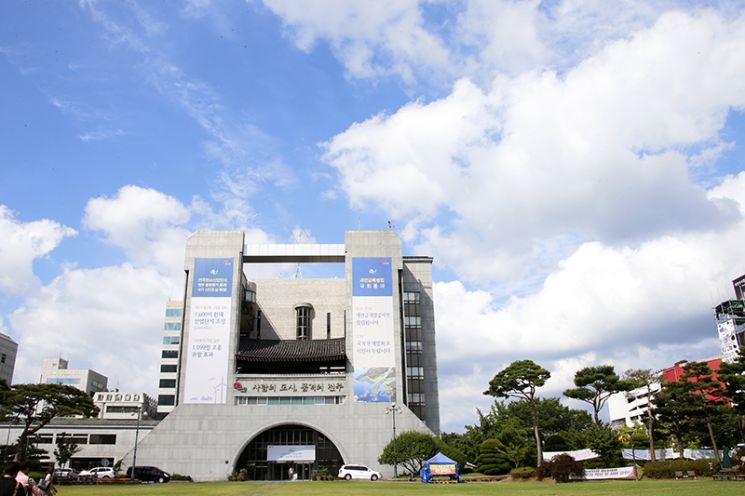
According to the city on April 23, as of the end of last month, there were approximately 454,000 parking spaces in the Jeonju area. This number is not insufficient when compared to the total number of registered vehicles in Jeonju, which stands at 343,402.
However, about 96% of all parking spaces are auxiliary parking lots attached to apartment complexes and general buildings. Due to the nature of these buildings, the parking lots are managed so that only authorized individuals can use them. As a result, there is a gap between the actual parking availability perceived by citizens and the official parking supply rate.
Since 2019, the city has been promoting the project to open auxiliary parking lots based on the voluntary participation of those responsible for managing these lots, working to spread a culture of shared parking that all citizens can benefit from.
Through this initiative, the city expects to secure parking spaces that are vacant during off-peak hours and make them available to the public, thereby alleviating parking shortages. Additionally, the project is anticipated to create a virtuous cycle by reducing the budget required for constructing new parking lots and making more efficient use of existing spaces.
In particular, while last year the city only provided support such as facility improvement costs for lots that were opened free of charge, starting this year, the support will be expanded to include auxiliary parking lots that are opened to the public for a fee, in order to secure more open parking spaces.
Auxiliary parking lots designated as open parking lots can receive up to 30 million won in facility improvement costs, such as for paving, painting, and the installation of security facilities. Additional incentives will be provided depending on the method of parking lot operation.
Specifically, for lots opened free of charge, up to 5 million won in operational compensation will be provided during the open period. For the newly introduced paid opening, the parking fee revenue generated through operation will be provided to the managing entity.
The paid opening will be operated in two forms: hourly parking, which will be charged at up to 50% of the public parking lot rate, and monthly passes, which will be set at up to 30,000 won per space per month.
To be eligible for subsidy support, parking lots must open at least 10 spaces for at least 7 hours per day and 35 hours per week for two years. In the case of apartment complexes, the application can only be made after obtaining the consent of at least two-thirds of residents and a resolution by the residents' representative council. Applications are open until May 30.
Choi Junbeom, Director of Public Transportation at Jeonju City, stated, "The spread of a shared parking culture is a key task for resolving parking shortages in modern society, and it can only be achieved through citizen participation." He added, "We will do our best to alleviate parking shortages in the city center by promoting the activation of open parking lots, developing incentives, and establishing a systematic operating system."
© The Asia Business Daily(www.asiae.co.kr). All rights reserved.
![Clutching a Stolen Dior Bag, Saying "I Hate Being Poor but Real"... The Grotesque Con of a "Human Knockoff" [Slate]](https://cwcontent.asiae.co.kr/asiaresize/183/2026021902243444107_1771435474.jpg)
















