Improving Agricultural Work Efficiency and Digitizing Farming Activities
"Expectations for Solving Rural Aging and Labor Shortages"
The Rural Development Administration has developed a program that enables the integrated operation of agricultural robots, each responsible for pest control, transport, and monitoring in the agricultural sector. This program allows farmers to connect and simultaneously manage multiple robots using a personal computer or mobile phone. The Rural Development Administration expects that this will help overcome the decline in agricultural labor and increase productivity.
On April 23, the Rural Development Administration announced that it had developed an "Integrated Management Program" equipped with technology that can link robots for each stage of agricultural work. The agency also revealed plans to support the related industry by distributing agricultural robots to farms and developing industrial standards.
Lee Seungdon, Director of the National Institute of Agricultural Sciences at the Rural Development Administration, stated, "Korean agriculture and rural communities are facing various social changes, such as population decline and aging. In response, the introduction of various agricultural robots has become essential. As agricultural robots diversify, the need for integrated management technology to collect and efficiently manage daily work information from each robot has increased, which led to the development of this management program."
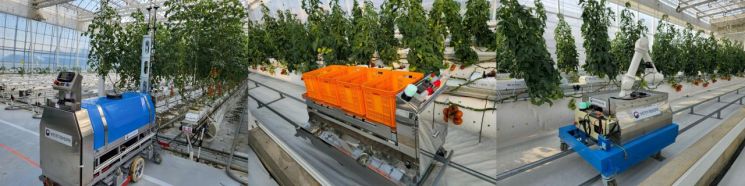 Pest control robot (left), transport robot (center), and inspection (monitoring) robot used in smart farms. By applying the newly developed "Integrated Management Program" from the Rural Development Administration, farm workers can simultaneously manage these robots and check work information.
The Integrated Management Program developed by the Rural Development Administration enables farmers to connect and simultaneously manage multiple robots and check robot work information using a personal computer or mobile phone. Its main functions are: robot management, crop management, and digital farming management.
The robot management function provides information on the current status of agricultural robots, such as their location, work speed, and travel distance. It also offers operational statistics, including real-time work volume and cumulative operation counts. Based on this information, farmers can set the work order for robots and operate them efficiently.
For crop management, the program provides farmers with the quantity and location information of harvestable fruits based on image data acquired by monitoring robots. It also analyzes the ripeness of each fruit and greenhouse environment data to predict the optimal harvest time. The digital farming management function collects real-time data on each robot's work status and crop conditions, and automatically provides daily work information based on this data. By reviewing this information, farmers can adjust pest control frequency and harvest timing as needed.
The Rural Development Administration applied the newly developed Integrated Management Program to pest control, transport, and monitoring robots. As a result, the pest control robot achieved full automation from work instruction to task confirmation. Compared to manual operation, work time was reduced by 40%, and pest control effectiveness increased by more than 15%.
The transport robot uses artificial intelligence and distance measurement technology to follow the operator at their working speed and assist with harvesting tasks. Operators no longer need to push carts or carry harvested crops themselves. The robot has also been improved to measure the weight of harvested crops in real time, eliminating the need for manual weighing. Since weight is measured simultaneously with harvesting, managing production volume has become much easier.
The monitoring robot performs the task of assessing fruit readiness for harvest, which must be checked daily and is difficult for unskilled workers. The fruit recognition accuracy of the monitoring robot reached 93.8%, and the accuracy for predicting harvest timing was 97.7%. Information on harvest readiness and timing is delivered to farmers in real time.
To apply and distribute smart farm robots in the field, the Rural Development Administration conducted field verification research in 2023. When three types of robots (pest control, transport, and monitoring) were applied to three tomato farms, annual labor costs per 0.5 hectares decreased by 12 million KRW for pest control, 8 million KRW for transport, and 9 million KRW for monitoring. Director Lee stated, "In the near future, the era of 'one farm, one robot' will arrive in rural areas, and automation of agricultural work at each stage using robots will help solve the labor shortage in rural communities. We will accelerate the integrated management, rapid distribution, and development and establishment of industrial standards for agricultural robots to ensure their swift adoption and utilization in agriculture and rural areas."
© The Asia Business Daily(www.asiae.co.kr). All rights reserved.
![Clutching a Stolen Dior Bag, Saying "I Hate Being Poor but Real"... The Grotesque Con of a "Human Knockoff" [Slate]](https://cwcontent.asiae.co.kr/asiaresize/183/2026021902243444107_1771435474.jpg)















