Kurt Campbell: "The U.S. Must Forward-Deploy Nuclear Deterrence for Key Allies Such as South Korea and Japan"
Mongjun Chung Calls for Redeployment of Tactical Nuclear Weapons and Establishment of "Asian NATO"
Foreign Minister Cho Taeyeol: "The U.S.-ROK Alliance Is Our Top Priority; Engagement with China Aligns with U.S. Interests"
On the 23rd, Kurt Campbell, former U.S. Deputy Secretary of State, stated, "The United States must forward-deploy its nuclear deterrence for key allies such as South Korea and Japan."
 On the 23rd, at the Grand Hyatt Seoul in Yongsan-gu, Seoul, Kurt Campbell, former U.S. Deputy Secretary of State, delivered the keynote speech at 'Asan Plenum 2025,' hosted by the Asan Institute for Policy Studies. Photo by Yonhap News
During his keynote speech at 'Asan Plenum 2025,' held at the Grand Hyatt Seoul under the theme "80th Anniversary of Liberation, 60th Anniversary of Korea-Japan Normalization of Diplomatic Relations," Campbell said, "Major Asian countries, including South Korea and Japan, could have developed nuclear weapons, but the reason they did not is because they trusted the U.S. nuclear deterrent."
He emphasized, "We (the United States) must not treat this issue as secondary," adding, "Although we are hesitating and reluctant, we must ultimately take steps forward if we are to prevent nuclear proliferation in the Asia region." Campbell served as Deputy Secretary of State under the Biden administration and is currently the founder and chairman of the global policy advisory firm The Asia Group (TAG).
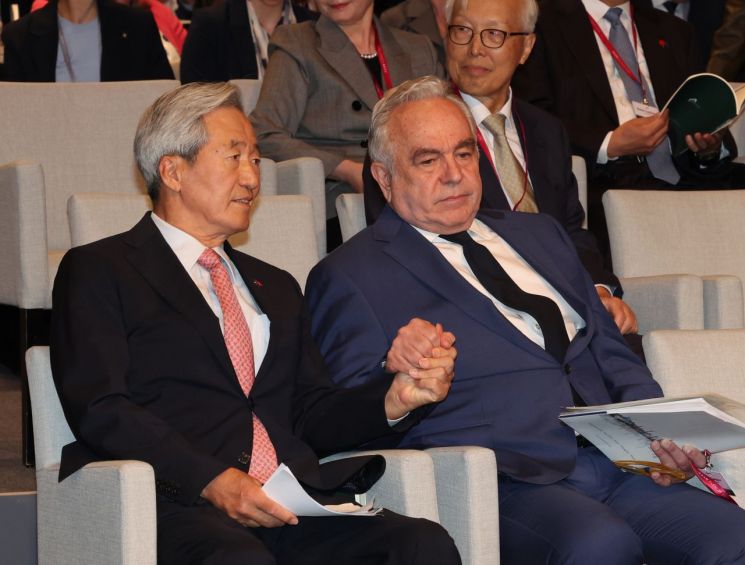 On the 23rd, at the Grand Hyatt Seoul in Yongsan-gu, Seoul, during the 'Asan Plenum 2025' hosted by the Asan Institute for Policy Studies, Mongjun Chung, Honorary Chairman of the Asan Institute for Policy Studies, is shaking hands with Kurt Campbell, former U.S. Deputy Secretary of State. Photo by Yonhap News
Earlier, Mongjun Chung, Honorary Chairman of the Asan Institute for Policy Studies, also argued for the redeployment of tactical nuclear weapons in his welcoming remarks, stating, "We need a stronger guarantee of nuclear deterrence." He further said, "It is time to establish an 'Asian version of NATO' centered on the United States and its allies," suggesting that "South Korea, Japan, Australia, the Philippines, and India could be included."
Meanwhile, Campbell also commented on the political situation in South Korea, predicting, "The period immediately after the presidential election will be an absolutely critical time for the U.S.-ROK alliance." Regarding tariff negotiations being pushed by a potential second Trump administration, he said, "It would be beneficial for the United States to increase investment in areas where it needs help," specifically citing "shipbuilding" as the best example.
He explained, "The United States is facing difficulties in both the civilian and military sectors of shipbuilding," and advised, "Although negotiations will be challenging, if we use shipbuilding as a channel to expand into other fields, it will be very helpful."
 On the 23rd, at the Grand Hyatt Seoul in Yongsan-gu, Seoul, Minister Cho Taeyeol delivered a congratulatory speech at 'Asan Plenum 2025' hosted by the Asan Institute for Policy Studies. Photo by Yonhap News
Minister of Foreign Affairs Cho Taeyeol attended the event and, in his congratulatory speech, stated, "The current international situation is reminiscent of the bleak period between the wars, dominated by blatant nationalism and zero-sum logic," emphasizing, "In this reality, the noble ideal of preventing war must never be diminished."
Regarding the U.S. containment of China, Minister Cho said, "It is an open fact that no country in the region wants to be forced to choose between the United States and China," and added, "There is also no country that wishes to see U.S.-China strategic competition develop into a zero-sum game." He particularly emphasized, "The unwavering priority of our foreign policy is the solid U.S.-ROK alliance, and China has not objected to this," while also stating, "Our engagement with China aligns with U.S. interests in many respects." He continued, "On issues where there are differences of opinion, such as the South China Sea and the West Sea, we will continue to candidly express our position and raise our concerns."
© The Asia Business Daily(www.asiae.co.kr). All rights reserved.



















