Deputy Prime Minister Choi Sangmok Arrives in the U.S.
'2+2' Consultation Scheduled for the 24th
Vice President Vance Visits India in Person
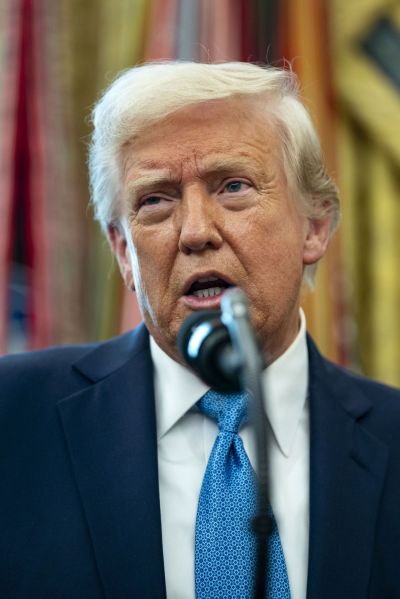 Donald Trump, President of the United States, is speaking in the White House Oval Office on the 22nd (local time). Photo by UPI
The White House officially announced on the 23rd (local time) that the Trump administration will hold trade talks with 34 countries this week. South Korea, which has reportedly been identified by U.S. Treasury Secretary Scott Besant as one of the "five allied countries," is also scheduled to sit at the negotiating table on the 24th, led by Deputy Prime Minister and Minister of Economy and Finance Choi Sangmok. However, some foreign media outlets have expressed a critical view, stating that, contrary to the White House's explanation that "significant progress has been made" in the trade negotiations, no concrete results have been achieved.
White House spokesperson Caroline Levitt stated at a briefing on the 22nd (local time), "We currently have 18 documented proposals, which have been submitted by each country to the Trump administration and our government." She emphasized that the entire trade team is holding meetings with 34 countries this week, adding, "We are moving at 'Trump speed.'"
The Trump administration, after implementing reciprocal tariffs with differentiated application to 57 global economic entities on the 9th, suspended them for 90 days just 13 hours after enforcement and is now conducting individual negotiations with each country. These are "America-first" negotiations aimed at lowering non-tariff barriers and reducing the U.S. trade deficit.
With negotiations with China at a standstill, the United States is pressuring allied countries to begin talks first by hinting at offering "packages of incentives." In an interview with Bloomberg TV on the 14th, Treasury Secretary Besant mentioned negotiations with Vietnam, Japan, and South Korea, stating, "These negotiations will proceed very quickly."
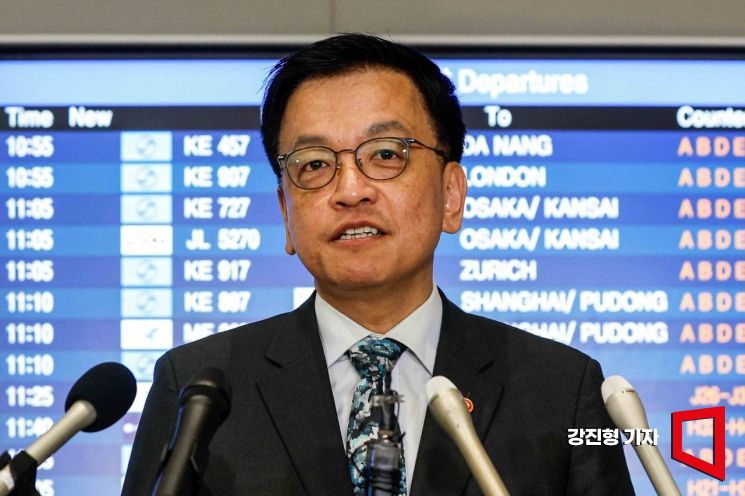 Choi Sangmok, Deputy Prime Minister for Economic Affairs and Minister of Economy and Finance, is giving a statement on the 21st at Incheon International Airport Terminal 2 before departing for Washington, USA, to attend Korea-US trade talks and the G20 Finance Ministers Meeting. 2025.4.22. Photo by Kang Jinhyung
South Korea will also join the negotiating table with the United States at 9:00 p.m. on the 24th (Korean time) and 8:00 a.m. (U.S. time). The key figures are Deputy Prime Minister and Minister of Economy and Finance Choi Sangmok and Minister of Trade, Industry and Energy Ahn Dukgeun. Deputy Prime Minister Choi and Minister Ahn are scheduled to hold a "Korea-U.S. 2+2 Trade Consultation" with Secretary Besant and Jamison Greer, U.S. Trade Representative (USTR). While the U.S. side intends to expand the scope of the negotiations as much as possible, the Korean government insists on using the term "consultation" rather than "negotiation" in the official sense. The United States is demanding a "one-stop shopping negotiation" that also covers defense cost-sharing issues, but Korea maintains a "two-track" approach, separating trade and security issues.
South Korea is one of the main targets that the United States, along with Japan, has designated as a priority negotiation partner. The Wall Street Journal (WSJ) reported that Secretary Besant has indicated to those around him that he will prioritize negotiations with five countries?South Korea, Japan, the United Kingdom, Australia, and India?during the 90-day reciprocal tariff suspension period.
Japan became the first to enter into tariff negotiations on the 16th, but faced internal discord. On the day of the negotiations, President Donald Trump unexpectedly held a direct pre-meeting with Japan's Minister in charge of tariffs, Ryosei Akazawa, Minister for Economic Revitalization, putting the Japanese government in a difficult position.
In the case of India, U.S. Vice President JD Vance is closely managing the process. According to AP and the Hindustan Times, Vice President Vance, who visited India for a four-day trip starting on the 21st, met with Indian Prime Minister Narendra Modi at the Prime Minister's residence in New Delhi to discuss bilateral trade issues. The U.S. political media outlet Politico reported, "The White House is increasingly likely to reach tariff agreements with Japan and India," adding, "It is highly likely that the thorny details will be discussed at a later stage."
The most challenging negotiation partner and weak point for the United States is China. On the 17th, President Trump stated, "A comprehensive agreement will be finalized within three to four weeks," but remained silent regarding whether he would speak with Chinese President Xi Jinping.
Some foreign media outlets have commented that there is a discrepancy between the words and actions of the Trump administration. Ian Bremmer, president of the international political consulting firm Eurasia Group, told the New York Times (NYT), "President Trump will ultimately announce trade agreements with a few countries that are weaker than the United States." The NYT cited Japan, Mexico, and Italy as examples of such cases.
© The Asia Business Daily(www.asiae.co.kr). All rights reserved.
![Clutching a Stolen Dior Bag, Saying "I Hate Being Poor but Real"... The Grotesque Con of a "Human Knockoff" [Slate]](https://cwcontent.asiae.co.kr/asiaresize/183/2026021902243444107_1771435474.jpg)
















