"Invest in AI Industry Transformation as We Did for IT"
Foster Service Industries with High Employment Inducement for the Long Term
There is an analysis that the sluggishness in domestic demand in the Korean economy has entered a long-term downward trend. This is the result of accumulated structural factors such as demographics, employment, and industry, rather than short-term factors like the COVID-19 pandemic or inflation.
The Korea Chamber of Commerce and Industry announced on the 23rd that, according to its study "Trends in Domestic Consumption and International Comparison," which analyzed mid- to long-term data, domestic consumption in Korea has been on a downward trend since 1996.
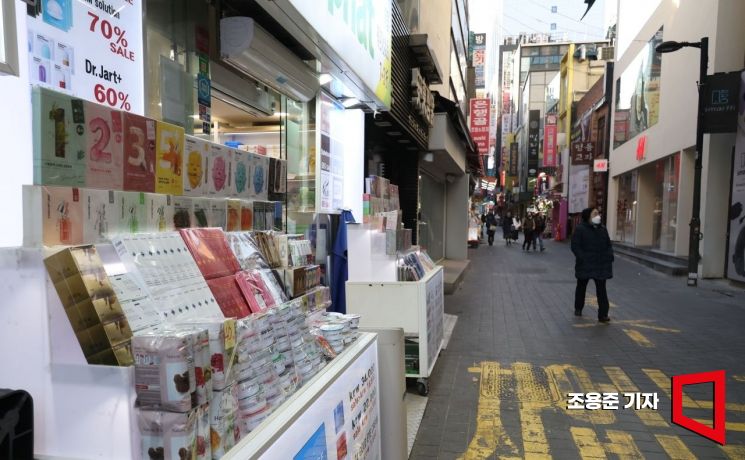
In particular, it was found that the consumption growth rate has declined step by step, like stairs, as the economy experienced crises. Four major events that had a significant impact on the economy between 1988 and 2024 served as turning points. The average consumption growth rate, which was 9.1% from 1988 to 1996, dropped to 4.5% (1997-2002) after the 1997 foreign exchange crisis, then to 3.1% (2003-2007) after the 2003 credit card crisis, and further to 2.4% (2008-2019) after the 2008 financial crisis. After the COVID-19 pandemic in 2020, which is a relatively recent event, the rate fell to 1.2%, showing an even greater decline.
Due to the slowdown in consumption growth, the share of domestic consumption in gross domestic product (GDP) has also been decreasing. The domestic consumption share, which was 56.3% in 2002, continued to decline and fell to 47.1% in 2021. During the 1988 Olympics, the spread of passenger cars and electronic products and the activation of consumption led to a steady increase in the consumption share, which rose to a level similar to major advanced countries like Germany and Japan by 2002, but has been on a downward trend since then.
As a result of this trend, as of 2023, Korea ranked 28th out of 38 OECD countries in terms of domestic consumption share. Among the 12 countries with an economic scale of over $1 trillion, Korea ranked 11th, just behind the Netherlands. The countries with a lower domestic consumption share than Korea were those with a domestic market of fewer than 10 million people, such as Israel, the Czech Republic, Sweden, and Luxembourg.
The Korea Chamber of Commerce and Industry identified several mid- to long-term factors behind the sluggish domestic consumption: a decrease in the propensity to consume among the elderly, a significant portion of household assets being tied up in real estate, and a decline in the employment inducement coefficient of the industrial sector.
The issue of aging was highlighted by the rapidly increasing proportion of the population aged 65 and older, which in turn has reduced the propensity to consume among the elderly. In the fourth quarter of 2006, the "average propensity to consume" for those aged 60 and over was 81.3%, but by the fourth quarter of 2024, it had dropped to 64.6%, the lowest among all age groups. The average propensity to consume is an indicator that shows how much of disposable income?income after taxes and interest payments?is spent on consumption.
In terms of household assets, the proportion held in real estate was very high at 70.5%, and when including rental deposits, it rose to 77.3%. In addition, household debt and the resulting interest burden have been increasing. Household credit grew from 465 trillion won at the end of 2002 to 1,927 trillion won at the end of last year, more than quadrupling. The Chamber pointed out that the recent rise in market interest rates has increased the interest burden, further restricting consumption.
The steady decline in the employment inducement coefficient in the industrial sector is also a problem. The employment inducement coefficient in manufacturing (the number of jobs created directly and indirectly when final demand increases by 1 billion won) fell from 15.4 in 2000 to 6.3 in 2020. In particular, industries leading exports, such as semiconductors and chemicals, showed even lower numbers. This indicates a weakening link between export growth and increases in domestic income through employment.
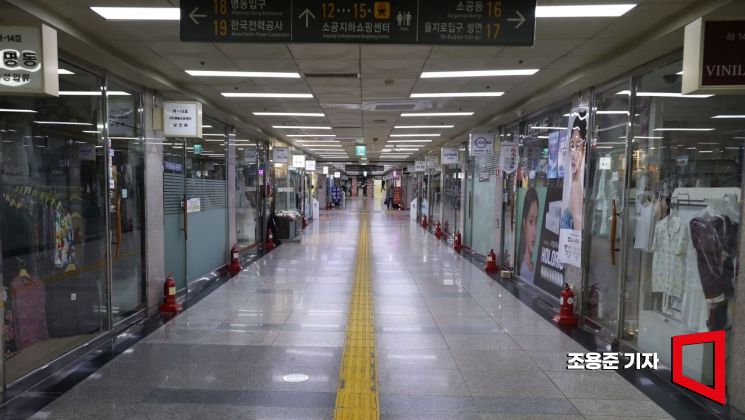 The underground shopping mall in Sogongdong, Jung-gu, Seoul is showing a quiet scene. Photo by Jo Yongjun
The Korea Chamber of Commerce and Industry proposed an aggressive recession-attacking policy. This approach, which was suggested in the UK during the global financial crisis, focuses on investing in industrial infrastructure and other areas for future growth.
In 1999, under the International Monetary Fund (IMF) management system, the government promoted the "Cyber Korea 21" policy, pushing for the construction of high-speed internet networks and fostering e-commerce. During 2000-2005, when annual GDP grew by an average of 5%, the information and communications industry recorded a high growth rate of about 14%. Currently, to achieve an industrial transformation based on artificial intelligence (AI), the government needs to make large-scale infrastructure investments, such as building data centers and power grids. The Chamber argued that government spending should be increased in these areas to achieve both economic stimulus and the fostering of future industries.
In addition, the Chamber called for a mid- to long-term focus on developing service industries with high employment inducement coefficients. In particular, it suggested that strengthening intermediate service sectors such as AI and software, which are becoming increasingly important in future supply chains, would help reinforce the link between export manufacturing and job creation.
Kim Hyunsoo, head of the Economic Policy Team at the Korea Chamber of Commerce and Industry, said, "In a situation of increasing external economic uncertainty, a strong domestic demand base is essential to reduce economic volatility and ensure sustainable growth. While short-term measures to boost consumer sentiment have been repeatedly implemented, they have not fundamentally changed the trend of slowing consumption. Therefore, it is now necessary to combine preemptive investment for the future with structural reforms of our economy."
© The Asia Business Daily(www.asiae.co.kr). All rights reserved.



















