Feasibility Study Begins for Sanggakji Overpass Demolition
Demolition and Construction of Four-Lane Underground Road Planned
Overpasses Lose Function as Traffic Increases
Ahyeon and Yaksu Overpasses Demolished... Seoul Station Overpass Converted into Park
The Seoul Metropolitan Government is set to begin the full-scale demolition of the Sanggakji Overpass in Yongsan-gu. As Korea's first multi-level interchange, it has stood for 50 years but has also been cited as a major cause of chronic traffic congestion. About a year after announcing its plan to demolish the overpass as part of the Yongsan International Business District development, the city has now decided to establish detailed plans, including the construction of an underground roadway.
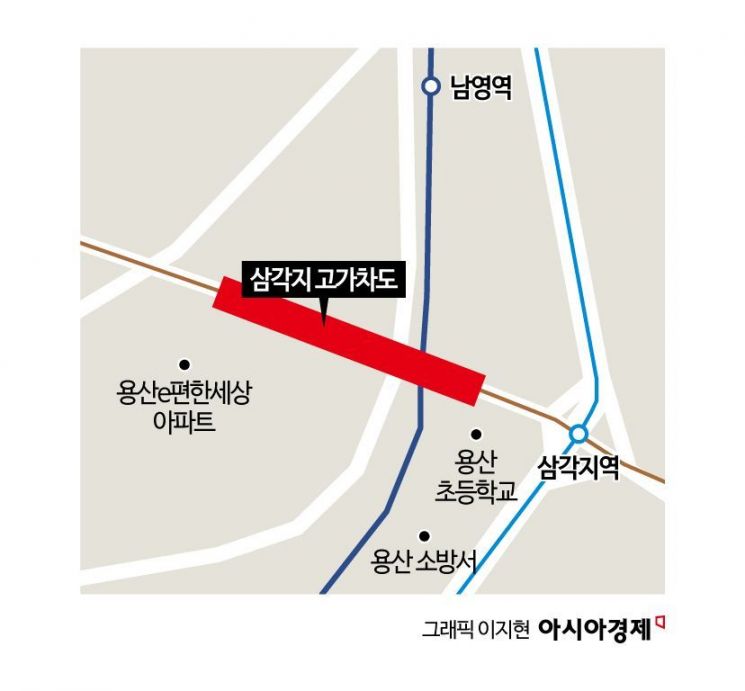
According to the maintenance industry on April 23, the city has recently launched a feasibility study for the demolition and undergrounding of the Sanggakji Overpass, located at the Sanggakji intersection and around Baekbeom-ro in Yongsan-gu.
The Sanggakji Overpass is the first multi-level interchange in Korea. Completed in 1974, it allowed vehicles to cross over the Gyeongbu Line and Subway Line 1 tracks, serving citizens for more than 50 years. Along with the Sanggakji multi-level interchange, which was completed in 1968 and demolished in 1994, it also connected Yongsan-gu and Mapo-gu.
At the time, when there were not many vehicles in the city, the interchange allowed for quick passage, resulting in high satisfaction among citizens. Overpasses were also constructed in other parts of the city, such as Ahyeon, Seoul Station, Yaksu Station, and Yeongdeungpo Rotary, to enable vehicles to pass through the city center quickly without waiting for traffic signals. However, as the number of vehicles in the city increased rapidly in the 1990s, the overpasses could no longer fulfill their intended function. Even for the Sanggakji Overpass alone, the hourly traffic volume was only about 4,000 vehicles, but during the morning rush hour, more than 5,000 vehicles would crowd onto it.
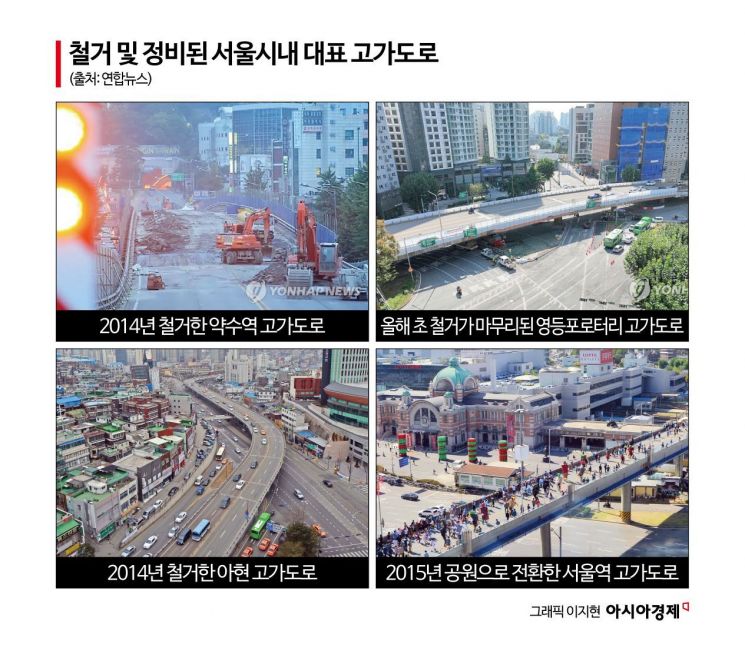
This is why, starting in the mid-1990s, Seoul began to demolish inner-city overpasses. The Ahyeon Overpass, the first overpass in Seoul, completed in September 1968, was demolished in 2014. Frequent bottlenecks before and after entering the overpass, along with aging infrastructure that exposed the limits of maintenance and management, were the main reasons.
The Yaksu Station Overpass, built in 1984 and considered relatively new, was also demolished in the same year. While it facilitated rapid movement from Jangchung-dong to Geumho-dong and Gangnam, the construction of large residential complexes in Sindang-dong and Yaksu-dong exacerbated traffic congestion and led to criticism that it damaged the city's aesthetics.
There are also cases where demolition was completed most recently. The demolition of the Yeongdeungpo Rotary Overpass was finished in early February this year. The removal of the road that had blocked the view has been credited with improving the cityscape. In its place, a 14-lane, bi-directional, straight surface road connecting Yeongdeungpo Station to Yeouido is being constructed.
There are also instances where overpasses have been converted into pedestrian parks instead of being demolished. The Seoul Station Overpass, envisioned by then-Mayor Kim Hyunok, known as the "Bulldozer" in the 1960s, and architect Kim Soogeun, was designated for demolition in a 2006 safety inspection. However, the late Mayor Park Wonsoon declared it would be transformed into a green space modeled after New York's High Line Park, and it now serves as a park. However, after Mayor Oh Sehoon took office, there have been renewed calls for its demolition to create a national symbolic space at Seoul Station.
In the case of the Sanggakji Overpass, demolition could begin as early as the end of next year. The schedule is expected to be finalized by the end of this year or early next year, once the feasibility study for the project plan is completed. After demolition, Seoul plans to build an underground roadway at the site, 700 meters in length and four lanes in both directions. This is to manage the increased traffic demand resulting from the development of the Yongsan International Business District. If vehicles are distributed between the surface and underground roads, traffic flow toward the southern part of the Yongsan International Business District is expected to improve.
This study will establish not only a phased demolition plan but also the construction cost, funding plan, and traffic management plan during construction. Discussions with the central government regarding the Yongsan International Business District's comprehensive transportation improvement plan, which includes the demolition, are still ongoing. Under current law, before undertaking large-scale development projects like the Yongsan International Business District, Seoul must establish a transportation plan, which is then subject to review by the Ministry of Land, Infrastructure and Transport.
© The Asia Business Daily(www.asiae.co.kr). All rights reserved.
![Clutching a Stolen Dior Bag, Saying "I Hate Being Poor but Real"... The Grotesque Con of a "Human Knockoff" [Slate]](https://cwcontent.asiae.co.kr/asiaresize/183/2026021902243444107_1771435474.jpg)
















