Supreme Court Signals Intention for Swift Conclusion
Ruling Date to Be Set Immediately Upon Consensus...
Focus on Whether a Verdict Will Come Before the Presidential Election
If Not Acquittal, More Time Likely Needed
With the Supreme Court’s full bench now handling the final verdict in the Public Official Election Act case involving former Democratic Party leader Lee Jaemyung, public attention is focused on whether a decision will be reached before the June 3 presidential election, and what the outcome might be if it is. Depending on the timing and direction of the verdict, political uncertainty could either be resolved or further intensified. Chief Justice Cho Heedae decided to refer the case to the full bench just two hours after it was initially assigned to a smaller panel of the Supreme Court on April 22. Immediately following the referral, the first conference of all 12 justices, including Chief Justice Cho, was held, and another meeting is scheduled for April 24. This is seen as a sign of the Court’s intention to reach a prompt decision.
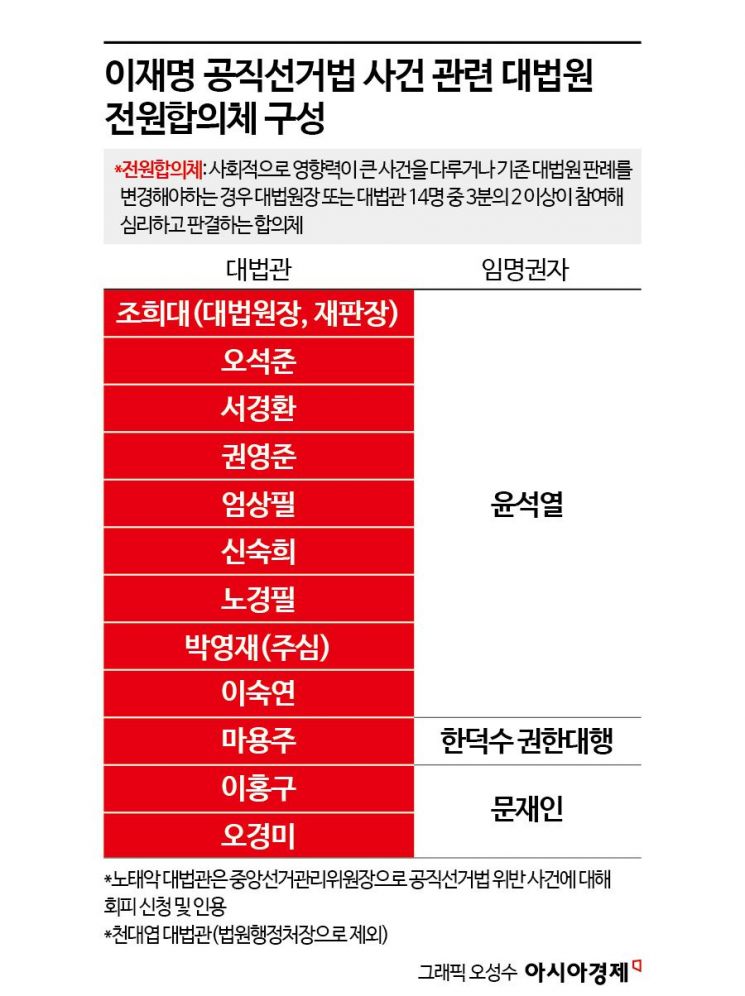
Initially, this case was assigned to the Supreme Court’s Second Panel, consisting of Justices Oh Kyungmi, Kwon Youngjun, Eom Sangpil, and Park Youngjae. The smaller panels, which handle routine cases, are made up of three groups of four justices each, excluding Chief Justice Cho and Court Administration Office Director Chun Daeyeob (who is also a Supreme Court Justice). The full bench consists of 12 justices, excluding the Court Administration Office Director (who does not handle trials), plus the Chief Justice as presiding judge. In this case, Justice Noh Taeak, who concurrently serves as Chairperson of the National Election Commission, recused himself to avoid any controversy over neutrality in election management, resulting in a 12-member bench including the Chief Justice.
According to the Court Organization Act and other relevant laws, the full bench handles cases where there is a need to change the Supreme Court’s previous interpretation or application of the Constitution, laws, decrees, or rules (precedent change), as well as cases where the smaller panels cannot reach consensus or cases of significant public interest. The Chief Justice presides, and the final verdict is determined by majority vote.
When reaching a final verdict, the justices, like Constitutional Court judges, state their opinions in order from the most recently appointed. If the number of participating justices is odd and the vote is tied, the Chief Justice casts the deciding vote. However, when the number is even, as in this case, it is customary for the Chief Justice to side with the majority. For example, if the justices are split 6 to 5, the Chief Justice would join the majority to make it 7 to 5.
Going forward, the speed of the full bench’s deliberations will depend on procedures such as reports from the Supreme Court’s research office and the justices’ own reviews. The justices will hold several conferences, and once consensus is reached, a ruling date will be set immediately. The main focus is whether the verdict will be delivered before the presidential election. Under the Public Official Election Act’s “6-3-3 Rule” (six months for the first trial, three months each for the second and third trials), the deadline for a ruling is June 26. However, if the full bench accelerates deliberations, it is possible that a verdict could be issued before the election. One lawyer, a former presiding judge, said, “Referring this case to the full bench again confirms the Supreme Court’s intention to conclude the matter quickly,” adding, “Since the Supreme Court only reviews legal issues and does not re-examine the facts, even once full deliberations begin, it should not take a long time.”
On the other hand, there are also strong opinions that it will be difficult to reach a verdict before the presidential election. A lawyer who formerly worked in the Supreme Court’s research office said, “No matter how much public attention a case receives, it is usually reviewed by a smaller panel before being referred to the full bench, but this time the process seems unusually expedited,” adding, “Even so, it seems physically difficult for a verdict to be reached before the election.”
If a decision does come before the election, there are three main scenarios. The Supreme Court could dismiss the appeal, confirming Lee’s acquittal; it could remand the case to the High Court for retrial with a finding of guilt; or it could directly determine the sentence itself, though this is extremely rare in Supreme Court history. If the case is remanded with a guilty verdict, the High Court would maintain the conviction and determine the sentence. The threshold for invalidating the election result and stripping candidacy is a fine of 1 million won. In the case of remand, further appeals are possible after the High Court’s retrial, making it unlikely for a final verdict to be reached before the election. Ultimately, except for a confirmed acquittal, it will be difficult for a final ruling to be issued before the presidential election, further increasing the ‘uncertainty’ surrounding the election.
© The Asia Business Daily(www.asiae.co.kr). All rights reserved.

















