Frequent road subsidence incidents are occurring across the country, heightening residents' concerns.
In response, autonomous districts in Seoul such as Gangdong-gu, Seongdong-gu, and Geumcheon-gu are conducting joint underground cavity investigations beneath roadways using specialized exploration equipment.
A cavity is an empty space formed within the ground that has not yet caused the pavement layer to collapse. Cavities can develop due to damage to aging underground infrastructure or groundwater leakage near large-scale construction sites. Over time, these cavities may cause the pavement to sink, resulting in ground subsidence.
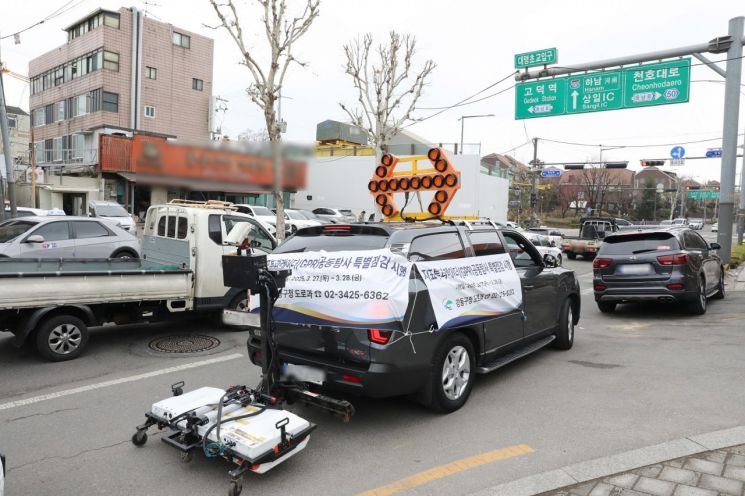
Gangdong-gu: Joint cavity investigation using ground-penetrating radar (GPR) on back roads and sidewalks near intersections affected by road subsidence on March 27-28.
Gangdong-gu (Mayor Lee Soohee) has announced the results of its investigation into underground cavities, conducted to address residents' concerns and prevent recurrence following last month's road subsidence incident.
From March 27 to 28, the district carried out a cavity investigation targeting back roads and sidewalks in residential areas near the Dongnam-ro intersection. After a detailed analysis using ground-penetrating radar (GPR), excavation inspections were performed in sections requiring further investigation, with soil experts present.
As a result, a small cavity was found at one location due to deterioration at a private sewer junction, and repairs were completed by April 10. All other investigated sections showed no abnormalities. Similarly, a joint investigation conducted by the Seoul Metropolitan Government in the accident area (north of Dongnam-ro and Sangam-ro) found no issues. To further alleviate public anxiety and ensure road safety, the district plans to launch a cavity investigation service within the first half of the year for district-managed roads around the subway line 9 extension construction area. Lee Soohee, Mayor of Gangdong-gu, stated, "We will continue to meticulously inspect Gangdong-gu's roads and create a safe road environment so that residents can go about their daily lives with peace of mind."
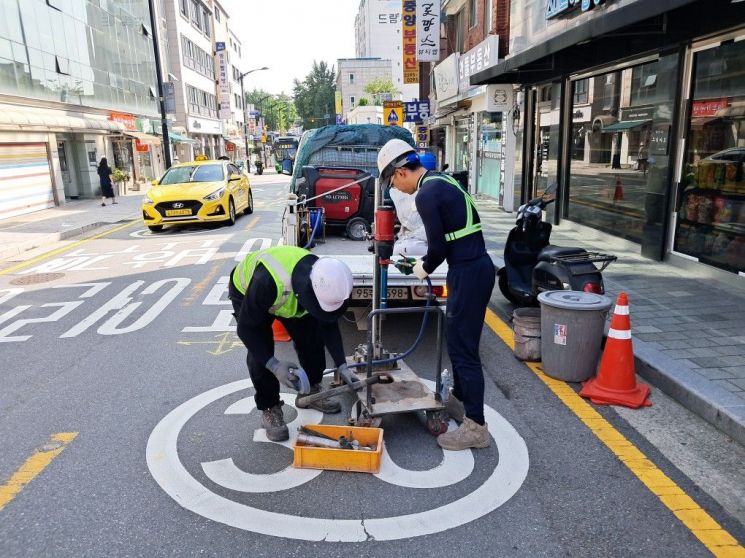
Seongdong-gu: GPR cavity investigation from May on district-managed roads, around large construction sites, and roads with aging water mains
Seongdong-gu (Mayor Jeong Wono) is proactively conducting ground-penetrating radar investigations to prevent ground subsidence and preemptively block sinkhole incidents.
Since 2022, the district has conducted annual joint investigations to precisely detect the location and size of cavities beneath roads, thereby preventing subsidence incidents in advance. By last year, a total of 305 km had been investigated, including the Dongbuk Line urban railway section. This year, the district plans to investigate district-managed roads, areas near large construction sites, and roads with aging water mains.
If a cavity is found, it is confirmed through drilling and endoscopic inspection, then quickly restored using flowable fill material. For larger cavities or those caused by aging underground infrastructure, permanent repairs are made through excavation to thoroughly eliminate hazards. Due to these ongoing efforts, the number of cavities in Seongdong-gu has decreased annually, from 54 in 2022 to 23 in 2023, and 13 in 2024. The district is also thoroughly maintaining aging sewer pipes, which are considered the main cause of subsidence. According to the Ministry of Land, Infrastructure and Transport, of the 867 ground subsidence incidents nationwide over the past five years (2020-2024), 394 were caused by sewer pipe damage, accounting for 45.4% of the total. Jeong Wono, Mayor of Seongdong-gu, stated, "We will address residents' concerns and create an even safer city by carefully and thoroughly inspecting even the areas that are not visible."
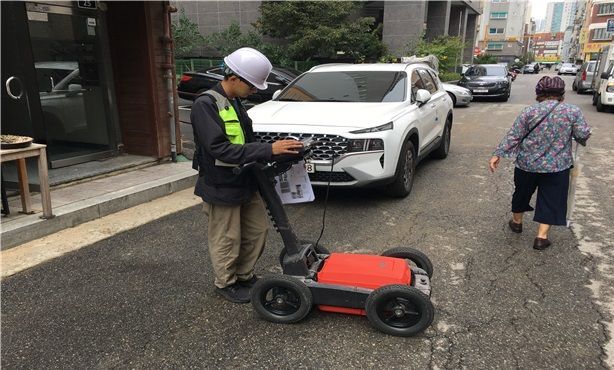
Geumcheon-gu: Investigation of 80 km of roadways and 20 km of sidewalks in Doksan 1-dong, 3-dong, and 4-dong
Geumcheon-gu (Mayor Yoo Sunghoon) will begin a subsurface cavity investigation service this month to prevent road subsidence and other ground collapse incidents and to enhance public safety.
The investigation method is tailored to the characteristics of each area. For roadways, vehicle-mounted equipment will be used to investigate each lane twice. For sidewalks, electric cart-type and small equipment will be used to thoroughly inspect pedestrian areas.
If abnormalities are detected, the presence of cavities will be confirmed through drilling and endoscopic inspection, and immediate restoration will follow. Small cavities will be repaired by injecting flowable fill material, while large cavities will be investigated through excavation to determine the cause before repair work is carried out.
Since launching a pilot project in 2021, the district has investigated a total of 484 km by 2024, discovered 127 cavities, and completed all necessary repairs. Last year, investigations were conducted in parts of Gasan-dong and Doksan-dong. This year, the focus will be on investigating 80 km of roadways and 20 km of sidewalks in Doksan 1-dong, 3-dong, and 4-dong. The district will continue to monitor for cavities under its management to proactively prevent ground subsidence incidents. Yoo Sunghoon, Mayor of Geumcheon-gu, stated, "We will do our utmost to create a road environment where residents can travel with peace of mind through thorough subsurface cavity investigations."
© The Asia Business Daily(www.asiae.co.kr). All rights reserved.



















