Proactive Cavity Inspections Using GPR on District Roads, Around Large Construction Sites, and Roads with Aging Water Mains Starting in May
A Total of 35 Kilometers of Maintenance Completed, Including Sewer Pipeline Improvements and Crack Repairs?Five Sewer Pipeline Improvement Projects Covering Approximately 2.2 Kilometers Planned for This Year
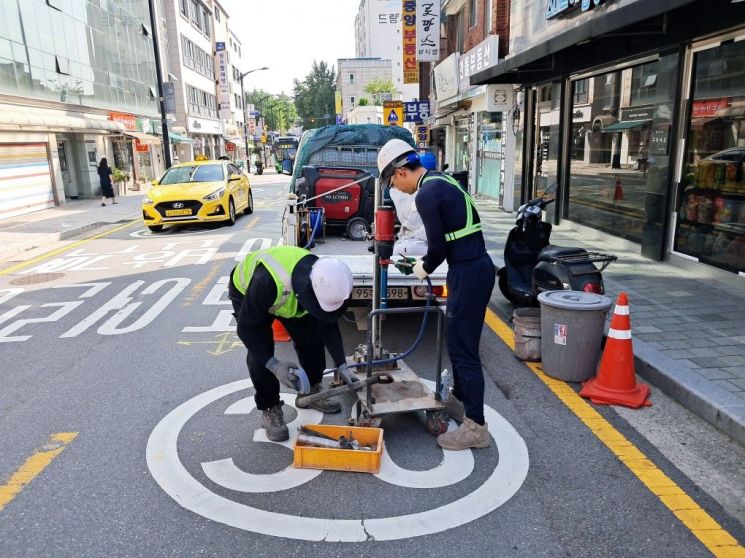
Seongdong District (District Mayor Jeong Wonoh) is taking proactive measures to prevent ground subsidence accidents by conducting ground-penetrating radar surveys in advance.
Amid growing public anxiety due to frequent road sinkhole incidents occurring across the country, Seongdong District will begin full-scale subsurface cavity inspections under roads starting in May, using ground-penetrating radar (GPR) equipment.
A cavity is an empty space formed within the ground that has not yet caused the pavement layer to collapse. Cavities can occur due to damage to aging underground infrastructure or groundwater leakage around large construction sites. Over time, these cavities can cause the pavement to sink, resulting in ground subsidence.
Since 2022, the district has been conducting annual surveys to accurately detect the location and size of subsurface cavities beneath roads, thereby preventing ground subsidence accidents in advance. As of last year, a total of 305 kilometers have been surveyed. In particular, last year, the district completed cavity inspections along the Dongbuk Line urban railway section.
This year, the district plans to conduct surveys on roads under its jurisdiction, areas around large construction sites, and roads with aging water mains.
When a cavity is discovered, the district will verify it through drilling and endoscopic inspection, then promptly restore it using flowable fill material. In cases where large cavities or those caused by aging underground infrastructure are found, the district will carry out excavation and permanent restoration to thoroughly eliminate risk factors. Thanks to these ongoing efforts, the number of cavities in Seongdong District has steadily decreased from 54 in 2022, to 23 in 2023, and 13 in 2024.
The district is also thoroughly maintaining aging sewer pipelines, which are considered a major cause of ground subsidence. According to the Ministry of Land, Infrastructure and Transport, of the 867 ground subsidence incidents that occurred nationwide over the past five years (2020-2024), 394 cases, or 45.4%, were caused by sewer pipe damage.
As of 2024, Seongdong District has completed maintenance on aging sewer pipelines over the past five years, including replacement and improvement work on a total of 35 kilometers of pipelines, as well as crack repair projects. This year, the district plans to carry out five sewer pipeline improvement projects, covering approximately 2.2 kilometers.
After identifying structural defects such as cracks and deformations through on-site inspections and unmanned camera (CCTV) surveys, the district will carry out maintenance according to the degree of aging. The district will also make active efforts to secure the necessary funding, including national, municipal, and disaster management funds.
In addition, in 2017, the district became the first in the country to introduce an “Underground Space Safety Management System” that uses the Internet of Things (IoT) to monitor abnormal signs beneath roads. Since 2020, the district has also operated an “Underground Space Leak Detection System” that continuously monitors water mains in underground spaces, taking proactive steps to prevent ground subsidence.
Jeong Wonoh, Mayor of Seongdong District, stated, “To prevent safety accidents caused by cavities, it is most important to identify and address risk factors in advance through regular and precise inspections. We will examine even the invisible areas with greater care and attention, alleviating residents’ concerns and building a safer city.”
© The Asia Business Daily(www.asiae.co.kr). All rights reserved.
![Clutching a Stolen Dior Bag, Saying "I Hate Being Poor but Real"... The Grotesque Con of a "Human Knockoff" [Slate]](https://cwcontent.asiae.co.kr/asiaresize/183/2026021902243444107_1771435474.jpg)















