The Gyeonggi-do Economic Science Promotion Agency is strengthening its cooperation system with related associations, medical institutions, and universities to foster specialized workforce tailored to the bio sector.
On April 22, the agency announced that it had signed a business agreement at the Gwanggyo Bio Center with the Korea Bio Association, Bundang Seoul National University Hospital, Sungkyunkwan University, Dongguk University (Ilsan), and Eulji University (Uijeongbu) to promote the "2025 Gyeonggi-do Bio Specialized Workforce Training Project."
This agreement aims at mutual cooperation, including the joint development and operation of training programs for practical bio workforce, as well as employment support for trained personnel.
In accordance with the agreement, the agency will provide training facilities within the GG Bio Hub Edu Station, which is equipped with 32 pieces of equipment across 21 types. The five partner institutions will operate customized bio workforce training programs based on future technologies such as artificial intelligence (AI) and big data.
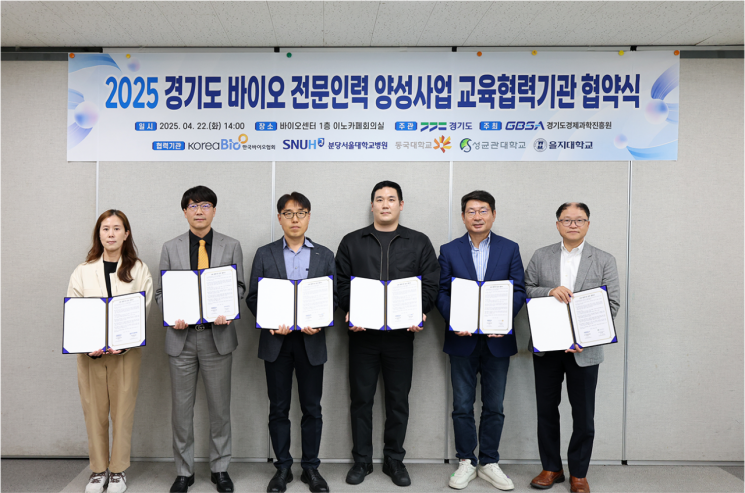 On the 22nd, the Gyeonggi-do Economic Science Promotion Agency signed a business agreement at the Gwanggyo Bio Center with the Korea Bio Association, Bundang Seoul National University Hospital, Sungkyunkwan University, Dongguk University (Ilsan), and Eulji University (Uijeongbu) to promote the "2025 Gyeonggi-do Bio Specialized Workforce Training Project." Provided by Gyeonggi-do Economic Science Promotion Agency
The bio workforce training programs will be designed to reflect the needs of the industry, focusing on both company demands and future technology-based training courses.
The areas of operation include: ▲ bio (genome) data analysis and process development ▲ digital healthcare AI solution development ▲ advanced biopharmaceutical development.
Through this project, the agency plans to train a total of 500 bio specialists, including 140 job seekers (or prospective job seekers) and 360 incumbent workers, to help resolve manpower shortages in bio industries and respond to the growing demand for digital transformation.
Lee Jongseok, Director of the Bio Industry Headquarters at the agency, stated, "By collaborating with leading educational institutions, we will strengthen practical, field-oriented training and nurture bio talent to lead future technologies." He added, "We will enhance the connectivity between courses and further solidify our cooperation system with partner institutions to ensure the successful operation of the training programs."
© The Asia Business Daily(www.asiae.co.kr). All rights reserved.
![Clutching a Stolen Dior Bag, Saying "I Hate Being Poor but Real"... The Grotesque Con of a "Human Knockoff" [Slate]](https://cwcontent.asiae.co.kr/asiaresize/183/2026021902243444107_1771435474.jpg)















