Attending the Launch of the National Assembly "Future Industry Forum"
In Lecture: "We Must Focus on Generating Soft Money"
Emphasizes "Mega Sandbox" Regulatory Exemptions for Companies
Choi Taewon, Chairman of the Korea Chamber of Commerce and Industry, met with members of the National Assembly and emphasized the need for cooperation with Japan. He also insisted that regulations should be eased and incentives provided so that companies can grow in key industries such as artificial intelligence (AI).
Chairman Choi made these remarks at the launch ceremony of the "Future Industry Forum" held at Sarangjae, the National Assembly, on the morning of the 22nd. The National Assembly Future Industry Forum is organized by the National Assembly Future Institute, a think tank, to discuss a paradigm shift in domestic industrial support policies amid rapidly changing international dynamics. The launch ceremony was attended by Woo Wonsik, Speaker of the National Assembly, Joo Hoyoung, Deputy Speaker of the National Assembly, and floor leaders from each party.
As the first invited speaker of the day, Chairman Choi pointed out that Korea's growth rate is slower than that of the United States. He said, "Korea has lost its momentum for strong growth," and explained, "The existing World Trade Organization (WTO) system has shifted to a protectionist regime, which is likely to continue for the next 30 years."
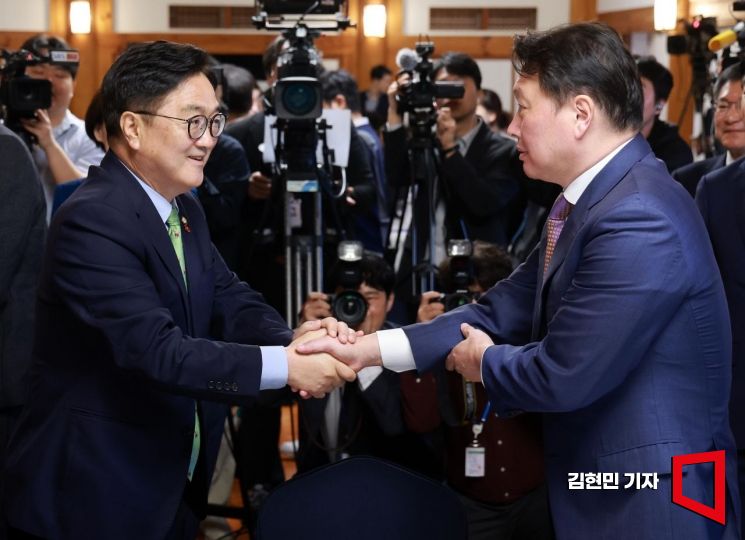 Woo Wonsik, Speaker of the National Assembly, and Choi Taewon, Chairman of the Korea Chamber of Commerce and Industry, are greeting each other at the launch ceremony of the National Assembly Future Industry Forum held at Sarangjae, the National Assembly, on the 22nd. Photo by Kim Hyunmin
He went on to say, "We need to cultivate partners and markets similar to the Korean economy," specifically mentioning Japan. He explained, "Japan is a rule follower, and, like Korea, has no clear solution to low birth rates and low growth, so we share the same concerns." He added, "We can benefit from cooperation in areas such as joint purchases of liquefied natural gas (LNG) and carbon capture and utilization." He proposed that, like the European Union (EU), Korea and Japan, and eventually other Asian countries, should build an economic cooperation structure and strengthen their collective influence. He stated, "To escape from being a low-growth, high-cost country, we need to use ideas to lower costs. Since it is difficult to do this alone, we must now move forward together."
He also stressed the need to expand domestic demand by attracting highly skilled talent. Chairman Choi explained, "If a certain number of highly skilled professionals flow into the country, it will increase consumption and tax revenue, which will contribute not only to economic growth but also to enhancing industrial competitiveness." He emphasized, "At a minimum, we need to attract one-tenth of Korea's population from overseas. We must bring in 'brains' from abroad to drive the development of future industries."
In addition, he argued that the focus of trade exports, which has traditionally been on goods balance, should shift to increasing primary income balance. To this end, he suggested increasing overseas investment and focusing on generating "soft money," which is less restricted by borders. He called for more strategic overseas investment and an increase in exports of intellectual property rights. As promising industrial sectors, he cited K-food, K-culture, and K-drama. Chairman Choi added, "Korean food is popular, but restaurants and services are not yet fully systematized. We need to maximize the income we can generate through soft power."
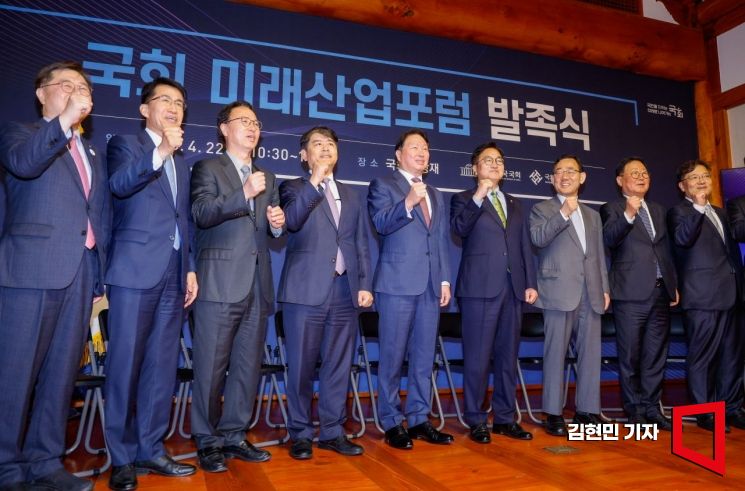 Woo Wonsik, Speaker of the National Assembly, Joo Hoyoung, Deputy Speaker of the National Assembly, Chey Taewon, Chairman of SK, Kim Kisik, Director of the National Assembly Future Institute, and other steering committee members attended the inauguration ceremony of the National Assembly Future Industry Forum held at Sarangjae, the National Assembly in Yeouido, Seoul, on the 22nd, and took a commemorative photo. Photo by Kim Hyunmin
As a concrete method of implementation, he mentioned the concept of a "mega sandbox." This involves designating special areas where only the regulations desired by companies are lifted, building AI infrastructure, and providing bold incentives. He also suggested encouraging companies to voluntarily participate in addressing social issues through incentives. He said, "In fact, when our company (SK) paid 71.5 billion won in social performance incentives to a company, it resulted in a real cash effect of 500 billion won, or 25%," adding, "This shows that social enterprises can actually create social value." He further explained that applying the social performance methodology in Jeju has produced social value 5.9 times the investment amount.
The steering committee of the Future Industry Forum consists of key figures from major industries, including Park Iljun, Executive Vice Chairman of the Korea Chamber of Commerce and Industry; Min Byungseok, Vice President of Samsung Global Research; Song Kyungyeol, Head of SK Management and Economic Research Institute; Kim Youngmin, President of LG Business Research Institute; Kim Dongwook, Vice President of Hyundai Motor Company; Cho Seok, Vice Chairman of HD Hyundai Electric; Joo Youngjun, President of Hanwha Futureproof; Kwon Namhoon, President of the Korea Institute for Industrial Economics and Trade; Lee Siwook, President of the Korea Institute for International Economic Policy; and Kim Hyunje, President of the Korea Energy Economics Institute.
© The Asia Business Daily(www.asiae.co.kr). All rights reserved.


















