Bank of Korea Survey:
Banks Expected to Tighten Lending Standards in Q2
Small Businesses and Households Face Stricter Loan Conditions
Credit Risk Remains High Across Financial Sectors
It is expected to become more difficult to obtain household and small business loans from banks in the second quarter of this year.
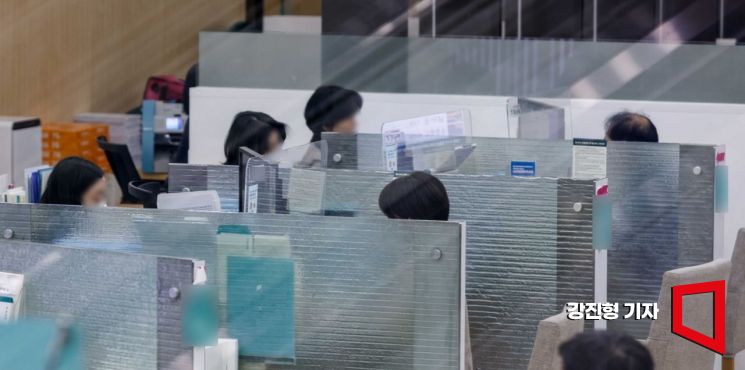
According to the results of the "Financial Institution Lending Attitude Survey" conducted by the Bank of Korea on lending officers at financial institutions, the overall lending attitude index for banks in the second quarter stood at -6. This is a decrease of 13 points from the first quarter's 7. The number of banks responding that they would tighten lending requirements increased compared to the previous quarter.
By borrower type, the attitude index shifted toward tightening for all categories except for large corporate loans. The index for small business loans fell from 0 in the first quarter to -6 in the second quarter. The index for household mortgage loans dropped from 14 to -6, and for general household loans (such as unsecured loans), it shifted from 8 to -8. A negative index indicates that more financial institutions responded that lending would be tightened rather than eased.
A Bank of Korea official stated, "In the case of small business loans, the lending attitude is expected to tighten, especially for vulnerable sectors, due to increased uncertainty in domestic and global economic conditions and a focus on managing credit soundness." The official added, "For household loans, lending may be tightened as financial institutions autonomously manage lending in line with household debt management policies." In contrast, lending to large corporations is expected to ease slightly, particularly at banks that saw sluggish loan growth in the first quarter.
The overall loan demand index for the second quarter was 11, down 3 points from the previous quarter's 14, but demand is still expected to increase. In particular, demand is expected to expand among large corporations (from 6 to 11) and small businesses (from 19 to 25). The Bank of Korea explained that companies are likely to increase demand for operating funds to prepare for uncertainties in domestic and global economic conditions. For households, the increase in housing transactions in the first quarter is expected to translate into loans in the second quarter, and demand is also expected to rise due to falling interest rates on unsecured loans.
The overall credit risk index anticipated by domestic banks for the first quarter was 20, up 5 points from the previous quarter's 15. Notably, concerns over rising credit risk increased for large corporations (from 6 to 8) and households (from 8 to 17). The index for small businesses remained at 22, but concerns over credit risk remain higher than for large corporations and households.
A Bank of Korea official said, "For households, credit caution is expected to persist due to concerns over slowing income growth and a decline in debt repayment capacity." The delinquency rate for unsecured loans at domestic banks rose from 0.64% in December last year to 0.83% in February this year.
As for non-bank financial institutions, such as savings banks, all sectors are expected to maintain a tightening stance on lending. Credit risk is also expected to remain high across all sectors. A Bank of Korea official commented, "With high levels of domestic and global uncertainty and persistently high delinquency rates amid downside economic risks, institutions are likely to continue strengthening asset soundness management." The official added, "The repayment capacity of vulnerable borrowers with low credit and low income is expected to decline, and the possibility of reduced profitability due to poor corporate performance means credit risk will likely remain high."
Meanwhile, this survey was conducted from March 4 to 14, targeting a total of 203 financial institutions (18 domestic banks, 26 mutual savings banks, 7 credit card companies, 142 mutual finance cooperatives, and 10 life insurance companies).
© The Asia Business Daily(www.asiae.co.kr). All rights reserved.

















