Pilot Projects in Eight Areas Including Buam and Geumho
Consideration of Local Characteristics, Commitment, and Regional Balance
City: "More Than 100 Zones to Be Established Across Seoul"
Seoul City is launching the creation of the 'Seoul-Style Walking Daily Zone,' which will allow residents to access various functions such as daily conveniences, leisure, care, learning, and public services within a 30-minute walk. The goal is to transform different areas of Seoul into self-sufficient living spaces.
On the 22nd, Seoul City announced that it will conduct pilot projects to establish walking daily zones in eight locations. The selected sites are Pyeongchang·Buam (Jongno-gu), Geumho·Oksu (Seongdong-gu), Cheongnyangni (Dongdaemun-gu), Singil (Yeongdeungpo-gu), Jeongneung (Seongbuk-gu), Suyu (Gangbuk-gu), Hongje (Seodaemun-gu), and Yangjae (Seocho-gu). Experts who participated in the advisory panel for the 'Establishment of Standards and Promotion of Pilot Projects for Walking Daily Zones' selected these areas.
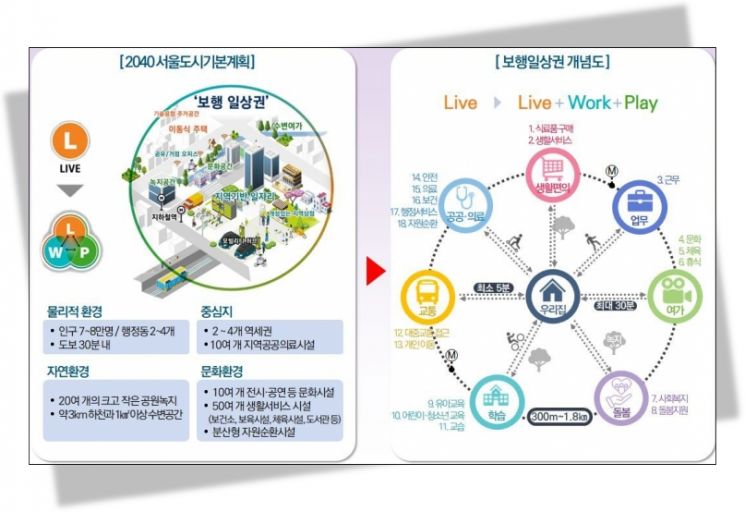
The concept of the 'Walking Daily Zone' was first introduced in the future spatial strategy '2040 Seoul City Master Plan' (announced in March 2022). It is an urban spatial concept that reflects changing lifestyles, such as the rise of residential areas as the center of daily life, in response to social changes like the pandemic and the digital transformation. It refers to a self-sufficient living zone where residents can enjoy a variety of daily activities near their homes without having to travel far.
Seoul City plans to significantly reorganize the city's daily living spaces, which are currently centered on 'residential use,' in order to improve the quality of life for its citizens. The focus is on 'establishing plans to realize the walking daily zone.' The city will develop plans for the creation of walking daily zones centered on major hubs such as areas near subway stations, plans to expand essential facilities within the walking daily zones, and strategies to build networks of local streets to improve accessibility. Based on this, Seoul City aims to establish 'standards for the creation of walking daily zones' by September and gradually expand the initiative citywide in the future.
Through the pilot projects, Seoul City will conduct a detailed analysis of the current status of essential facilities in each walking daily zone and develop customized plans to expand facilities that reflect the unique characteristics of each area. Regarding future supply plans, the city intends to utilize methods such as donations or public funds for public facilities, and to encourage private facilities to adopt recommended uses through district unit plans. In this process, the city is also considering ways to reflect the 'population characteristics of each area.' If this function is realized, it is expected that in areas with concentrations of specific population groups, such as infants or the elderly, essential facilities tailored to those demographic characteristics can be expanded.
Cho Namjun, Director of Seoul City's Urban Space Headquarters, said, "This pilot project is the first step in establishing standards before the full-scale introduction of the Seoul-style walking daily zone," adding, "We will sequentially create more than 100 self-sufficient living zones throughout Seoul, bringing real changes to citizens' daily lives."
© The Asia Business Daily(www.asiae.co.kr). All rights reserved.

















