April TIGER Index Declines for Second Consecutive Month
Global Confidence Down for Third Month, Financial Index Falls for Second Month
Atmosphere Shifts in U.S. After Reciprocal Tariff Announcement
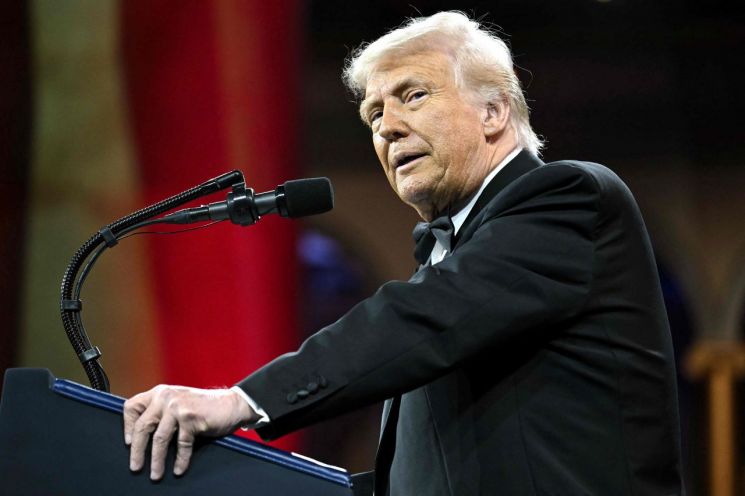 Donald Trump, President of the United States, is speaking at the National Republican Congressional Committee (NRCC) event held in the United States on the 8th (local time). Photo by AFP
There is an analysis suggesting that the policies of Donald Trump, President of the United States, have dampened the prospects for a global economic recovery this year. While macroeconomic indicators remain positive, financial indicators have collapsed and private sector confidence has plunged.
According to the 'Tracking Indexes for the Global Economic Recovery' (TIGER Index), jointly released on the 20th (local time) by the Brookings Institution, a U.S. think tank, and the Financial Times (FT), the global TIGER Index for April stood at 5.950, marking a decline for the second consecutive month after reaching 7.710 in February. The TIGER Index is a composite index that assesses the state of the global economic recovery by aggregating various economic and financial indicators, as well as confidence indices.
By sector, the global confidence index (reflecting business and consumer confidence, among others) fell for the third consecutive month to -1.044 in April, while the financial index (reflecting credit growth, stock market capitalization, stock indices, etc.) also declined for the second consecutive month to 7.144. Researcher Eswar Prasad and others commented, "While the global economy was showing signs of stabilization, the possibility of a policy-induced global recession has increased significantly due to heightened financial market volatility and increased policy uncertainty," describing it as "the worst possible timing."
In contrast to the relatively favorable macroeconomic indicators, which are compiled with a time lag, this month saw declines in both financial and confidence indices, reflecting mixed signals. The research team explained that U.S. tariff policies have disrupted global trade and financial markets, and have also negatively impacted growth prospects that had been positive at the beginning of the year.
In the United States, indicators such as production and employment were solid through the first quarter, but the atmosphere changed after President Trump announced reciprocal tariffs on the 2nd of this month, according to the researchers. Since then, stock markets have been volatile, consumer confidence has weakened amid growing uncertainty, and if tariffs further intensify inflation, the scope for lowering benchmark interest rates will inevitably be limited.
This month, South Korea's confidence index also turned negative, recording -1.426. South Korea's confidence index had declined for six consecutive months through January this year amid economic slowdown and domestic political uncertainty, reaching a low of -1.478 in March 2023, before showing a recovery in February and March. However, it has now reverted to a downward trend. This month's financial index for South Korea was also -3.441, the lowest since March 2023 (-3.895). South Korea's TIGER Index for January was -1.457, marking four consecutive months of decline since September last year, and the lowest since September 2023.
The researchers assessed that the Chinese economy is vulnerable to a full-scale trade war with the United States, as it faces deflationary pressure due to oversupply. They also projected that the dual shocks of U.S. tariffs and China's oversupply would particularly impact emerging economies, including those in Southeast Asia. The research team cautioned, "It is premature to say that a global recession is imminent," but also warned, "The collapse of global trade and increased policy uncertainty will clearly restrain growth."
Regarding Europe, the researchers noted that while core economies are in recession, peripheral countries are holding up relatively well. For example, Germany, France, and Austria?the core economies?are suffering from low growth and fiscal burdens, but Greece, Italy, Spain, and Portugal are showing relatively robust trends. However, a slowdown in international trade is expected to negatively affect the entire European manufacturing sector.
India is expected to be the only country to benefit. Its stable growth trajectory, emergence as an alternative supply chain hub, robust rural consumption and services sector, and gains from U.S. companies' China exit strategies all contribute to its relative insulation from tariff impacts. Financial market stability and expanding domestic demand are also cited as positive factors.
Meanwhile, the International Monetary Fund (IMF) is scheduled to release its World Economic Outlook on the 22nd, during the IMF-World Bank (WB) Spring Meetings held from the 21st to the 26th. Kristalina Georgieva, Managing Director of the IMF, stated on the 17th, "Our new growth outlook will include a noticeable downward revision, but it will not include a recession," adding, "For some countries, the outlook will also include an upward revision for inflation."
© The Asia Business Daily(www.asiae.co.kr). All rights reserved.
![Clutching a Stolen Dior Bag, Saying "I Hate Being Poor but Real"... The Grotesque Con of a "Human Knockoff" [Slate]](https://cwcontent.asiae.co.kr/asiaresize/183/2026021902243444107_1771435474.jpg)















