Wemade Files for Forced Execution of 300 Billion Won Against Shengqu
Zhejiang Huanyu and Jiuling Owe 540 Billion Won Despite Court Approval
"Delays in Enforcement Due to Baseless Protests"
Wemade has achieved a string of victories in its legal battles against Chinese game companies over "Legend of Mir 2" (Mir 2), but has yet to collect a total of 840 billion won in damages. The company claims that local firms are avoiding payment by concealing sales or siphoning off assets.
At a meeting on the 21st, Wemade announced that in February, it filed an "application for recognition and enforcement of arbitral award" with a Chinese court against Lansha Information Technology (Shanghai) Co., Ltd., a subsidiary of Shengqu Games (formerly Shanda Games). This action follows a ruling by the Singapore International Chamber of Commerce (ICC) arbitration tribunal, which ordered Shengqu Games to pay approximately 1.5079 billion yuan (3 billion won) in damages. For an international arbitral award to be enforced, it must be recognized and enforced by a local court.
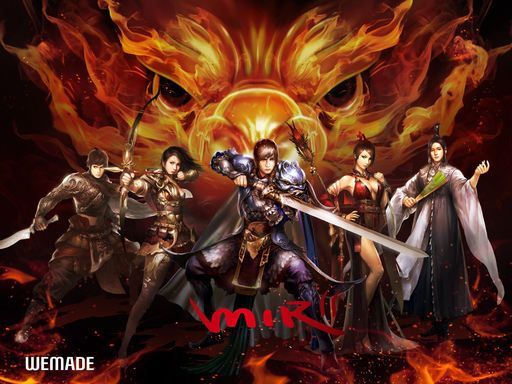
The conflict between Wemade and Shengqu Games dates back to 2001. After splitting from Actozsoft in 2000, Wemade agreed to jointly hold the copyright for the MMORPG Mir 2 it was developing, and in 2001 signed a licensing agreement with China’s Shengqu Games.
Mir 2 achieved tremendous success in the Chinese market. However, from 2002 to 2005, Shengqu Games failed to properly pay royalties owed to Wemade, leading to ongoing disputes. In 2005, Shengqu Games acquired Actoz, shifting the conflict to one between Wemade and Shengqu Games/Actoz. Starting in 2014, Shengqu Games unilaterally signed licensing agreements with third parties in China and provided them with the Mir 2 intellectual property (IP), yet paid no royalties to Wemade despite repeated objections.
Due to limited access to information in China, Wemade was only able to file for arbitration with the ICC in 2017, requesting a halt to the copyright infringement and breach of contract. The ICC acknowledged Shengqu Games’ breach of contract and concluded that Actoz was jointly liable for colluding in illegal activities. In August of last year, the Seoul Central District Court approved Wemade’s application for recognition and enforcement of the arbitral award against Actoz. Actoz has appealed this decision.
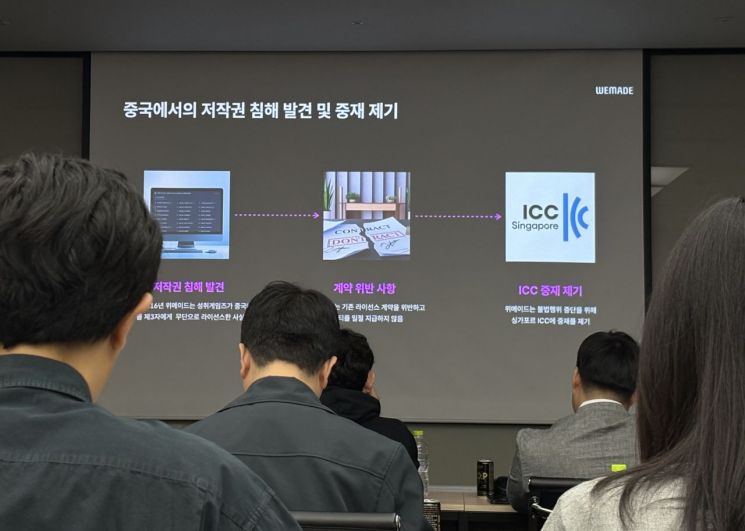 A representative from Wemade's legal team is explaining the lawsuit with Chinese game companies regarding the intellectual property (IP) of "Legend of Mir 2" at a meeting on the 21st. Photo by Jeon Youngju
The lawsuits against Shanghai Kingnet and its subsidiaries, which have lasted more than five years, are also ongoing. A company representative stated, "After discovering Shengqu Games’ illegal activities, we directly signed Mir 2 IP license agreements with Chinese game companies such as Zhejiang Huanyu and Jiuling between 2016 and 2017." He added, "After learning of this, Shanghai Kingnet acquired both companies but refused to pay royalties." Zhejiang Huanyu operates "Nan Yue Zuanqi," while Jiuling provides "Long Cheng Zhan Jia" and "Zhuan Qi Lai Liao" in China.
In the case of Zhejiang Huanyu, a Chinese court granted recognition and enforcement of the arbitral award, but the company was unable to pay approximately 481.57 million yuan (96 billion won) in damages due to insufficient assets. Shanghai Kingnet had already funneled game profits out of the company. In response, Wemade argued that Zhejiang Huanyu was merely a shell company and invoked the "piercing the corporate veil" doctrine, demanding that Shanghai Kingnet be held jointly liable for damages.
The appellate court, the Shanghai High People’s Court, accepted this argument and determined that Shanghai Kingnet and Zhejiang Huanyu were essentially the same entity. Nevertheless, Shanghai Kingnet continues to avoid paying damages. A member of Wemade’s legal team commented, "The Chinese court has stated that it cannot enforce the ruling due to strong resistance from Shanghai Kingnet," and questioned, "Is it really possible for enforcement to be delayed solely due to baseless protests and objections?"
Immediately after the international arbitral awards for "Long Cheng Zhan Jia" and "Zhuan Qi Lai Liao," Shanghai Kingnet sold its stake in Jiuling, severing the parent-subsidiary relationship to avoid further corporate veil litigation. Jiuling’s assets had already been transferred outside the company. As a result, even though local courts granted recognition and enforcement of the arbitral awards, Wemade has been unable to collect 340 billion won (for "Long Cheng Zhan Jia") and 100 billion won (for "Zhuan Qi Lai Liao") in damages.
© The Asia Business Daily(www.asiae.co.kr). All rights reserved.


















