Not Semi-Autonomous, but Driver Assistance
ACC Cannot Detect Stationary Vehicles
Only 1 Accident in 2020, 12 Last Year
19 Fatalities in the Past 5 Years
# Office worker Mr. A was recently involved in a car accident while on a family trip. The root cause was his lack of understanding about Adaptive Cruise Control (ACC). He did not know that when ACC is activated, it cannot detect stationary vehicles ahead. Mr. A had ACC turned on and was distracted, when a truck far ahead in the same lane came to a stop. However, ACC failed to recognize the truck. By the time Mr. A noticed the truck, a collision was imminent. He pressed the brake pedal, but it was already too late. Although his family members were not seriously injured, the car, which he had only recently purchased, was nearly totaled.
 An accident that occurred in March 2024 on the Gochang-Damyang line. A following vehicle, driving with ACC activated, collided with a vehicle that was parked diagonally on the first and second lanes due to a preceding accident. After the subsequent collision, other vehicles including a large bus were also damaged. Three people, including the driver of the accident vehicle, died in this accident. Provided by Korea Expressway Corporation
Accidents caused by overreliance on ACC, like Mr. A's, have been increasing significantly. As consumers entrust driving to ACC without fully understanding its functions, major accidents similar to Mr. A's are occurring frequently. Experts emphasize that driving should always be performed by the driver, and that ACC should be regarded as an assistive device. They stress the need for drivers to take a more proactive approach to safety.
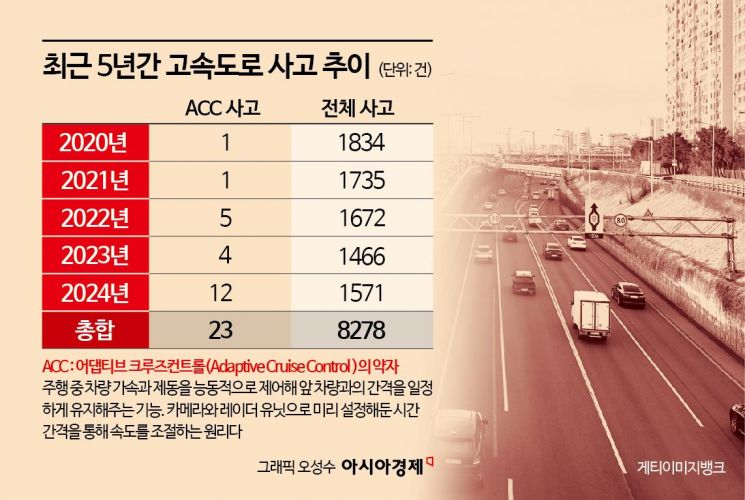
According to the Korea Expressway Corporation on April 19, accidents involving the use of ACC numbered only one in 2020 and one in 2021. However, the following year saw five cases, four in 2023, and a sharp increase to twelve cases last year. Over the past five years, 19 people have died in such accidents. During the same period, the total number of traffic accidents on highways has been steadily decreasing, from 1,834 cases in 2020 to 1,571 in 2024.
Overconfidence in ACC Leads to Accidents: Not an Autonomous Driving Feature but a Driver Assistance System
ACC is a function that automatically adjusts driving speed to maintain a set distance from the vehicle ahead. Traditional cruise control, introduced decades ago, keeps the vehicle at a constant speed without the need to press the accelerator pedal. ACC goes a step further by using sensors and front-facing radar to maintain a consistent distance from the vehicle in front. It is most commonly used on highways, where less driver intervention is typically required.
However, ACC does not function consistently in all situations. Vehicle manuals warn that ACC may not properly detect stationary vehicles, vehicles positioned to one side of the lane, slow or rapidly decelerating vehicles, oncoming vehicles, or trailers with small rear profiles.
It is also noted that in curves or on slopes, ACC may fail to detect vehicles in the same lane, causing the car to accelerate rapidly. Additionally, motorcycles, pedestrians, and animals may not be properly recognized.
"Keep Your Hands on the Wheel and Eyes on the Road": Drivers Must Proactively Ensure Safety
Nevertheless, some drivers perceive ACC as a form of autonomous driving. According to the Korea Expressway Corporation, accidents are increasing as drivers overestimate or misuse ACC. There has also been a rise in major accidents resulting in casualties due to improper use.
In March last year, on the Gochang-Damyang line, a car traveling at 120 km/h in the first lane with ACC activated caused a collision that killed three people, including the driver. The accident occurred because the system failed to detect a vehicle that was parked diagonally. After the accident, the Korea Transportation Safety Authority and the police analyzed the event data recorder and confirmed that the accident occurred while ACC was in operation.
 A vehicle driving with the ACC function activated in the first lane collided with a safety patrol car managing traffic accident safety. The Korea Expressway Corporation determined that the accident occurred due to inattentive driving. The safety patrol officer in the patrol car died as a result of this accident. Photo by Korea Expressway Corporation
In May last year, on the Honam Expressway, there was also an accident in which a vehicle driving at 130 km/h with ACC activated struck and killed a safety patrol officer who was managing traffic on the road. In this case, although the forward collision prevention system was activated just before the crash, the high speed rendered it ineffective.
Experts emphasize that since ACC is a driver assistance system, not an autonomous driving feature, drivers must take a more active role in ensuring safety while driving. Ha Sungyong, president of the Korea Automobile Mobility Safety Association, stated, "ACC is one of several driver support systems that make driving easier, but it does not function in all situations and may be limited depending on traffic conditions, road, or weather."
He added, "Since ACC does not replace the driver's attention and judgment, drivers are always responsible for maintaining an appropriate speed, keeping a safe distance from other vehicles, and operating their vehicles in compliance with current laws and regulations."
© The Asia Business Daily(www.asiae.co.kr). All rights reserved.



















