Leftover Land Remained Due to Budget Shortage in 1991
LH Demands '880,000 Won Daily' Interest Under Industrial Sites Act
Plans for IBS Research Facilities in Physics, Chemistry, and Life Sciences
"Continued Government Attention Needed for Basic Science Research"
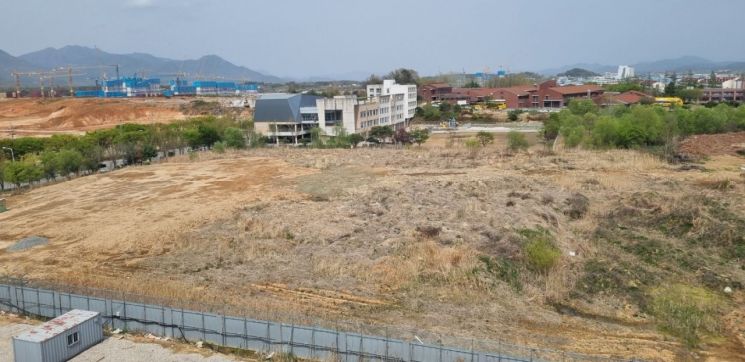 On the 18th, the remaining land (31,709㎡) on the Gwangju Institute of Science and Technology campus was left unattended, overgrown with weeds. Photo by Min Chanki
The Gwangju Institute of Science and Technology (GIST) is still facing difficulties in acquiring approximately 10,000 pyeong of remaining land that was left undeveloped due to budget shortages at the time of its establishment.
In particular, GIST plans to utilize this land for IBS research facilities and other purposes in accordance with the Ministry of Science and ICT's "Second Basic Plan for the International Science Business Belt." However, under the relevant laws, an additional interest of 880,000 won is accruing daily, which is increasing the financial burden. As a result, government support is being called for.
According to GIST and other sources on April 18, when the GIST campus was established in 1991, Korea Land and Housing Corporation (LH) and the Ministry of Science and Technology agreed to leave 31,709 square meters (about 5% of the total campus area) as remaining land under a land acquisition agreement.
The remaining land was designated for educational use, but due to budget shortages at the time and the absence of immediate plans for its use, it was decided to acquire the land in phases. This unacquired land, located within the GIST campus, has been left virtually unattended for 35 years, overgrown with weeds.
The burden is increasing as the additional interest on the land exceeds one billion won each year. At the time of the land acquisition contract, GIST and LH agreed on the development cost (6.4 billion won) plus additional interest (about 880,000 won per day, approximately 320 million won per year). The additional interest has been accruing since 2013 in accordance with the Industrial Sites and Development Act, and about 4 billion won in interest has accumulated so far.
The issue is that GIST is pursuing the construction of campus research facilities for the Institute for Basic Science (IBS) on this land, in line with the Ministry of Science and ICT's Second Basic Plan for the International Science Business Belt. If the situation continues, there is a risk that only the additional interest will continue to pile up, hindering basic science research essential for industrial innovation.
According to the second basic plan for the construction of the Institute for Basic Science, IBS plans to invest 309 billion won by 2030 to build campus research buildings at GIST, DGIST, and other locations, including the second phase of its headquarters.
GIST is planning to purchase the remaining land (about 10,000 pyeong) to establish a dedicated building connecting three research groups: the existing IBS Relativistic Laser Science and Quantum Conversion Research Group, and a newly invited research group in the field of life sciences. Since November last year, GIST has been in the final negotiation stage to select the final candidate for the head of the life sciences research group.
GIST expects that the IBS research facilities will establish a research cluster focusing on physics, chemistry, and life sciences, and produce leading basic science research outcomes in specialized fields.
In addition, GIST plans to utilize the remaining land for facilities such as Science FLOWer, an immersive complex space for stable housing for young researchers, and the Future Strategy Center, which will conduct innovative research focusing on AI, advanced biotechnology, and quantum science. Therefore, government support is needed to secure the budget for acquiring the remaining land.
A GIST official stated, "We are continuously appealing to the government and local members of the National Assembly to secure the budget for acquiring the remaining land," and added, "Government attention is necessary to ensure that the IBS research facilities can be established without any setbacks."
© The Asia Business Daily(www.asiae.co.kr). All rights reserved.
![Clutching a Stolen Dior Bag, Saying "I Hate Being Poor but Real"... The Grotesque Con of a "Human Knockoff" [Slate]](https://cwcontent.asiae.co.kr/asiaresize/183/2026021902243444107_1771435474.jpg)















