U.S. LNG imports to China suspended for over 10 weeks
Russia emerges as China's third-largest LNG supplier
High tariffs exchanged between the two countries
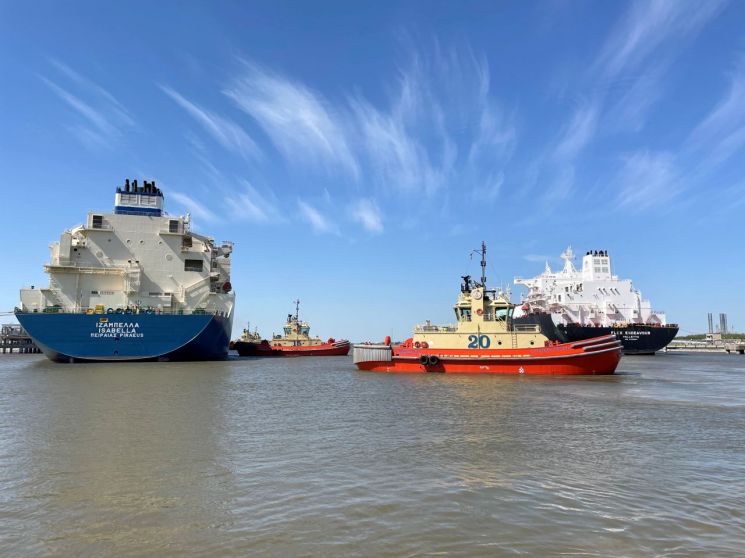 An LNG tanker, a special vessel for transporting liquefied natural gas (LNG), is surrounded by tugboats near the coast of Louisiana, USA. Photo by Reuters Yonhap News
The tariff war between the United States and China has escalated into an energy war. China is reportedly seeking to make up for its energy shortfall by increasing imports of Russian liquefied natural gas (LNG) instead of U.S. LNG.
The Financial Times (FT), a British daily, reported on the 18th that China has halted purchases of U.S. LNG. Citing shipping data, FT stated that since a 69,000-ton LNG carrier departed from Corpus Christi, Texas, on February 6 and arrived in Fujian Province, southern China, there have been no imports of U.S. LNG into China for more than 10 weeks.
The next LNG carrier also set sail for China, but failed to arrive before February 10, when China began imposing an additional 15% tariff on U.S. LNG, and was redirected to Bangladesh. Since then, China has raised the tariff rate on U.S. LNG to 49%, eliminating any economic incentive for Chinese importers to bring in U.S. LNG.
This is not the first time China has suspended imports of U.S. LNG, as it previously halted imports for over a year during Donald Trump’s first term as U.S. president. However, FT pointed out that the recent suspension is likely to strengthen energy cooperation between Russia and China and casts a shadow over the outlook for large-scale LNG terminal expansion projects underway in the United States and Mexico.
Anne-Sophie Corbeau, a gas expert at Columbia University's Center on Global Energy Policy, said, "In the long term, it seems unlikely that Chinese LNG importers will sign new contracts for U.S. LNG." Since Russia's invasion of Ukraine, China's imports of U.S. LNG have declined. Last year, 6% of the LNG consumed in China was imported from the U.S., down from a peak of 11% in 2021.
Gillian Bockara, an analyst at Kepler, a provider of raw materials and logistics data, predicted there is no reason for trade between the two countries to resume in the short term. "Last time, LNG imports were completely suspended, but the Chinese authorities lifted the suspension by granting tariff exemptions to companies during a period of surging gas demand," she said. "Now, with economic growth rates declining, I believe China can withstand a prolonged suspension of LNG imports."
Instead, China is seeking to increase imports of Russian LNG. Zhang Hanhui, Chinese ambassador to Russia, said, "There are certainly many buyers interested in Russian LNG. Several buyers have asked the embassy to help them make contact with Russian suppliers, so it is clear that imports of Russian LNG will increase." Russia has emerged as China's third-largest LNG supplier, after Australia and Qatar. The two countries are reportedly negotiating prices and supply volumes for the construction of the new gas pipeline "Power of Siberia 2."
Richard Bronze of the energy consulting firm Energy Aspects said, "If tariffs rise to a level that effectively amounts to a trade ban, trade flows will be reshaped." He predicted that total LNG demand in Asia could decline by 5 million to 10 million tons, while LNG prices in Europe may fall slightly.
Previously, as a retaliatory measure against the Trump administration's imposition of an additional 10% tariff on Chinese goods, China imposed a 15% tariff on U.S. coal and LNG and a 10% tariff on crude oil, agricultural machinery, and vehicles starting February 10. As retaliatory measures continued between the two countries, China's additional tariff rate on U.S. goods was raised to 125% as of the 12th. This followed the U.S. announcement that the cumulative tariff rate imposed on China since the start of Trump’s second administration had been recalculated at 145%.
© The Asia Business Daily(www.asiae.co.kr). All rights reserved.

















