Damage Area More Than Twice the Wildfire-Affected Zone
Wildfire-Affected Area and Damage Area Are Distinct Concepts
Unusual for Damage Area to Exceed Wildfire-Affected Zone
Final Wildfire Damage Area to Be Announced by the Central Disaster Headquarters at the End of This Month
The provisional area affected by wildfires in Gyeongnam, Gyeongbuk, and Ulsan has been tallied at 104,000 hectares.
The Korea Forest Service announced the results of a detailed investigation into the wildfire-affected regions of Gyeongnam, Gyeongbuk, and Ulsan on April 18.
According to the investigation, the provisional forest damage area by region is as follows: Gyeongbuk, 99,289 hectares (Uiseong 28,853 ha, Andong 26,709 ha, Cheongsong 20,655 ha, Yeongyang 6,864 ha, Yeongdeok 16,208 ha); Gyeongnam, 3,397 ha (Sancheong 2,403 ha, Hadong 994 ha); and Ulsan (Ulju), 1,190 ha.
Considering that the Korea Forest Service had previously announced the estimated wildfire-affected area as 45,157 hectares until recently, the area provisionally tallied through the actual investigation has more than doubled.
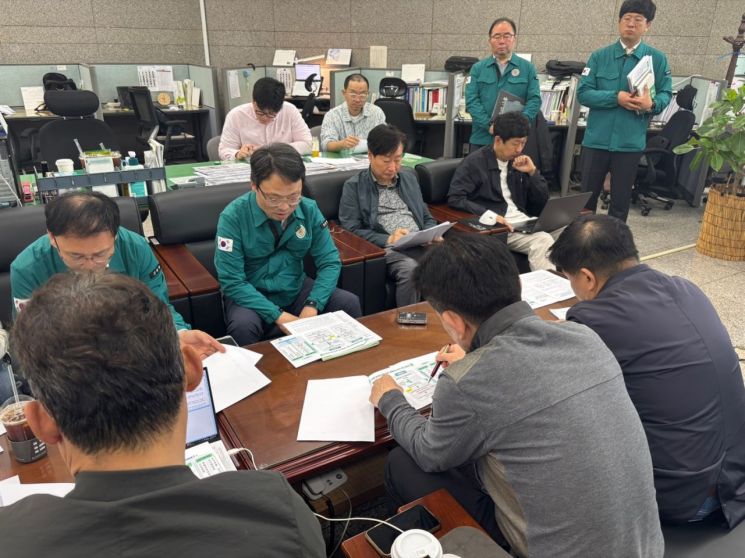 Eunsik Park, Director of the Forest Industry Policy Bureau at the Korea Forest Service, is announcing the detailed investigation results of wildfire-affected areas in Gyeongnam, Gyeongbuk, and Ulsan at the Government Complex Daejeon on the 18th. Photo by Jeong Ilwoong
The Korea Forest Service emphasized that the discrepancy between the previously announced wildfire-affected area and the provisionally tallied wildfire damage area from this investigation stems from the difference between these two concepts.
The wildfire-affected area refers to the boundary of the fire line identified using helicopter and drone footage, as well as ground observations, for the purpose of establishing firefighting strategies at the site when a wildfire occurs. In contrast, the wildfire damage area means the actual forest area where wildfire damage occurred, as determined through on-site investigations for the purpose of restoration, and is therefore distinct from the wildfire-affected area, according to the Korea Forest Service.
Specifically, because the wildfire-affected area is set broadly along the fire line, it has often been assessed as larger than the actual wildfire damage area. Typically, the wildfire-affected area announced during firefighting operations was larger than the wildfire damage area, which is determined after firefighting is complete and further investigation is conducted (including provisional figures).
However, in the case of this wildfire, the Korea Forest Service explained that the wildfire damage area ended up being larger than the wildfire-affected area. This was due to several factors: typhoon-level gusts exceeding 27 meters per second rapidly spread the flames, which created blind spots in the wildfire-affected area (since regions where the fire had already been extinguished were not included); and, after firefighting was complete, additional areas where trees died from residual heat were included in the wildfire damage area.
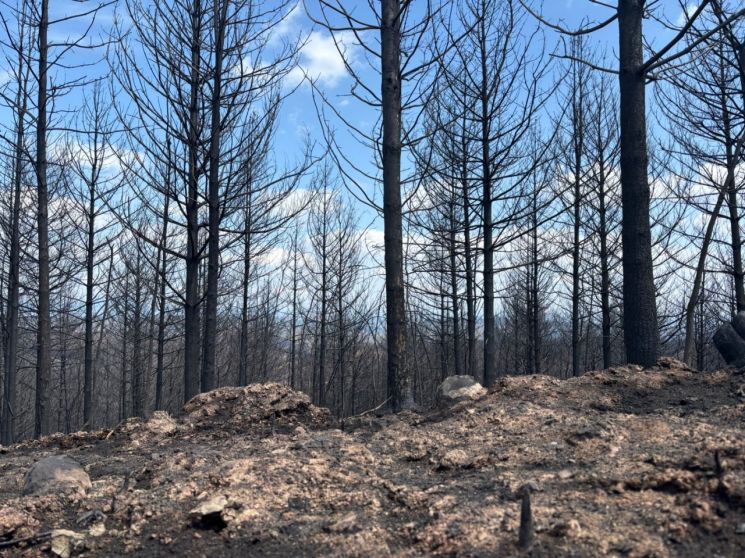 Charred trees stand pitifully like lumps of charcoal due to the wildfire in Uiseong, Gyeongbuk. Photo by Jeong Ilwoong
In response, the Korea Forest Service plans to work closely with related ministries to establish dual and triple monitoring systems for future ultra-fast, large-scale wildfires. These systems will utilize fixed-wing aircraft, medium- and high-altitude drones, and satellite imagery to enable fire line observation even under strong winds and heavy smoke.
Additionally, the agency will prioritize emergency restoration in areas at risk of secondary damage such as landslides or soil runoff, and will focus on promptly removing wildfire-damaged trees around residential zones and major facilities.
Eunsik Park, Director of the Forest Industry Policy Bureau at the Korea Forest Service, stated, "Given the scale of the wildfire damage, emergency restoration of the affected areas is urgently needed. The Korea Forest Service will do its utmost to ensure the swift recovery of forest owners, forestry workers, and local residents, and help them return to their daily lives as soon as possible."
Meanwhile, the wildfire damage investigation was carried out in two stages: local governments conducted the first investigation from March 28 to April 8, and the Central Disaster Damage Joint Investigation Team, based on the results of the first investigation, conducted a second on-site verification with the local governments from April 9 to 15.
The final damage area will be confirmed by the Central Disaster and Safety Countermeasures Headquarters and is scheduled to be announced at the end of this month.
© The Asia Business Daily(www.asiae.co.kr). All rights reserved.
![Clutching a Stolen Dior Bag, Saying "I Hate Being Poor but Real"... The Grotesque Con of a "Human Knockoff" [Slate]](https://cwcontent.asiae.co.kr/asiaresize/183/2026021902243444107_1771435474.jpg)
















