100 Detailed Tasks to Create a Special Economic Free Autonomous Province
Gyeongsangnam-do has requested that the core strategic tasks to transform Gyeongnam into a Special Economic Free Autonomous Province be included as pledges in the 21st presidential election, appealing to candidates and each political party.
On the 17th, the provincial government announced 24 core strategic tasks across five major fields and 100 detailed tasks to be proposed as presidential election pledges at the press center of the provincial office.
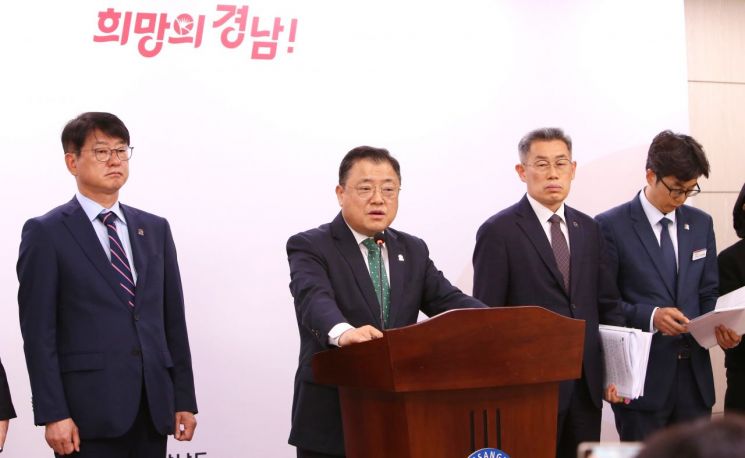 Park Myungkyun, Deputy Governor of Gyeongnam Province, is announcing the key strategic tasks to propose as pledges to the candidates and parties of the 21st presidential election. Photo by Lee Seryung
In the industry and economy sector, Gyeongnam plans to expand the entire region into an economic free zone by enacting the Gyeongnam Economic Free Zone Special Act.
The province will also separate the Hadong office of the Gwangyang Bay Area Free Economic Zone Authority and establish an independent Gyeongnam Free Economic Zone Authority, aiming to make Gyeongnam a Special Economic Free Autonomous Province of Korea.
Additionally, Gyeongnam will push for the enactment of a special law for the construction of an aerospace complex city, create a specialized future air mobility cluster, establish a space exploration technology test and development center and an aerospace parts and materials promotion institute, and set up an aerospace science gifted school affiliated with a science and technology institute. By concentrating related infrastructure, the province aims to accelerate the development of the aerospace industry.
Plans also include attracting a national artificial intelligence (AI) computing center, establishing a quantum computer research and development center, and creating the Gyeongnam Digital Innovation Valley, with the goal of transforming from a manufacturing hub of Korea to the mecca of manufacturing AI.
Furthermore, the province will advance its key industries such as defense, nuclear power, and shipbuilding by establishing the Changwon Defense-Nuclear Fusion National Industrial Complex, creating a small modular reactor manufacturing innovation hub, founding a defense parts research institute, and developing a naval MRO cluster.
Efforts will also be made to create a biomedical industry innovation belt, establish Donguibogam Korean Medicine University, and attract science and technology institutions to Gyeongnam.
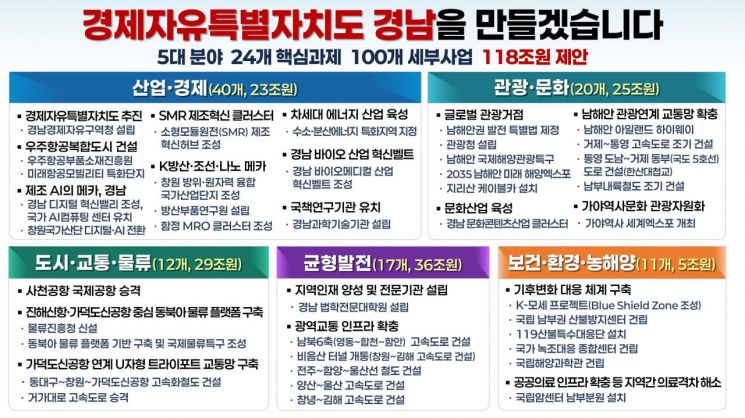 Key strategic tasks proposed as pledges to the 21st presidential election candidates and each political party by Gyeongsangnam-do. Provided by Gyeongnam Province
In the tourism and culture sector, Gyeongnam plans to enact a special law for the development of the southern coastal region, aiming to designate the area as an international marine tourism special zone.
The province also plans to develop a multi-purpose tourism complex with premium hotels, resorts, integrated convention centers, shopping centers, business facilities, and a foreigner-only casino in the planned hinterland city of the new airport in Gadeokdo.
To improve access to major tourist destinations, detailed projects include building the Southern Coast Island Highway, early construction of the Geoje-Tongyeong Expressway and the Southern Inland Railway, construction of the Geoje-Masan (National Route 5), installing a Jirisan cable car, and establishing the Gyeongnam Cultural Content Industry Cluster.
In the urban, transportation, and logistics sector, Gyeongnam will focus on upgrading Sacheon Airport to an international airport, establishing an International Logistics Promotion Agency, creating a Northeast Asia logistics platform, and enacting a special law for international logistics promotion areas.
Additionally, policies for balanced development include establishing a law school, a national social welfare worker training center, and expanding a metropolitan transportation network to connect all of Gyeongnam within one hour.
Health, environment, agriculture, and marine policies include the K-Mose Project, a leading initiative to create cities safe from coastal disasters such as typhoons and tidal waves, installing flap gates at Masan Port, establishing the National Southern Region Wildfire Prevention Center and the 119 Wildfire Special Response Unit, and founding a National Green Algae Response Integrated Center.
Plans are also in place to attract a southern branch of the National Cancer Center and establish a medical school in the province to reduce regional medical disparities and improve access to cancer treatment for patients in the southeastern region.
Park Myungkyun, Vice Governor for Administrative Affairs, emphasized, "The future of Korea is threatened by the dominance of the Seoul metropolitan area," adding, "Local governments must have autonomy and find new growth engines."
He continued, "The proposed core projects are essential for Gyeongnam to grow as a new growth engine for Korea," and expressed hope that the major political parties would show great interest and support for Gyeongnam's proposals.
He added, "Although it may not be easy for all proposals to be accepted, we will spare no effort to ensure that as many of Gyeongnam's pending projects as possible are reflected in the major parties' pledges and the next government's national agenda through active consultations."
© The Asia Business Daily(www.asiae.co.kr). All rights reserved.
![Clutching a Stolen Dior Bag, Saying "I Hate Being Poor but Real"... The Grotesque Con of a "Human Knockoff" [Slate]](https://cwcontent.asiae.co.kr/asiaresize/183/2026021902243444107_1771435474.jpg)
















