"Transgender Individuals Are Protected from Discrimination on the Grounds of Gender Reassignment," Court Emphasizes
The UK Supreme Court has ruled that only biological women fall within the category of women protected under the Equality Act. As a result of this ruling, transgender women, even if they hold a certificate recognizing them as women in the UK, will no longer be considered women in legal equality matters. The transgender community has expressed concerns over this decision.
On the 17th, Yonhap News reported that the UK Supreme Court ruled that transgender individuals holding a Gender Recognition Certificate (GRC), which legally recognizes a person's gender, are not considered women under the Equality Act unless they were born female. This ruling came from a lawsuit filed by the group 'For Women Scotland' (FWS) against the Scottish government.
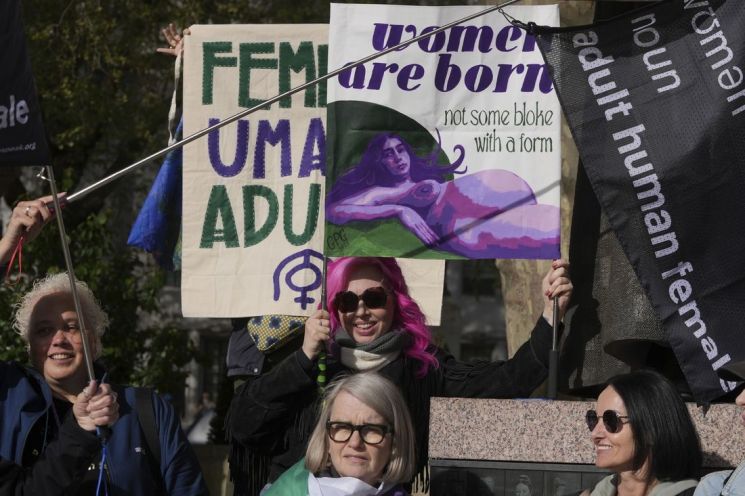 Female rights activists are cheering while holding signs that read "Women are born" near the Supreme Court in London, UK, on the 16th (local time). Photo by AP Yonhap News
However, in the 88-page judgment, the court emphasized that this ruling "does not remove protections for transgender people." Transgender men and women "are protected from discrimination on the grounds of gender reassignment." Judge Hodge stated, "This ruling should not be interpreted as a victory gained by one group in society at the expense of another."
The Equality Act was enacted in 2010 to supplement and consolidate existing laws to ensure individuals are protected from discrimination and can enjoy equal opportunities. Since this law applies broadly across public and private sectors, including employment, education, healthcare, and housing, the impact of this Supreme Court decision is expected to be significant.
One of the most affected areas is likely to be single-sex facilities such as male-only or female-only restrooms, changing rooms, and shelters. This ruling provides a legal basis to regulate the access of transgender individuals. At the same time, services that are exclusively for women or separated by gender may also be broadly affected.
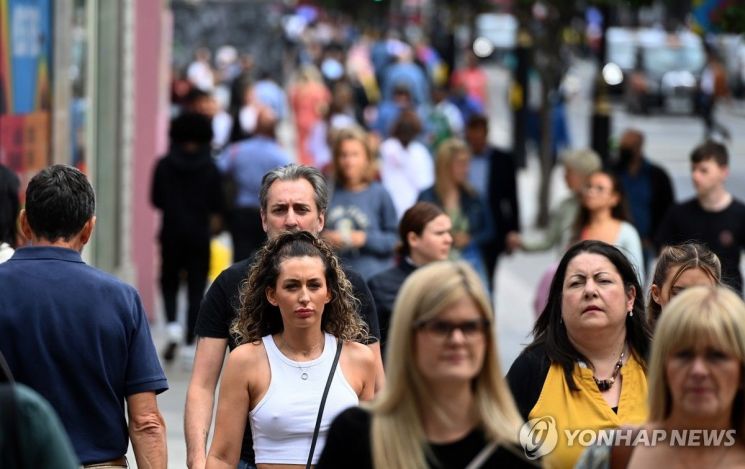 According to the interpretation of the Equality Act by the UK Supreme Court, the UK is on the verge of a perceptual shift in everyday life. EPA Yonhap News
Previously, in 2018, the Scottish local council passed a law requiring that women must make up 50% of the boards of public bodies in Scotland, and this law included transgender women as women.
Regarding this, the group 'For Women Scotland' (FWS) argued that redefining women exceeds the authority of the parliament and challenged the constitutionality of this law. FWS also criticized that if gender is not defined in the usual way, then 50% of men and 50% of men who have transitioned (confirmed) with certificates would legally fulfill the female representation quota.
Joe Mosley, an employment expert at the UK law firm Irwin Mitchell, analyzed that this decision will provide legal certainty for employers to make lawful decisions. It also establishes a standard for employers on how to decide regarding men who have received female certification under the GRC when hiring workers.
Attention is also focused on whether this decision will bring changes to sports competitions in which transgender athletes participate. Activist Soon Wong stated, "This decision applies to female athletes at all levels, including professional sports," and added, "There will no longer be women penalized for raising concerns about men competing in women's categories."
At the same time, it appears that there will be no further controversy regarding the gender criteria used by the government when collecting data. Professor Alice Sullivan, who recently studied government gender data collection, explained, "This ruling provides absolute certainty to institutions that collect information."
Meanwhile, among those who helped and supported the women's group that won the Supreme Court case is J.K. Rowling, the author of 'Harry Potter.' Rowling, who is known to have donated tens of thousands of pounds to the group's lawsuit, has argued that the rights of people born biologically female should not be sacrificed for the rights of those who have transitioned to women.
Amnesty International, which has criticized this group, has stated that excluding transgender people from protections against sex discrimination contradicts human rights law. Amnesty emphasized in its legal brief that it is concerned about the deterioration of transgender rights in the UK and abroad.
© The Asia Business Daily(www.asiae.co.kr). All rights reserved.


















