196 in Favor, 98 Against, 1 Abstention, 4 Invalid Votes
Democratic Party Plans to Reintroduce Bill Including Cumulative Voting System
The amendment to the Commercial Act, which aimed to expand the duty of loyalty of directors from the 'company' to the 'shareholders,' was finally rejected in the National Assembly re-vote on the 17th. The Democratic Party of Korea, which led the bill's submission, refined the amendment by deleting some provisions to secure votes from the People Power Party, but it was ultimately rejected and discarded.
On the same day, the National Assembly held a plenary session in the afternoon and, as a result of the re-vote on the partial amendment to the Commercial Act, out of 299 total votes, 196 were in favor, 98 against, 1 abstention, and 4 invalid votes, resulting in final rejection. Earlier, on the 1st, Han Duck-soo, Acting President and Prime Minister, exercised the right of reconsideration (veto) on the amendment to the Commercial Act passed by the National Assembly led by the Democratic Party. A bill subject to veto requires the attendance of more than half of the total members and approval by two-thirds (199 members) of those present to pass, but it failed to clear the National Assembly hurdle that day.
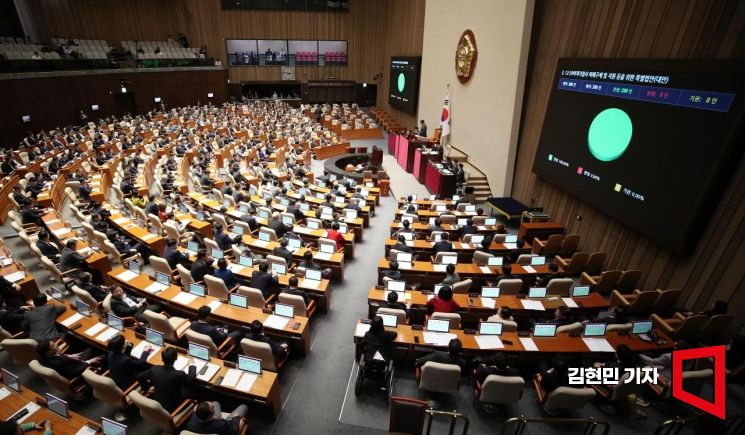 On the 17th, the special law for relief and support for the victims of the December 29 passenger plane disaster was passed at the plenary session held at the National Assembly. 2025.4.17 Photo by Kim Hyun-min
The discarded amendment to the Commercial Act centered on expanding the 'duty of loyalty of directors' from the existing company to 'company and shareholders.' It also allowed listed companies to hold electronic shareholders' meetings alongside general meetings.
The Democratic Party announced plans to reintroduce the bill, including the expansion of the duty of loyalty of directors, along with provisions such as 'separate election of audit committee members' and 'cumulative voting system,' since the related bill was rejected in the plenary session. The provision for separate election of audit committee members is a system where audit committee members are elected independently from major shareholders, instead of being selected from directors appointed by major shareholders. This strengthens the independence of audits from the control of major shareholders. The cumulative voting system grants voting rights equivalent to the number of directors to be appointed per share when appointing two or more directors. For example, if three directors are to be elected, a shareholder holding one share can exercise three votes and concentrate all votes on a specific candidate.
While the business community, which had opposed the amendment to the Commercial Act, breathed a sigh of relief at the bill's rejection, it is too early to be complacent. The Democratic Party may push for the bill's passage by reintroducing the amendment including all three provisions. The Democratic Party emphasized that the amendment is essential to improve corporate governance and protect the rights of minority shareholders. Jin Sung-jun, the Democratic Party Policy Committee Chair, stressed, "This will be the starting point to resolve the Korea Discount, a chronic problem in our securities market."
The business community is most concerned about the mandatory cumulative voting system among the amendments. They argue that contrary to the amendment's intent, hedge funds might abuse the system to infringe on shareholder rights for short-term profits.
Meanwhile, among the eight bills vetoed by the Yoon Suk-yeol administration on the same day, only the 'Partial Amendment to the Broadcasting Act Reconsideration' was passed in the re-vote. Besides the amendment to the Commercial Act, bills such as ▲the Special Investigation Act on Internal Rebellion ▲the Special Investigation Act on Myung Tae-gyun ▲the Special Act on the Statute of Limitations for Inhumane State Crimes ▲the Amendment to the Act on the Establishment and Operation of the Korea Communications Commission ▲the Amendment to the Elementary and Secondary Education Act ▲and the Amendment to the Local Education Finance Grant Act were rejected.
© The Asia Business Daily(www.asiae.co.kr). All rights reserved.
![Clutching a Stolen Dior Bag, Saying "I Hate Being Poor but Real"... The Grotesque Con of a "Human Knockoff" [Slate]](https://cwcontent.asiae.co.kr/asiaresize/183/2026021902243444107_1771435474.jpg)















