Focusing on High Value-Added OLEDs Drives Sales Rebound
Market Share Slightly Decreases to 33.1%
OLED Demand and Expansion into New Markets Expected This Year
U.S. Tariff Measures Remain a Key Variable
Despite China's low-cost supply offensive, our display industry has held its ground by focusing on high value-added products such as organic light-emitting diodes (OLEDs).
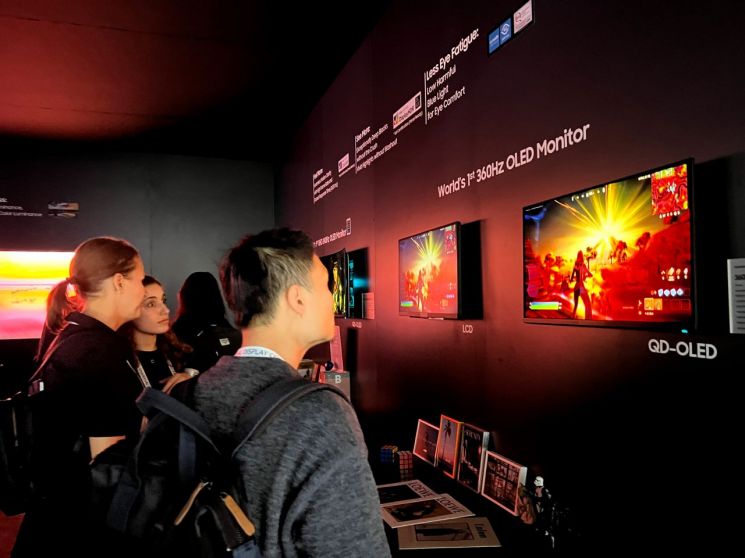
According to the 'Key Statistics of the Display Industry' released by the Korea Display Industry Association on the 17th, the sales revenue of Korean panel companies last year was recorded at $44.2 billion, an increase of 13.3% compared to the previous year.
Among these, OLED sales increased by 15.1% to $36.3 billion, and liquid crystal display (LCD) sales rose by 5.9% to $7.9 billion. OLED was applied for the first time in Apple’s iPad, and with the expansion of artificial intelligence (AI), demand for low-temperature polycrystalline oxide (LTPO) OLEDs, which can improve power efficiency, increased, leading to a rebound in sales for our companies.
In South Korea, the proportion of OLED sales increased from 69% in 2021 to 82.1% in 2024, accelerating the transition to OLED. However, last year, our companies’ market share in the global display market fell slightly by 0.1 percentage points to 33.1% compared to the previous year.
During the same period, China’s market share increased by 2.7 percentage points from 48.1% to 50.8%. Meanwhile, Taiwan’s share declined from 16.7% to 14.6%, and Japan’s from 1.7% to 1.1%.
The association analyzed, "Chinese companies are producing excess supply based on government subsidies, and the oversupply problem, which was previously limited to steel, is spreading to advanced fields such as smartphones and electric vehicles. However, Korea has relatively well defended its position by focusing on the high value-added OLED sector."
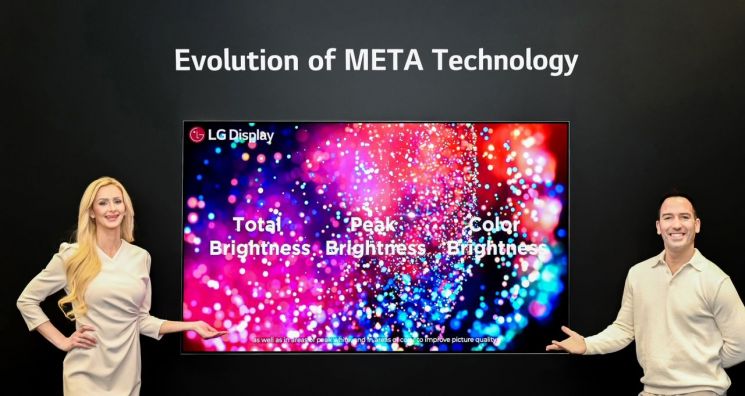 An LG Display model is showcasing a new OLED TV panel product featuring 'Meta Technology 2.0'. Photo by LG Display
Last year, the global OLED market size recorded $54 billion, a 26.2% increase from the previous year ($42.8 billion). For our companies, OLED sales increased due to the spread of global medium-to-large OLEDs and the rise in demand for low-power OLEDs driven by AI commercialization, but market share (67.2%) decreased by 6.4 percentage points compared to the previous year due to the expansion of Chinese smartphone manufacturers’ global presence and prioritization of domestic components.
Specifically, South Korea’s smartphone OLED panel market share (62.8%) decreased by 9 percentage points from the previous year due to a reduction in Chinese volume share, and the automotive OLED panel market share (76.1%) also dropped by 5.5 percentage points due to the impact of Chinese government subsidy policies. However, OLED TVs are exclusively produced by Korean companies with 8th-generation OLED fabs, maintaining a 100% market share, and the supply share of OLED tablets increased by 15.6 percentage points from the previous year to 69.3%.
Regarding LCDs, the global market size last year increased by 6.3% to $79.2 billion, but due to worsening business conditions caused by oversupply, Korean panel companies have reduced production, resulting in a market share of only 10.0%, down 0.1 percentage points.
This year, the display market is expected to reach approximately $139.3 billion, a 4.6% increase from last year, driven by OLED adoption in IT products and expansion of automotive displays. OLED is projected to grow by 6.5% to $57.5 billion, and LCD by 3.3% to $81.8 billion.
In particular, the OLED market is expected to continue favorable conditions with the application of LTPO panels in the iPhone 17 series, increased shipments of laptops and monitors using OLED, and expanding demand in new markets such as automobiles, sustaining the leadership of domestic companies.
However, the tariff policies initiated by Trump remain a variable. Especially in China, where assembly companies produce American set (finished) products such as Apple, Dell, and HP, if the tariff policies toward China are prolonged, the high inflation in the U.S. could reduce demand for electronic products and panels, potentially negatively impacting display performance.
This year, the Chinese government expanded the scope of subsidies under the "Iguhwanshin" (以舊換新, support for replacing old products with new ones) program to include tablet PCs, smartphones, and smartwatches, and with a clear preference for domestic products due to the U.S.-China trade dispute, China’s offensive is expected to intensify further.
Lee Dong-wook, vice chairman of the association, said, "The recent increase in uncertainty in the U.S.-China trade environment is concerning," adding, "Through the trade response task force, we will continuously discuss the rapidly changing trade environment and key issues with the industry and share them with the government to maintain a strategic preparation system."
He continued, "To break free from the stagnation of global market share that the industry is worried about, it is time to explore cooperation with American companies such as DuPont," and added, "In addition to domestic demand stimulation projects like the OLED high-efficiency home appliance replacement support program, it is urgent to establish a special display law that can support domestic companies through measures such as extending the tax credit carryover period and direct refund systems."
© The Asia Business Daily(www.asiae.co.kr). All rights reserved.
![Clutching a Stolen Dior Bag, Saying "I Hate Being Poor but Real"... The Grotesque Con of a "Human Knockoff" [Slate]](https://cwcontent.asiae.co.kr/asiaresize/183/2026021902243444107_1771435474.jpg)
















