Korean Medical Association and Medical Education Council Urge Participation in Classes
Ministry of Health and Welfare Expresses Regret Over Change in Principle
The medical community responded to the government's plan to restore next year's medical school admission quota to the pre-increase level as a 'progress toward normalization.'
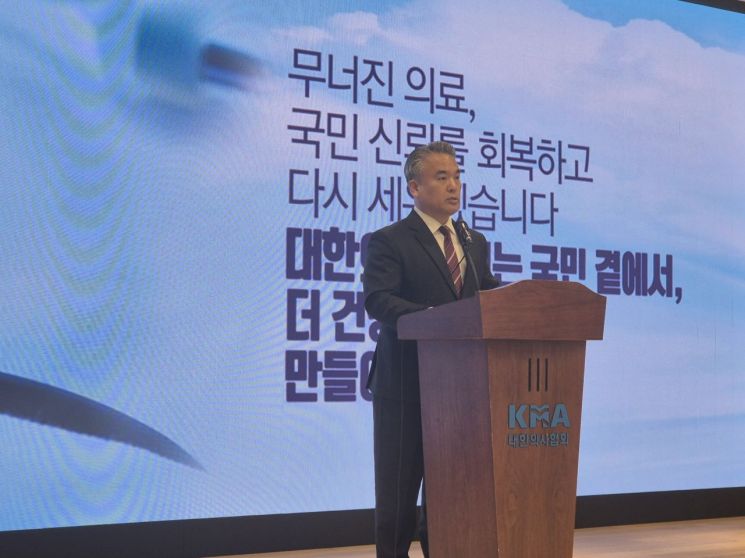
The Korean Medical Association (KMA) expressed this stance during a regular briefing held on the afternoon of the 17th at the KMA headquarters in Yongsan-gu, Seoul. Kim Seong-geun, the KMA spokesperson, said, "Although it is belated, it is evaluated as a step toward returning to normal," adding, "Unreasonable increase policies without basis and without considering educational conditions were wrong."
Spokesperson Kim continued, "We have been saying for over a year to correct the mistake and talk again. I don't understand why it was so difficult to get to this point," he added.
Medical students and resigned residents also showed a generally positive response. A first-year medical student, A, from the Chungcheong region said, "It seems that the minimum necessary condition for opening the negotiation table has been met." Resident B, who resigned from a training hospital in the Yeongnam region, also said, "For now, it appears to be a step forward."
Although the government has finalized and announced this position and the medical community has responded positively, there remains significant uncertainty as to whether this will lead to the full academic return of medical students.
A explained, "It is practically impossible to return for realistic reasons," and added, "First- and second-year students in the preclinical phase have an enormous academic load, and without measures such as implementing a flexible semester system, even if they return, they will not be able to keep up with the curriculum."
A further stated, "I don't know how many will participate in classes, but those who could return have already done so," and added, "It can be seen as somewhat insufficient to persuade students who are still refusing to attend classes."
On the same day, Lee Ju-ho, Deputy Prime Minister for Social Affairs and Minister of Education, announced at a briefing held at the Government Complex Seoul in Jongno-gu that the medical school admission quota for the 2026 academic year will be restored to 3,058, the pre-increase level. However, the principle of maintaining the medical school quota of 5,058, which was increased by 2,000 from the previous level, remains intact.
Organizations related to medical education attended the briefing and urged medical students to participate in classes. Lee Jong-tae, chairman of the Korean Association of Medical Colleges and Medical Schools (KAMC), said, "Most students from 40 medical schools nationwide have returned to school, but a significant number still hesitate or refuse to attend classes," adding, "Training doctors is a mission entrusted to medical schools by society and the nation, and all members of medical schools must fulfill the responsibilities entrusted by the community."
Lee emphasized, "Remaining medical reform issues are the responsibility of policy experts," and added, "Students have done their part sufficiently, and now it is time to participate in classes and seek ways to reflect their opinions."
Lee Jin-woo, president of the Korean Medical Association and chair of the Korean Medical Education Council, also said, "Confirming the admission quota of 3,058 is an important turning point to calm confusion in education and training sites and to seek the sustainability of the medical system again," adding, "Now is the time to return to each one's place."
Meanwhile, the Ministry of Health and Welfare, which had been leading the increase in medical school admissions, expressed a skeptical stance toward the Ministry of Education's decision. The Ministry of Health and Welfare stated in a press release immediately after the Ministry of Education's briefing, "Although we think this is a measure considering educational conditions while the medical school academic schedule has not been fully normalized, we regret the change in the principle of deciding the 2026 medical school admission quota announced in early March."
Meanwhile, the medical school quota and admission numbers from 2027 onward are expected to be discussed by the Medical Workforce Supply and Demand Estimation Committee, which includes experts.
© The Asia Business Daily(www.asiae.co.kr). All rights reserved.
![Clutching a Stolen Dior Bag, Saying "I Hate Being Poor but Real"... The Grotesque Con of a "Human Knockoff" [Slate]](https://cwcontent.asiae.co.kr/asiaresize/183/2026021902243444107_1771435474.jpg)















