"Tariff Hikes Higher Than Expected"
Cautious Stance on Future Rate Path
No Intention to Intervene Amid 'Powell Put' Expectations
Jerome Powell, Chairman of the U.S. Federal Reserve (Fed), warned that the Trump administration's tariffs are more excessive than expected and that the tariff policy could lead to a dilemma between controlling inflation and promoting economic growth. He showed a cautious stance regarding the future interest rate path.
According to CNBC and others on the 16th (local time), Powell stated in a speech at the Economic Club held in Chicago, Illinois, "The level of tariff increases announced so far is much higher than expected," adding, "The impact on the economy is also likely to be similarly significant, including rising inflation and slowing growth."
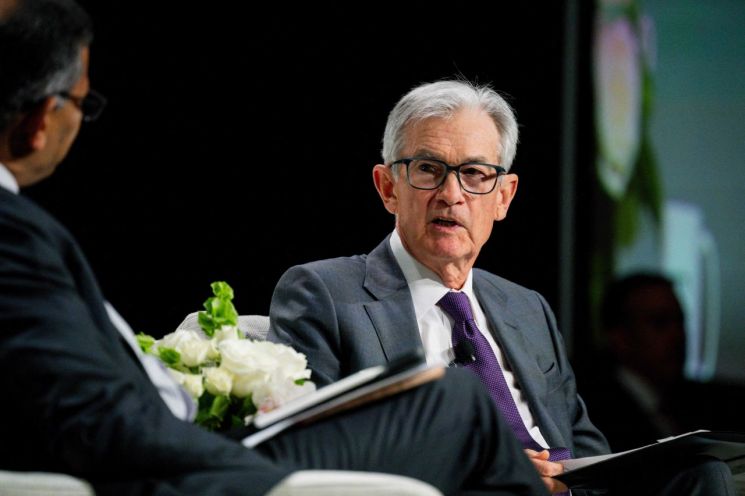
He continued, "We may face a difficult situation where our two main goals conflict," and said, "If that happens, we will consider how far the economy is from each goal and how different the expected timing is for closing the gap between each goal and reality."
The Fed must catch two rabbits at once: maintaining maximum employment while lowering the inflation rate to around 2%. When the economy slows down, prices fall and unemployment rises. At this time, lowering interest rates can achieve both goals simultaneously. However, Fed officials and economists believe that tariffs can raise both prices and unemployment at the same time.
In a Q&A session after the speech, Powell said about tariffs, "They are likely to push us further away from our goals," adding, "Probably for the rest of this year."
However, he reaffirmed the existing stance of monitoring the situation without considering rate cuts or other measures. He also did not comment on the direction of interest rates. He said, "For the time being, it would be better to wait for clearer results before making any adjustments to the policy stance." Powell forecasted that the impact of tariffs on prices is temporary but could last longer.
Beth Hammack, President of the Cleveland Federal Reserve Bank, expressed a similar view to Chairman Powell, stating that interest rates should be maintained at the current level until clear results on the impact of the Trump administration's tariff policy emerge.
On the other hand, Christopher Waller, Fed Governor, said on the 14th, "It is clear that inflation will rise significantly, but if inflation expectations remain well anchored, inflation will return to a more moderate level by 2026," adding, "If the slowdown is substantial and even threatens a recession, I expect the Federal Open Market Committee (FOMC) to prefer cutting rates faster and more aggressively than previously thought."
The Fed freezes or raises interest rates to curb demand when inflation is high. However, if growth slows, it lowers rates. Since a series of rate cuts at the end of last year, the Fed has maintained the benchmark rate at 4.25-4.5% since December. According to the Chicago Mercantile Exchange (CME) FedWatch on the day, Wall Street forecasts a 29.7% probability that the benchmark rate will remain unchanged until the end of June. The market expects 3 to 4 rate cuts by the end of this year. However, there is also a view that cautious mode may continue due to the impact of the Trump administration's tariff policy.
In the market, there is an expectation of the so-called 'Fed put' or 'Powell put,' where the Fed intervenes to stabilize the market if the stock market plunges sharply. However, Powell made remarks that dampened such expectations in response to related questions on the day. Powell said, "The market is functioning as originally intended and maintaining order," indicating no intention to intervene.
Julian Emanuel, Chief Strategist at Evercore ISI, evaluated, "Powell's remarks rejecting the Fed put and suggesting that inflation caused by tariffs may last longer than expected highlighted the deep uncertainty hanging over the market."
Following these remarks, which poured cold water on market expectations, the Nasdaq index closed down 3.07%, and the U.S. stock market extended its decline. U.S. Treasury yields also fell slightly.
© The Asia Business Daily(www.asiae.co.kr). All rights reserved.

















