Office for Government Policy Coordination Announces Inspection Results
Violations of the Farmland Act and Cases of High-Priced Hotel Purchases Detected
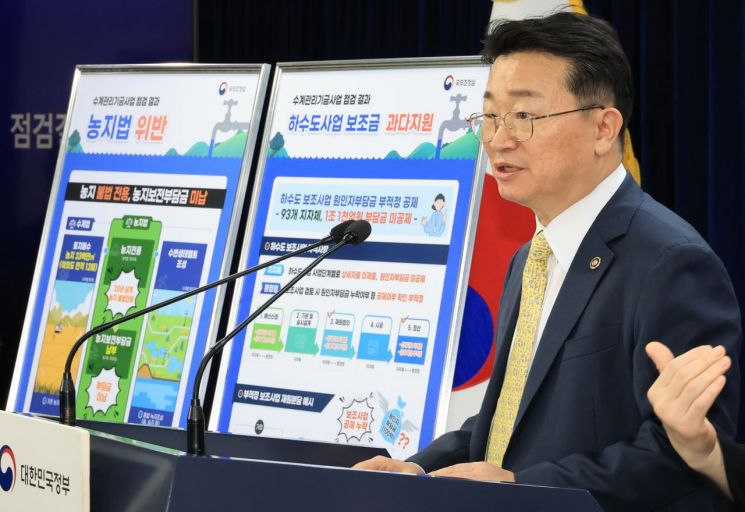 Kim Jong-moon, First Deputy Minister of the Office for Government Policy Coordination, jointly inspected the 'Water System Management Fund Project Implementation Status' with the Ministry of Environment and announced the results on the 17th at the Government Seoul Office in Jongno-gu, Seoul. Photo by Yonhap News
It has been revealed that the watershed management fund project, which invests over 1.2 trillion KRW annually for water quality management and resident support in the Four Major Rivers and other areas, is being operated inadequately. The Environmental Agency has illegally converted farmland and failed to pay approximately 92.2 billion KRW in farmland preservation charges while implementing the ecological belt creation project for over 20 years. It was also confirmed that a large amount of real estate, such as high-priced hotels, with minimal water quality improvement effects was purchased.
The Government Joint Anti-Corruption Promotion Team of the Office for Government Policy Coordination announced on the 17th that, in cooperation with the Ministry of Environment, it inspected the "Watershed Management Fund Project Implementation Status" from September last year to March this year and uncovered such illegal and improper cases.
The Watershed Management Fund Project is a project for water quality management and resident support in the Han River, Nakdong River, Geum River, and Yeongsan River·Seomjin River watersheds, funded by water usage charges (170 KRW per ton). Approximately 1.25 trillion KRW in funds are spent annually on installing and operating basic environmental facilities, land acquisition and management, and resident support projects. However, despite the large-scale budget execution, there has been no inspection or audit of the overall project, raising issues such as improper land acquisition and poor project management.
The Promotion Team and the Ministry of Environment inspected the Watershed Management Fund projects carried out by the Environmental Agency and local governments from 2021 to 2024 and detected 34 cases (1,000 detailed cases) of illegal and improper activities, including violations of the Farmland Act and abnormal operation of buffer retention facilities.
According to the Promotion Team, the Environmental Agency purchased farmland totaling 33 million square meters?equivalent to 12 times the area of Yeouido?and implemented the riverside ecological belt creation project without obtaining farmland conversion permits. Additionally, about 92.2 billion KRW in farmland preservation charges, which are imposed when obtaining farmland conversion permits, were not paid.
The Environmental Agency purchased land and buildings around rivers to remove pollution sources and reduce pollutant inflow in upstream water source areas, but it was found that they acquired land and buildings with minimal water quality improvement effects. The Promotion Team explained, "The Environmental Agency purchased 117 plots (worth 28.1 billion KRW) including unsold lots, vacant land, and detached houses among sites developed with development permits from local governments. This reduces real estate development risks, potentially encouraging indiscriminate development activities and misuse as speculative tools."
Furthermore, the Environmental Agency operates 17 buffer retention facilities to store polluted water within the Nakdong River watershed, all of which have had at least one real-time water quality measuring device broken and left unattended for a long time. There were also cases of abnormal operation such as gate/valve failures (5 locations), central controller failure (1 location), and unauthorized burial of manholes (1 location).
In addition, although subsidies for sewerage projects are stipulated to be calculated after deducting charges from the total project cost, 93 local governments failed to properly deduct these charges and thus received excessive subsidies. From 2016 to 2023, the 99 local governments that received watershed funds collected a total of 1.8 trillion KRW in charges, but 1.1 trillion KRW of these charges were not deducted from the total project costs of sewerage projects, resulting in 93 local governments receiving excessive national and watershed fund support.
Kim Jong-moon, First Vice Minister of the Office for Government Policy Coordination and head of the Promotion Team, stated, "Considering that buffer retention facilities are disaster response facilities, we have requested the Ministry of Environment to take prompt action, and plan to complete repairs of all buffer retention facilities by May this year. We will strictly manage the Watershed Management Fund projects to ensure efficient water quality improvement in upstream water source areas and resident support projects."
© The Asia Business Daily(www.asiae.co.kr). All rights reserved.


















