Advice for Integrated Risk Management Using Data and AI
Emphasis on Reorganizing Internal Audit Organizations and Securing Independence for External Auditors
Advice has emerged that companies need integrated risk management utilizing data and artificial intelligence (AI) to implement effective internal controls. Additionally, to establish the designated auditor exemption system, it is essential to reorganize the company's internal audit organization and secure independence and expertise for external auditors.
On the 17th, Samil PwC Governance Center announced that it held a seminar on the theme "The Future of Companies Created by Governance Advancement: Transparency and Trust" the previous day at its headquarters in Yongsan-gu, Seoul.
In the first session, Yoon Yeo-hyun, a partner at Samil PwC, introduced the reasons why companies fail in internal control and the preparation measures for strengthening internal financial controls. Partner Yoon cited rapid changes in the business environment, such as regulations and work environments, as the biggest challenges in internal control. He emphasized, "Risk management must now be approached from an enterprise-wide and broad infrastructure perspective," adding, "It is necessary to respond effectively to risks through integrated risk governance based on data and AI infrastructure."
In the second session, partner Hong Woo-sik delivered a lecture on "Ways to Enhance the Effectiveness and Independence of Audit Committee Support Organizations." He argued, "The independence of the audit committee support organization is realized when the audit committee has the authority to approve appointments and dismissals of department heads and members, and the support organization secures a direct reporting line."
The third session featured expert presentations and discussions under the theme "Designated Auditor Exemption System: From Regulation to Opportunity." Jeong Jae-gyu, head of the ESG Information Analysis Center at the Korea ESG Standards Institute, gave an in-depth introduction to the evaluation criteria of the designated auditor exemption system, which consists of 17 items across five major areas. Since the Financial Services Commission announced the policy to periodically exempt designated auditors in April last year, detailed plans are currently under discussion. Under this system, companies selected for excellence in accounting and audit governance can receive a three-year exemption from periodic auditor designation.
In the subsequent discussion, chaired by Samil PwC partner Lim Seong-jae, participants included Professor Jeong Jun-hyuk of Seoul National University Law School, Tae Hyun-soo, head of the Accounting System Team at the Financial Services Commission, and Jang On-gyun, head of the Samil PwC Governance Center.
Meanwhile, at the seminar, Samil PwC unveiled for the first time its recently developed AI-based internal accounting management system (K-SOX) solution. The process of uploading the company's internal control items and conducting operational evaluations of those items was demonstrated. Jeong Su-jeong, director in charge of internal control at Samil PwC who participated in the solution development, explained, "Existing operational evaluations often suffered from evaluator bias and were perceived as low value-added activities, but through AI-based operational evaluations, consistent and high-quality assessments can be performed, allowing professionals to focus on more valuable tasks."
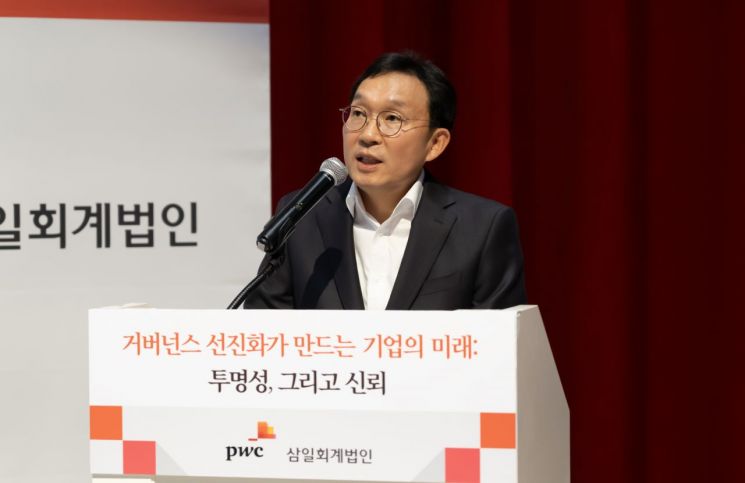 Hong Jun-ki, Head of the Audit Division at Samil PwC, is delivering a greeting at a seminar held on the 16th in Yongsan-gu, Seoul. Samil PwC
© The Asia Business Daily(www.asiae.co.kr). All rights reserved.
![Clutching a Stolen Dior Bag, Saying "I Hate Being Poor but Real"... The Grotesque Con of a "Human Knockoff" [Slate]](https://cwcontent.asiae.co.kr/asiaresize/183/2026021902243444107_1771435474.jpg)
















