100% Survival Rate Achieved in SFTS Animal Model
Antibody Treatment Using mRNA Technology Shows Promising Results
Catholic University announced on the 19th that a research team led by Professor Nam Jae-hwan of the Department of Biomedical Sciences has developed an antibody treatment based on messenger ribonucleic acid (mRNA), similar to the COVID-19 vaccine, targeting the Severe Fever with Thrombocytopenia Syndrome (SFTS) virus, also known as the "murder tick virus."
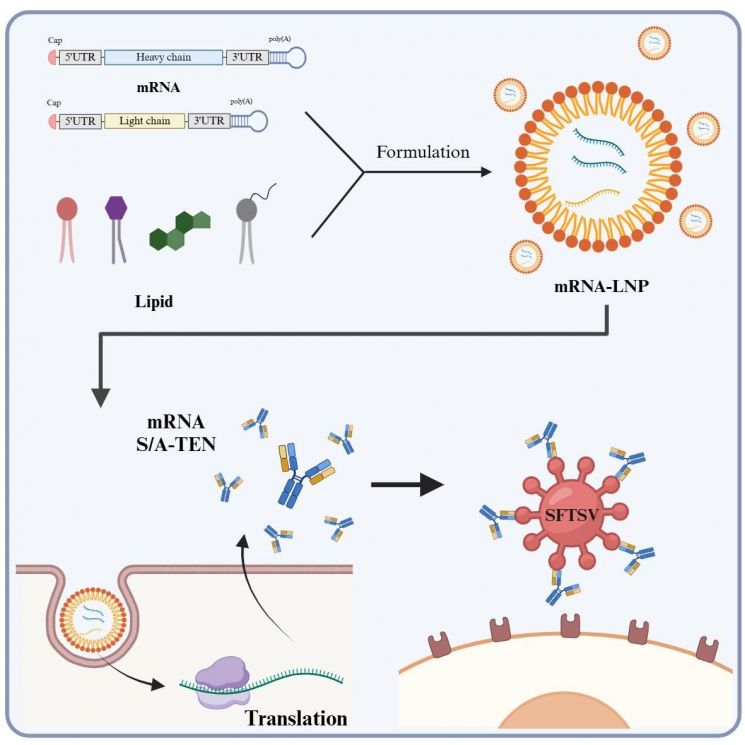 Figure description: The process of treating by directly producing antibodies inside the body to eliminate the Severe Fever with Thrombocytopenia Syndrome (SFTS) virus. Two genes that make up the antibody (heavy chain and light chain) are designed in mRNA form and injected encapsulated in lipid nanoparticles (LNP). The mRNA entering the body is translated into antibody proteins, which bind to and remove the virus.
 SFTS is an acute infectious disease, with 200 to 300 cases occurring annually in South Korea alone. The mortality rate reaches 20%, but there are currently no approved treatments or vaccines.
The treatment developed by the research team demonstrated the potential of an antibody-based therapeutic strategy using mRNA technology and showed a 100% survival rate in animal models infected with SFTS.
The team synthesized a human monoclonal antibody in mRNA form that recognizes the surface protein (Gn) of the SFTS virus and designed it to produce antibodies in vivo by delivering it via lipid nanoparticles (LNP). When the mRNA·LNP-based antibody treatment was administered to mice infected with a lethal dose of the virus, all subjects survived, proving the treatment's efficacy.
The mRNA·LNP-based antibody treatment is currently undergoing preclinical trials for entry into Phase 1 clinical trials through 'SML Biopharm.' The research team confirmed through this study that mRNA technology is a platform capable of rapidly and cost-effectively expressing antibodies. They also explained that there is high potential for expansion to various diseases such as cancer and chronic infectious diseases.
Professor Nam said, "This study is the first case to prove that mRNA-based antibody treatment can be an effective countermeasure against SFTS," adding, "We will strive to provide practical help in treating SFTS patients through clinical trials in the future."
The research results were published in the internationally renowned journal in the field of drug delivery, the Journal of Controlled Release. The research team from SML Biopharm, Professor Cho Nam-hyuk’s team from Seoul National University, and Professor Lee Sang-myung’s team from Chungbuk National University participated as co-researchers.
© The Asia Business Daily(www.asiae.co.kr). All rights reserved.
![Clutching a Stolen Dior Bag, Saying "I Hate Being Poor but Real"... The Grotesque Con of a "Human Knockoff" [Slate]](https://cwcontent.asiae.co.kr/asiaresize/183/2026021902243444107_1771435474.jpg)
















