Trump Signs Executive Order on Drug Price Reduction
Expectations Rise for Expansion of the Biosimilar Market
U.S. President Donald Trump signed an executive order favoring biosimilars (biologic drug replicas) to reduce the burden of high-priced medicines, raising concrete expectations that Korean companies such as Celltrion and Samsung Bioepis will benefit.
According to the pharmaceutical and bio industry on the 17th, President Trump announced an executive order titled "Putting Americans First, Lowering Drug Prices Once Again" on the 15th (local time).
The order includes provisions for the U.S. Food and Drug Administration (FDA) to simplify guidelines and approvals for biosimilars and encourage doctors to prescribe cheaper competing products. It also contains measures to pressure pharmacy benefit managers (PBMs) by requiring them to disclose fees.
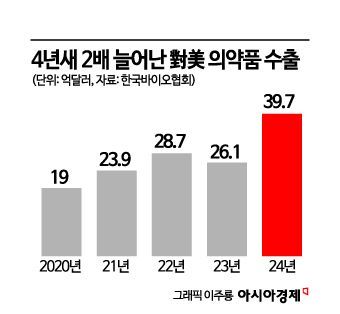
As the drug price reduction policy is being actively pursued, domestic biosimilar companies are also expected to benefit. Celltrion and Samsung Bioepis are representative examples. Celltrion currently holds approvals for nine products and has launched seven, while Samsung Bioepis has received approval for ten biosimilars and launched six products. An industry official said, "President Trump has continuously pursued policies to lower drug prices since his first term, and these policies are becoming more concrete in his second term. Biosimilars will be a key part of the drug price reduction policy in terms of expanding consumer choice." Some predict that competition may intensify as barriers to entry for generics are lowered. If the approval process is eased, more companies may enter the market, intensifying price and quality competition.
Meanwhile, the Trump administration is also considering imposing tariffs on pharmaceuticals separately from semiconductors. The U.S. Department of Commerce announced on the 14th that it has launched an investigation to assess the impact of pharmaceutical and semiconductor imports on national security. This investigation is based on Section 232 of the Trade Expansion Act, which allows the president to impose tariffs or import restrictions on imports deemed a threat to national security. The investigation reportedly covers finished pharmaceuticals, generics, active pharmaceutical ingredients (APIs), vaccines, and antibiotics.
However, there is a widespread view that imposing high tariffs on pharmaceuticals by the U.S. would be difficult to realize as it could be a burden at the administration level. An industry official pointed out, "Most pharmaceuticals significantly affected by U.S. tariffs are high-priced drugs such as cancer treatments and autoimmune disease therapies. If the prices of these products rise due to tariffs, patients in the U.S. who must use these medicines will be impacted." He added, "Nonetheless, since the U.S. regards pharmaceuticals as strategic items, we must closely monitor the situation, keeping in mind the possibility of shocks to pharmaceutical imports and exports through tariffs, non-tariff barriers, or other means."
© The Asia Business Daily(www.asiae.co.kr). All rights reserved.
![Clutching a Stolen Dior Bag, Saying "I Hate Being Poor but Real"... The Grotesque Con of a "Human Knockoff" [Slate]](https://cwcontent.asiae.co.kr/asiaresize/183/2026021902243444107_1771435474.jpg)















