13,986,987 People Caught by Unmanned Enforcement in Five Years
167,000 Received Fines 15 Times or More as Habitual Offenders
Habitual Offenders Have an Accident Rate of 9.6%
One out of every ten people who violate traffic laws is a small number of habitual offenders.
According to the 'Status and Management Measures of Habitual Offenders Detected by Unmanned Enforcement' announced on the 17th by Samsung Fire & Marine Insurance Traffic Safety Culture Research Institute, the number of people caught by unmanned enforcement from 2019 to 2023 was 13,986,987. Considering that the number of licensed drivers in Korea as of 2023 is 34,436,680, about 40% of drivers were caught at least once in five years.
Among those caught, 167,000 were habitual offenders who received fines 15 times or more. This accounts for 1.1% of all traffic law violators. Although a small number, the number of enforcement cases against them was 4,181,275, accounting for 11.3% of all unmanned enforcement cases.
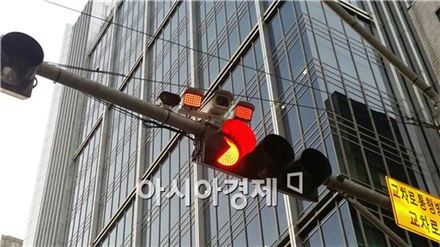 Unmanned surveillance camera (Photo by Asia Economy DB)
The more habitual the offender, the higher the probability of causing an accident. The number of accidents caused by the 167,000 offenders with 15 or more violations was 16,004, resulting in an accident occurrence rate of 9.6%. This is 3.5 times higher than the 2.7% accident rate of non-habitual drivers. It can be seen as a high-risk group that requires stronger regulations to prevent accidents.
According to a survey conducted by Samsung Fire & Marine Insurance Traffic Safety Culture Research Institute on 1,000 citizens, 76.6% of respondents defined people who habitually violate traffic laws as 'habitual offenders' and answered that they need to be managed differently from non-habitual offenders. 74.6% of respondents said that a progressive penalty system is necessary for habitual offenders.
In Korea, drivers can avoid penalty points by paying fines when caught by unmanned enforcement devices. Therefore, even if drivers are caught multiple times, they may not receive any license sanctions.
On the other hand, in countries such as Australia and Japan, even if caught by unmanned enforcement devices, drivers often receive the same penalties as police enforcement. Basically, the violating vehicle owner is fined and penalized with points, and the 'burden of proof on the driver' simultaneously applies. Economic and administrative sanctions are also intensified for habitual violations. In California, USA, fines increase by 2 to 2.5 times depending on the number of violations. Florida defines those with 15 or more violations in five years as 'habitual offenders' and imposes strict penalties such as revoking their driver's license for five years.
Choi Kwan, senior researcher at Samsung Fire & Marine Insurance Traffic Safety Culture Research Institute, said, "Although habitual offenders are a minority, their accident occurrence rate is higher than that of non-habitual offenders, and they increase the social costs caused by actual traffic accidents," adding, "The fundamental problem is that currently, when caught by unmanned enforcement, violators can arbitrarily choose between fines or penalties, and habitual and non-habitual offenders are punished at the same level."
© The Asia Business Daily(www.asiae.co.kr). All rights reserved.
![Clutching a Stolen Dior Bag, Saying "I Hate Being Poor but Real"... The Grotesque Con of a "Human Knockoff" [Slate]](https://cwcontent.asiae.co.kr/asiaresize/183/2026021902243444107_1771435474.jpg)















