'Mid-sized Enterprises Global Risk Response Strategy Seminar: Exchange Rate Edition' Held
Amid the Trump administration's tariff policies exacerbating confusion in the international trade order, it was suggested that to effectively respond to increased volatility in the Korean won exchange rate, tailored response strategies should be sought by closely analyzing the differing impact patterns across industries.
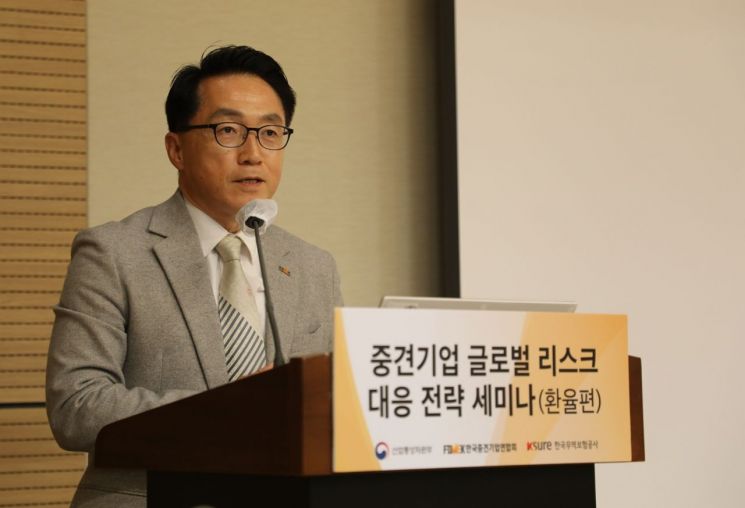 Lee Hojun, Executive Vice President of the Korea Federation of Medium-sized Enterprises, is delivering the opening address. Korea Federation of Medium-sized Enterprises
Jang Min, Senior Research Fellow at the Korea Institute of Finance, stated this on the 16th at the "Mid-sized Enterprises Global Risk Response Strategy Seminar: Exchange Rate Edition," jointly hosted by the Korea Federation of Mid-sized Enterprises, the Ministry of Trade, Industry and Energy, and the Korea Trade Insurance Corporation. He emphasized, "Especially for mid-sized enterprises in sectors such as apparel, accessories, plastics, and chemicals, which are significantly affected by China's low-priced supply offensive blocking exports to the U.S., urgent crisis response strategies like diversifying export destinations must be activated."
Senior Research Fellow Jang said, "South Korea, a major target country of the Trump administration's tariff policies, is likely to be exposed to greater uncertainty than other countries due to additional factors such as the high Korea-U.S. interest rate differential, sluggish domestic demand, and internal political uncertainty." He added, "Observing the trends of domestic and international environmental changes, rather than aggressive economic activities, it is necessary to strengthen the stability foundation by managing debt and enhancing financial soundness to reduce the risk of missed opportunities, while actively seeking ways to expand the entry of competitive products such as electronics, ICT, and batteries into the U.S. market."
At this seminar, following Senior Research Fellow Jang’s presentation, there were presentations on 'Exchange Rate Fluctuation Insurance and Trade Insurance Utilization Strategies' by the Korea Trade Insurance Corporation and 'Exchange Rate Risk Hedge Measures' by Hana Bank.
Lee Ho-jun, Executive Vice Chairman of the Korea Federation of Mid-sized Enterprises, said, "In the recent five-year survey of mid-sized enterprises, 'exchange losses due to exchange rate fluctuations' were identified as the biggest export difficulty for mid-sized enterprises, making exchange rates the factor that most significantly affects not only short-term corporate profits and losses but also mid- to long-term management strategy formulation." He added, "While minimizing the direct damage from the Trump administration’s tariff policies, we will closely communicate with the government and the National Assembly to establish an industry-specific tailored support system that can effectively respond to the positive and negative effects of the balloon effect caused by the U.S. excluding China."
© The Asia Business Daily(www.asiae.co.kr). All rights reserved.
![Clutching a Stolen Dior Bag, Saying "I Hate Being Poor but Real"... The Grotesque Con of a "Human Knockoff" [Slate]](https://cwcontent.asiae.co.kr/asiaresize/183/2026021902243444107_1771435474.jpg)















