"Surrealism and Korean Modern Art"
At the National Museum of Modern and Contemporary Art, Deoksugung, until July 6
Raising the Discourse: What Is Korean Surrealism?
The exhibition "Surrealism and Korean Modern Art," aimed at uncovering modern art artists who were neglected in 20th-century Korean art, will be held at the National Museum of Modern and Contemporary Art, Deoksugung, until July 6.
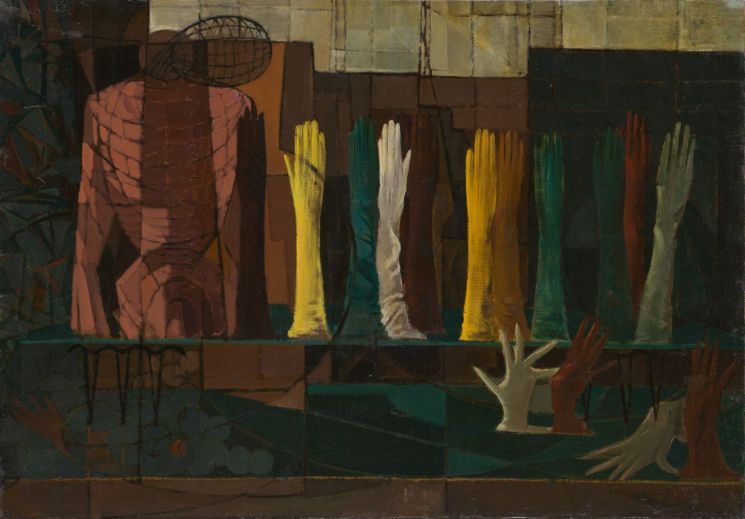 Kim Jong-ha's Colored Gloves (1957): For surrealists, gloves functioned like a part of the body while simultaneously existing as a dual entity separate from the body, emphasizing the delicate beauty of women while also being regarded as a symbol of oppression. National Museum of Modern and Contemporary Art
Surrealism is an artistic revolutionary movement that began in France, valuing liberation from all oppression that confines the human spirit. It spread worldwide in the 1920s and was attempted domestically in the late 1930s through Korean students studying in Japan such as Kim Whanki, Lee Jungseop, and Yoo Youngkuk, but it did not gain attention amid the turmoil of national division.
French surrealism is a transformative movement that warns against nationalism and imperialism and calls for breaking all artificial frameworks. It is characterized by a strong will to change reality. Andr? Breton, a poet and art critic representing surrealism, stated in the "Surrealist Manifesto," "To live and to have ceased to live, that is the solution of imagination. Life is elsewhere." Here, "elsewhere" refers to the unconscious, dreams, mysticism, etc., and for surrealists, art was a pathway to newly perceive reality.
Although surrealism spread worldwide, including Japan, it did not take root in Korea. Firstly, artists aiming for surrealism did not form groups nor attempt transformation. Each artist was absorbed only in their own artistic world, failing to significantly influence the real world. This is why Korea is often said to lack surrealism.
Nevertheless, there were artists in Korea who pursued surrealism. Six representative artists are Kim Wookyu (1911?1990), Kim Jongnam (Minabe Hideo, 1914?1986), Kim Jongha (1918?2011), Shin Youngheon (1923?1995), Kim Younghwan (1928?2011), and Park Kwangho (1932?2000). Instead of following the mainstream abstract painting, monochrome painting, and minjung art of the time, they pursued an avant-garde faithful to creative instincts. This is highly regarded for awakening the diversity of modern and contemporary Korean history.
This exhibition explores their artistic worlds and raises the discourse on "What is Korean surrealism?"
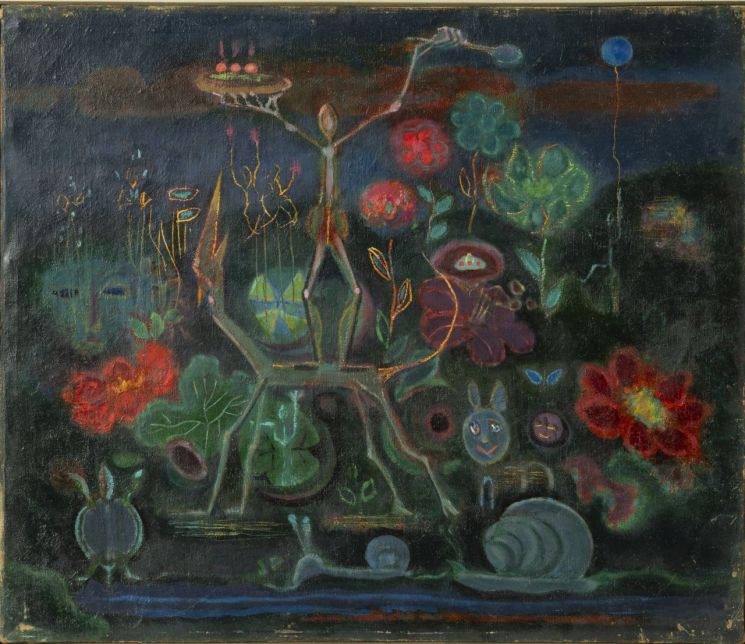 Kim Wook-kyu 'Untitled' (1970), An unidentified creature hidden in the grass evokes awe and fear. National Museum of Modern and Contemporary Art
Kim Wookyu went to Japan in 1930 and studied for four years at Kawabata Art School, experiencing Japanese surrealism. After liberation, he returned to his hometown Hamheung but fled south during the January 4th retreat, surviving by painting portraits for the U.S. military. Although he left about 400 works during his lifetime, most lack titles, production years, or signatures because he had no intention to sell them. He endured the trauma of diaspora by immersing himself in his work, isolated from the world. His works strongly convey a sense of anxiety through distorted images of bizarre creatures.
Kim Jongha, who studied in Japan and France, unusually revealed a unique eroticism for the time. He is praised for creating an erotic atmosphere through mannequins that reveal the silhouette of a female nude and gloves, which, while tools to cover the female body, paradoxically symbolize sexual union.
Park Kwangho, who graduated from Seoul National University’s Department of Painting and devoted himself to nurturing students in his hometown Daegu, stimulates dormant sexual desire in everyday consciousness using "symbolic function objects." Although the objects do not reproduce genitals or analogous organs, parts of the body are fetishized and sexual attributes are imaged to express repressed desires.
Kim Younghwan was fascinated by surrealism since his painting days at Hongik University. He believed it could overcome the tragic realities of war and division. He expressed anger toward reality through geometric abstraction. The perspective space symbolizes a dream that can break at any moment, and each entity inside voices its own but fails to unite, creating dissonance.
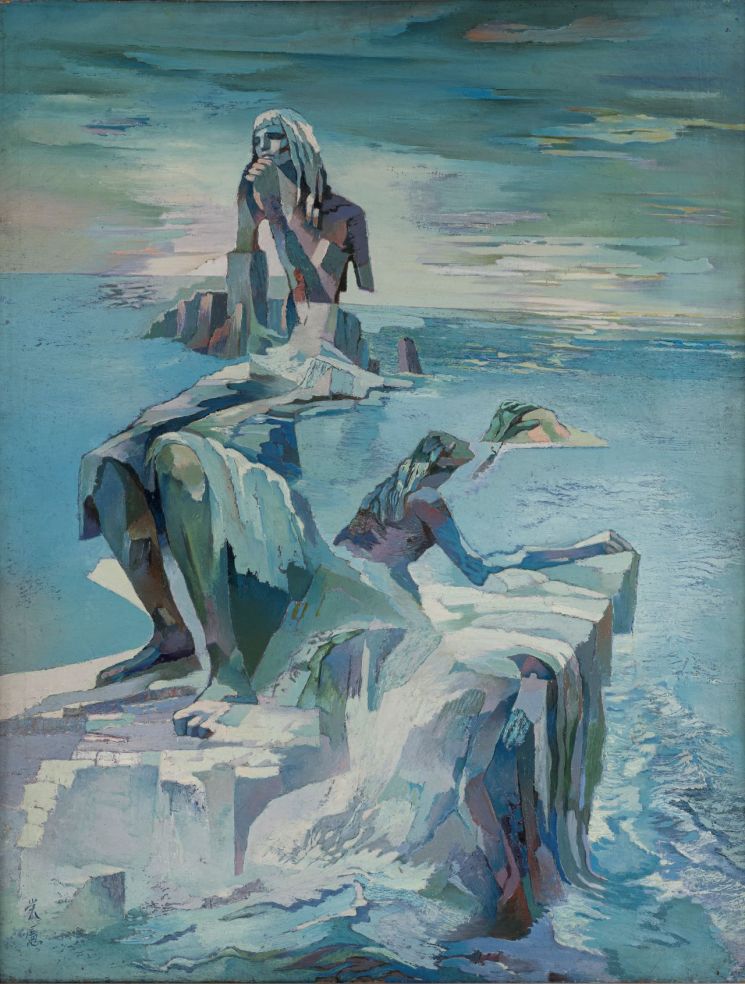 Shin Youngheon, "Chapter of Han (恨)" (1969), powerfully recalls the tragic reality of the divided Korean Peninsula. National Museum of Modern and Contemporary Art
Shin Youngheon, who began painting at Pyongyang Normal School in 1939, visualized the history of colonization, war, southward migration, and division in a unique form. Since the 1960s, he depicted the war- and division-ravaged homeland with bizarre images using the "double image" technique favored by Salvador Dal?.
Kim Jongnam, who entered a Japanese art school in 1934, consistently concealed his Korean identity. He lived thoroughly as a Japanese to the extent that he only confessed to his children shortly before his death that he was Korean. However, his life was not smooth amid discriminatory policies against Korean residents in Japan. Bombers flying overhead and destroyed airplanes appear as sad self-portraits.
Park Hyesung, the curator in charge of this exhibition, said, "Surrealism is different from fantasy. It is a desire to change while standing firmly on reality," adding, "I hope this opportunity will allow us to reconsider whether Korea truly lacked surrealism. I hope it becomes a chance to explore how to define and accept Korean surrealism."
© The Asia Business Daily(www.asiae.co.kr). All rights reserved.



















