Uigae Special Committee Holds Public Hearing on "Comprehensive Secondary Hospital Support Project"
Additional Fees to Be Paid for Emergency Surgeries Performed Within 24 Hours of Patient Visit
Strengthened Compensation for Regional Hospitals... Annual 2 Trillion Won Support with Differentiated Payments
The government will invest 2 trillion won over the next three years to develop regional general hospitals into comprehensive secondary hospitals. Based on the appropriateness evaluation results, a fixed amount will be added to the intensive care unit (ICU) admission fees, and additional fees will be paid for emergency surgeries performed within 24 hours of a patient's visit.
The Presidential Commission on Medical Reform (Uigae Special Committee) and the Ministry of Health and Welfare held a public hearing on the 16th at the President Hotel in Jung-gu, Seoul, where they disclosed detailed evaluation and support plans for the comprehensive secondary hospital development plan announced last month as part of medical reform.
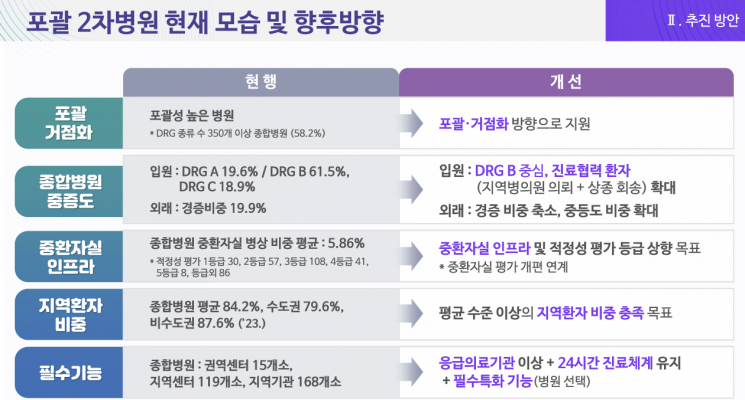
Previously, the government announced its intention to develop general hospitals that have comprehensive medical capabilities to meet most regional medical demands and perform essential functions as 'comprehensive secondary general hospitals.' The aim is to ensure that patients with mild to moderate conditions (between mild and severe) can receive adequate treatment at regional general hospitals and clinics without having to visit large metropolitan hospitals.
To this end, the government plans to allocate 2 trillion won over three years, approximately 700 billion won annually, to increase ICU fees, strengthen compensation for emergency medical procedures and emergency standby, and support performance incentives.
First, ICU fees will be linked to the appropriateness evaluation results of each institution and paid as a fixed amount per day of hospitalization. Grade 1 and 2 institutions will receive 150,000 won, grade 3 will receive 90,000 won, and grade 4 will receive 30,000 won, with differentiated payments.
Additionally, 170 billion won annually will be spent to increase fees for emergency surgeries performed within 24 hours after a patient visits a hospital emergency room. For regional emergency medical centers, fees will increase by 150% compared to the existing rates, while regional, specialized, and regional trauma centers will receive a 50% increase. To support 24-hour care at comprehensive secondary hospitals, a total of 200 billion won annually will be provided for medical staff on duty and standby costs.
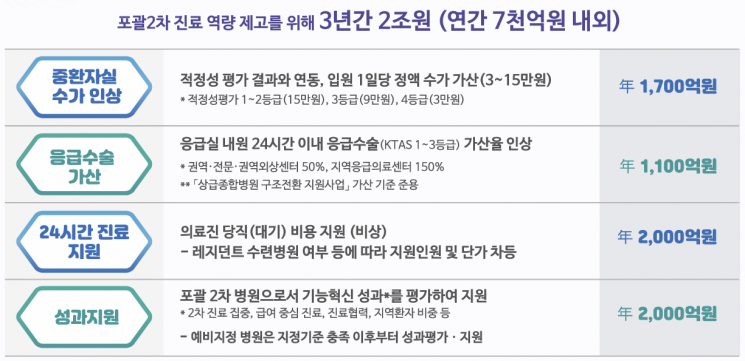
About 30% of the total support funds will be paid as rewards based on the results of hospital function innovation performance evaluations. The evaluation assesses whether hospitals treated general diagnosis-related groups (DRG-B), which are less severe than specialized diagnosis-related groups (DRG-A) mainly treated at tertiary hospitals, as well as patients referred from regional hospitals and clinics, patients returned from tertiary hospitals, and regional emergency patients.
Other evaluation indicators include essential contribution, which considers the number of departments providing 24-hour care, emergency patient acceptance rates, and the proportion of regional patients; collaborative treatment performance; and treatment effectiveness and efficiency, which comprehensively assess adjusted mortality rates (a figure comparing expected deaths adjusted for severity of acute inpatients with actual deaths), readmission rates, and medical expenses.
The government plans to include structural and process indicators and conduct relative evaluations during the initial implementation phase to establish conditions, then shift to absolute evaluations focused on results once hospital-specific situations are confirmed.
Accordingly, the project targets will be selected starting in May, full support will begin in July, and performance evaluations will be conducted from next year. Plans for 'regional fees' to be applied in areas with weak medical demand and supply will also be announced in the second half of the year.
Park Min-su, the second vice minister of the Ministry of Health and Welfare, said, "Now is the right time to strengthen the capabilities of secondary hospitals as tertiary hospitals shift their focus to severe cases and secondary hospital care is revitalized. Through the comprehensive secondary general hospital support project, we will foster secondary hospitals that local residents can trust and use, completing the restoration of the regional medical ecosystem."
© The Asia Business Daily(www.asiae.co.kr). All rights reserved.


















