About 40,000 Seniors Work in Market-Type Jobs
Distinctiveness and Competitiveness Remain Challenges Compared to Regular Shops
"Did you order the corn bread?"
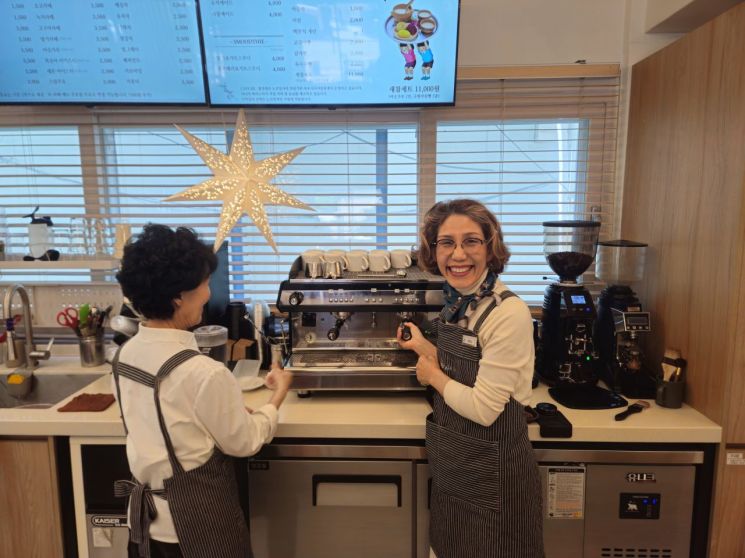
There is a cozy cafe that is a bit slow and clumsy but warm. Gu Jeong-im (75), who works as a barista at a 'senior cafe' in Hapjeong-dong, Mapo-gu, Seoul, double-checked with the reporter who ordered sweet potato bread to make sure they hadn't ordered corn bread by mistake. Even when making a cup of green tea latte, she carefully prepared the coffee while consulting with her colleague beside her. Having lived her whole life as a full-time housewife, Gu now goes to work here every day at over seventy years old. People aged 60 and above can work at senior cafes like Gu’s after receiving barista training and obtaining certification. In fact, six trainees were receiving education in a corner of the cafe to become senior baristas like Gu.
In an era where more than 10 million people are aged 65 or older, the forms of elderly employment are also diversifying.
According to the Korea Senior Club Association on the 17th, a total of 312 senior cafes were operating nationwide as of last year. Senior clubs across the country collaborate with local governments to create these market-type elderly jobs. The Korea Senior Club Association estimated that over 40,000 elderly people were engaged in market-type jobs as of last year.
Lee Young-hee (64), who works alongside Gu, has also been working as a senior barista for three years after obtaining a level 2 barista certification. Lee, who quit working in her mid-50s due to health reasons, applied after seeing a notice recruiting senior baristas at a local gym by chance. She smiled, saying that she is very happy to be able to make coffee every day and serve customers.

However, Gu and Lee expressed regret that their working hours are not sufficient. The working hours at this senior cafe are from 9 a.m. to 3 p.m., with five baristas working in rotation. They work about three hours a day, twice a week, earning only about 240,000 won per month. The senior cafe in nearby Mangwon-dong has longer working hours, but there are more baristas, so the situation is the same. Lee said, "On days that include holidays, the salary is even less," and added, "I hope they increase the working hours."
Some argue that for market-type elderly jobs to be sustainable for a long time, they need to have distinctiveness. Professor Jung Soon-dul of Ewha Womans University’s Department of Social Welfare said, "Existing elderly job projects have mainly focused on public interest jobs, but recently there is a trend to expand market-type jobs," and added, "While market-type jobs offer better pay than public interest jobs, it is difficult to secure competitiveness in terms of generating real economic effects."
© The Asia Business Daily(www.asiae.co.kr). All rights reserved.


















