'Wildfire Spread Prediction System' Considering Maximum Wind Speed
Immediate Evacuation and Response Based on Fire Front Reach Distance
The government has decided to improve the wildfire spread prediction system to reduce casualties from wildfires. The system will apply maximum instantaneous wind speed, and guidelines for evacuation time considering the distance the fire front reaches will also be established.
On the 16th, the Ministry of the Interior and Safety announced that it will reorganize the resident evacuation system in preparation for the recent ultra-fast wildfire that occurred in Gyeongbuk.
This wildfire spread very rapidly due to strong gusts of wind, so strong that it was called a disaster-level climate event, with the fire jumping 2 km. As a result, 31 people died during the evacuation process. The weather conditions at the time were optimal for wildfire spread. The nationwide average temperature was 14.2 degrees Celsius, the highest ever recorded, and precipitation was at an all-time low, causing extreme dryness. The maximum instantaneous wind speed in the Andong area reached 27.6 m/s.
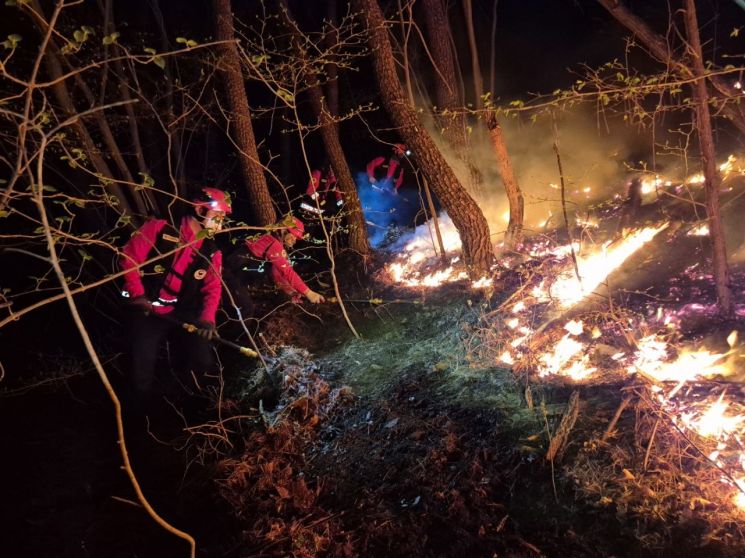
The problem was that due to worsening weather, it was difficult to obtain accurate fire front information, and the timing for evacuation matching the wildfire spread speed was not identified. Limitations of the existing resident evacuation system were revealed, including evacuation plans that did not consider the walking speed of the elderly (about 72% of that of the general population) and the need for evacuation beyond city and county boundaries, as well as delays in situation dissemination caused by power and communication outages.
Accordingly, the Ministry of the Interior and Safety, together with related agencies such as the Korea Meteorological Administration, Korea Forest Service, National Institute of Forest Science, and National Disaster Safety Research Institute, analyzed the characteristics of this wildfire and prepared improvement measures for the resident evacuation system. First, the wildfire spread prediction system (Korea Forest Service) will be improved to predict the wildfire spread range by considering not only average wind speed but also maximum instantaneous wind speed. The wildfire spread prediction map will be created applying the maximum instantaneous wind speed, and resident evacuation guidelines will be revised. For example, areas where the fire front is expected to reach within 5 hours, designated as "danger zones," will require immediate evacuation, while areas where the fire front is expected within 8 hours, designated as "potential danger zones," will prepare for evacuation.
Based on the danger zones, a "3-stage wildfire disaster resident evacuation" system will be operated: ▲Preparation stage requiring caution due to wildfire occurrence and movement in nearby cities and provinces ▲Standby stage requiring prior preparation as evacuation orders may be issued depending on wildfire spread ▲Immediate execution stage requiring rapid and immediate evacuation.
In cases where worsening weather prevents the use of fire front observation equipment such as helicopters and drones, the danger zones will be set as conservatively as possible by applying the case of this wildfire. The Korea Forest Service plans to actively guide and support local governments to prepare for wildfires using the wildfire spread prediction maps.
Each local government will establish resident evacuation plans in preparation for ultra-fast wildfires. If the maximum instantaneous wind speed in the area exceeds 20 m/s, evacuation plans will be established considering the overall local situation, allowing evacuation from the village level up to the eup, myeon, dong, and city, county, district levels. Lee Han-kyung, Director of the Disaster Safety Management Headquarters, said, "Ultra-fast wildfires like the recent Gyeongbuk wildfire require rapid evacuation as the top priority," and urged, "Citizens should familiarize themselves with the national action guidelines and evacuate quickly for safety even if it is somewhat inconvenient when evacuation orders are issued."
© The Asia Business Daily(www.asiae.co.kr). All rights reserved.

















