Progressive Parties Show Clear Discomfort
Direct Criticism Remains Difficult
In the upcoming June 3 presidential election, 'basic income' is emerging as a variable in the opposition coalition. This is because former Democratic Party leader Lee Jae-myung excluded his policy brand, basic income, from his presidential campaign pledges. Attention is focused on whether cooperation with progressive parties can continue following Lee's policy shift.
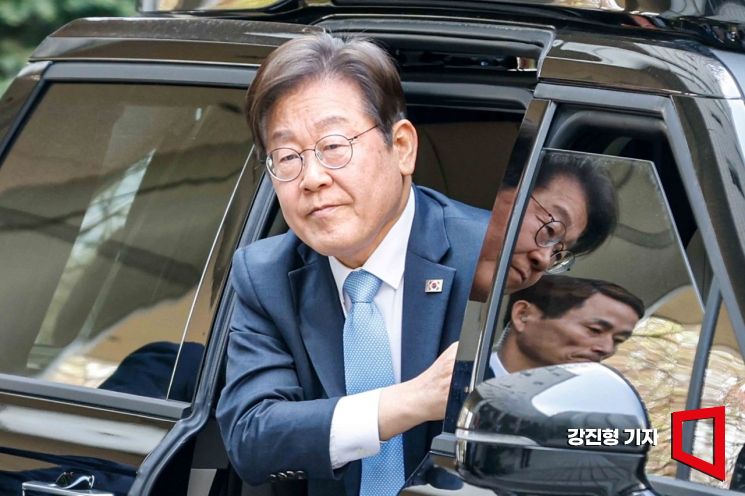 Former Democratic Party leader Lee Jae-myung, who is suspected of breach of trust in Daejang-dong and bribery related to Seongnam FC, is attending a trial held at the Seoul Central District Court in Seocho-gu, Seoul on the 15th. Photo by Kang Jin-hyung
Yong Hye-in, a member of the Basic Income Party, said in a phone interview with Asia Economy on the 16th, "We have basically formed an alliance with political forces that agree on basic income," adding, "Of course, we cannot support candidates who oppose basic income."
The Basic Income Party is discussing ways to realize basic income and whether to run a solo candidate. Shin Ji-hye, the party's supreme council member, said, "We will finalize the basic income plan and continuously propose agendas to resolve inequality," adding, "We plan to decide on our presidential election policy by the end of April."
Other progressive parties are also positive about basic income. The Progressive Party believes that while discussions on specific methods of basic income are necessary, the social safety net and welfare system must be further strengthened. The Social Democratic Party aims to develop a Korean-style basic income model and create a welfare state with basic income.
Progressive parties have shown discomfort with Lee’s rightward shift. However, since the Roundtable Meeting for Ending Internal Conflict and Protecting Democratic Governance, which includes the five opposition parties, is still ongoing, it is difficult to voice direct criticism. Currently, the roundtable is addressing agendas consistently advocated by minor parties, such as easing the requirements for negotiation groups and introducing a runoff voting system.
Previously, during the 20th presidential election, the Democratic Party pledged universal basic income for all citizens. The plan was to establish a presidential basic income committee to facilitate public discussion and then provide 250,000 KRW annually in local currency. The plan also included funding through land value dividends and carbon dividends, aiming to reach 1 million KRW annually within the term.
However, former leader Lee has begun erasing the basic income policy that was once his trademark. Unlike the previous election, he shifted his economic policy focus from fairness to growth to appeal to centrist and conservative voters. A key official from Lee’s campaign stated, "The economy is currently in crisis. It is time to recover the economy, and growth is the priority," adding, "It is difficult to plan the 250,000 KRW annual basic income policy to the level of implementation."
© The Asia Business Daily(www.asiae.co.kr). All rights reserved.

















