Expansion of Exports and Establishment of Factories in the U.S. and Europe
From "Taste Competitiveness" to "Infrastructure Competitiveness"
Major domestic food companies are accelerating the 'globalization of K-Food' by investing more than 2.6 trillion won to expand their production bases. This is a strategic move to overcome the growth limitations of the domestic market and actively respond to the surge in overseas demand. Considering the rapidly increasing overseas consumer demand, food companies have judged that 'production infrastructure' is the key to strengthening K-Food competitiveness.
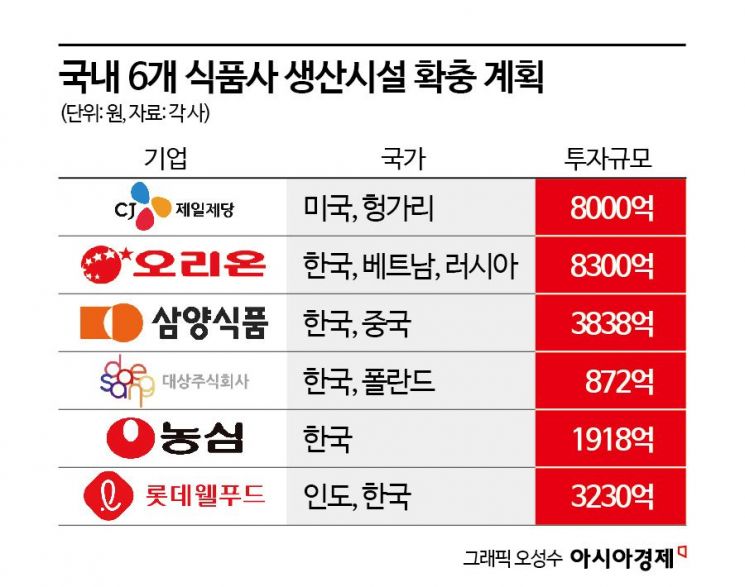
According to the industry on the 17th, six major food companies including CJ CheilJedang, Orion, Daesang, Samyang Foods, Nongshim, and Lotte Wellfood are investing a total of 2.6158 trillion won in new and expanded domestic and overseas production facilities.
Full-scale Expansion of Bases in North America, Europe, and Asia
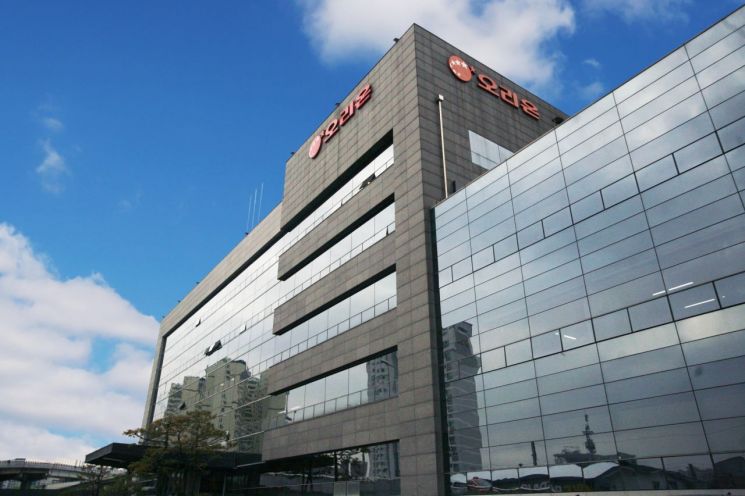
Orion is investing a total of 830 billion won to expand production capacity both domestically and internationally. Orion has 18 production facilities: 7 in Korea and 11 overseas (China, Vietnam, Russia, India). In Jincheon, Chungbuk, it is building a production, packaging, and logistics center by 2027 with an investment of 460 billion won. This plant will be developed on a site of 188,000㎡ (about 57,000 pyeong) with a total floor area of 149,000㎡.
Overseas, production capacity at factories in Russia (240 billion won) and Vietnam (130 billion won) will be more than doubled. Currently, the Tver plant in Russia is operating at over 120% capacity and cannot keep up with local demand for products like Choco Pie. With this investment, 16 new production lines for pies, biscuits, snacks, jelly, etc. will be established, increasing production capacity to an annual scale of 750 billion won, twice the current level. In Vietnam, where 130 billion won is invested, production lines for rice snacks, pies, and jelly will be expanded mainly at the Hanoi Yen Phong plant and the third plant, securing an annual production capacity of 900 billion won.
CJ CheilJedang is investing a total of 800 billion won to establish production bases in the United States and Europe. In South Dakota, USA, it plans to complete the largest Asian food production base in North America by 2027 with an investment of 700 billion won. This factory, built on a site equivalent to 80 soccer fields (575,000㎡), will produce consumer products focusing on dumplings and egg rolls.
In Europe, CJ CheilJedang is investing 100 billion won to build production facilities for dumplings and chicken products in Dunabars?ny, Hungary. This plant, equipped with automated lines on a 115,000㎡ site, will start producing 'Bibigo dumplings' from the second half of next year, with chicken lines to be added later. CJ CheilJedang plans to use the Hungarian plant to expand its business in Central and Eastern Europe and the Balkan Peninsula, aiming for large-scale European operations. Currently, CJ CheilJedang operates 34 food factories worldwide, and with two additional plants, the total will increase to 36.
Daesang plans to secure a new factory site in Asan, Chungnam, with an investment of 72.2 billion won, and is building a kimchi production facility with an annual capacity of 3,000 tons in Poland with an investment of 15 billion won. Daesang operates 12 overseas production bases in Japan, the Philippines, the United States, and other countries, and is accelerating exports to Europe.
Samyang Foods is investing a total of 383.8 billion won in its second factory in Miryang, Gyeongnam, and a local factory in China. The Miryang 2nd factory, scheduled for completion in June, will have six production lines capable of producing up to 690 million ramen noodles annually, increasing Samyang Foods' maximum annual production capacity from the existing 1.8 billion to about 2.5 billion. The Miryang 2nd factory will be used to handle export volumes to countries such as the United States and Europe, supporting the growth in exports. Samyang Foods is investing 200 billion won to build its first overseas base, a factory in China, by 2027.
Securing Infrastructure is the Key, Preparing Forward Bases for Exports
Nongshim is investing 191.8 billion won in Noksan, Busan, to build a new export-dedicated ramen factory. It plans to double ramen production capacity for exports to Southeast Asia and Europe from 500 million to 1 billion units. The new factory will be established on a 17,000㎡ (5,100 pyeong) site near the existing Noksan factory, which produces dried noodles. Completion is targeted for the first half of next year. Nongshim also has factories in the United States and China.
Lotte Wellfood currently operates 20 factories in 7 overseas countries. Lotte Wellfood is investing a total of 323 billion won to expand ice cream and confectionery production facilities both domestically and internationally. Earlier this year, it started operating an ice cream factory in Pune, India, with an investment of 70 billion won, and is expanding the Pepero production line at the Haryana factory with an investment of 33 billion won. It also plans to invest 220 billion won in its Cheonan factory in Korea to increase ice cream production capacity.
The aggressive moves by major food companies to secure global production bases and expand facilities are analyzed as a result of two factors: the growth limit of the domestic market and the increase in global demand. In particular, the recent K-Food boom has greatly expanded growth potential in major global markets such as the United States, Europe, and Southeast Asia.
The global food market is estimated to be worth 10 trillion dollars. Companies that build production infrastructure first are likely to secure advantageous positions. If the U.S. reshoring policy and Europe’s preference for domestic production policies become full-fledged, localization strategies of Korean food companies will also be important. An industry insider said, "The K-Food boom is expanding growth opportunities in global markets such as the U.S., Europe, and Southeast Asia," adding, "Companies that build production infrastructure first will gain advantageous positions to dominate the global market."
© The Asia Business Daily(www.asiae.co.kr). All rights reserved.
![Clutching a Stolen Dior Bag, Saying "I Hate Being Poor but Real"... The Grotesque Con of a "Human Knockoff" [Slate]](https://cwcontent.asiae.co.kr/asiaresize/183/2026021902243444107_1771435474.jpg)

















