BoA Rises 3.35% on Strong Q1 Earnings
Trump Hints at Auto Tariff Exemptions... Semiconductor Probe Launched
Tariff Uncertainty Continues
The three major indices of the U.S. New York stock market showed slight gains on the 15th (local time). Amid growing uncertainty over President Donald Trump's tariff policies, the market appears to be taking a breather after digesting first-quarter earnings this year.
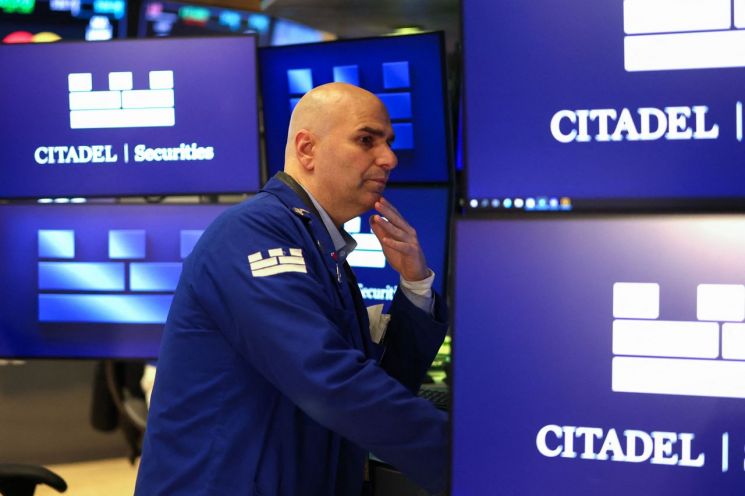
As of 10:21 a.m. in the New York stock market on the day, the Dow Jones Industrial Average (Dow) focused on blue-chip stocks was up 64.97 points (0.16%) from the previous trading day, standing at 40,589.76. The S&P 500, centered on large-cap stocks, rose 10.66 points (0.2%) to 5,416.63, and the Nasdaq, focused on tech stocks, increased by 13.6 points (0.08%) to 16,845.09.
By individual stocks, Bank of America (BoA) rose 3.35% after reporting first-quarter earnings that exceeded market expectations. Boeing, the U.S. aircraft manufacturer, was down 2.13%. The Chinese government, amid escalating tariff conflicts with the U.S., instructed its domestic airlines to halt deliveries of Boeing aircraft, leading to selling pressure. Ford and General Motors (GM), which had risen after President Trump hinted at tariff exemptions on auto parts the previous day, were down 1.8% and 1.68%, respectively.
The market closed higher the previous day, led by tech stocks, as major electronics such as smartphones and PCs were excluded from mutual tariff impositions. Earlier, the U.S. Customs and Border Protection (CBP) announced on the 11th that some electronics would be excluded from mutual tariffs. Although President Trump and U.S. Commerce Secretary Gina Raimondo suggested this might be a temporary measure, the market focused on the easing of tariff shocks. Additionally, President Trump hinted the previous day that tariffs on auto parts might be exempted.
The market views the reduction in tariff scope and rates, as well as tariff deferral measures, positively; however, concerns are rising that repeated reversals by President Trump on tariff policies are only increasing uncertainty. Critics point out that President Trump's zigzagging stance on tariff policies makes it more difficult for major trading partners and companies to formulate response strategies.
In fact, the day after President Trump hinted at tariff exemptions for the auto industry, the U.S. Department of Commerce announced via the Federal Register that it had begun investigating the impact of semiconductor and pharmaceutical imports on national security. This investigation is based on Section 232 of the Trade Expansion Act, which allows the president to restrict imports through tariffs if certain imports are deemed a threat to national security. Based on this, the Trump administration is expected to impose tariffs on semiconductors and pharmaceuticals following steel, aluminum, and automobiles.
Steve Eisman, a veteran Wall Street investor famous as one of the protagonists of the movie "The Big Short," said, "Volatility is expected to persist for a considerable period," adding, "The Trump administration has created a situation where it leads negotiations with multiple countries on various issues, and it could take months to reach agreements."
U.S. Treasury yields are moving in a narrow range. The U.S. 10-year Treasury yield, a global bond yield benchmark, stands at 4.35%, while the 2-year Treasury yield, sensitive to monetary policy, is at 3.83%.
This week, major companies such as United Airlines and Netflix will report earnings. On the 16th, March retail sales data will be released, and on the 17th, weekly initial jobless claims and other key economic indicators are scheduled. Attention is also focused on Federal Reserve Chairman Jerome Powell's speech on the 16th. On the 18th, 'Good Friday,' the U.S. financial markets will be closed.
© The Asia Business Daily(www.asiae.co.kr). All rights reserved.
![Clutching a Stolen Dior Bag, Saying "I Hate Being Poor but Real"... The Grotesque Con of a "Human Knockoff" [Slate]](https://cwcontent.asiae.co.kr/asiaresize/183/2026021902243444107_1771435474.jpg)















