4th National Assembly Forum for the Enactment of the Digital Asset Basic Act Held
Calls for Detailed Classification and Regulation of Virtual Asset Service Providers
Experts Emphasize the Need for Systematic Industry Development and Investor Protection
Financial Authorities Agree on the Necessity of Business-Type-Based Regulation
There has been criticism that the current classification system for virtual asset service providers (VASPs) in South Korea is limited and unable to keep pace with the industry's development speed. It was suggested that for the advancement of the virtual asset industry and the formation of its ecosystem, the currently discussed 'Digital (Virtual) Asset Basic Act' should include detailed regulations by business type and reflect the characteristics of each sector.
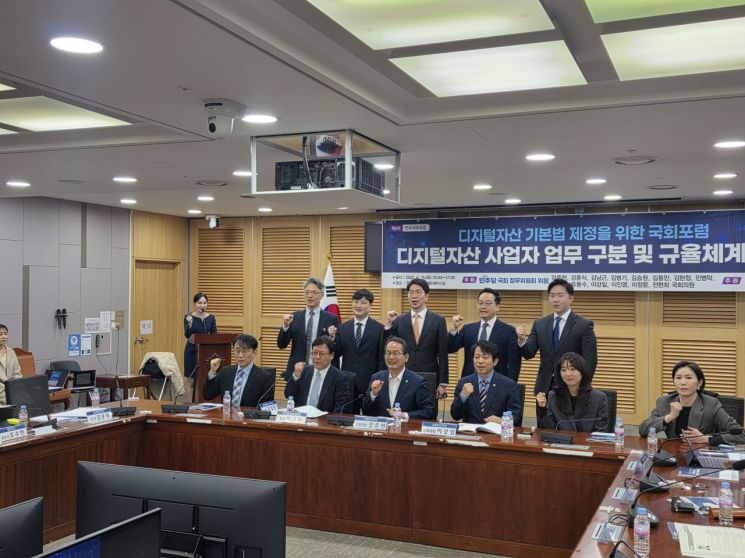
On the 15th, the 4th session of the National Assembly forum for the enactment of the Digital Asset Basic Act, titled "Establishing a Classification and Regulatory System for Digital Asset Service Providers," was held at the 2nd Seminar Room of the National Assembly Members' Office Building. The forum was hosted by the Democratic Party's National Assembly Committee on Economy and Finance and organized by the Korea Fintech Industry Association. This forum is the fourth of six planned sessions for the enactment of the Digital Asset Basic Act.
At the forum, Professor Chaesangmi from Ewha Womans University’s Business School delivered the keynote speech on the topic "Improvement Plan for the Classification System of Virtual Asset Service Providers (VASPs) for Industry Promotion and Investor Protection."
Professor Cha explained that systematizing the classification of virtual asset service providers is an essential element to simultaneously achieve industry promotion and investor protection. However, she pointed out that in South Korea, due to insufficient VASP classification, issues such as regulatory gaps, lack of international standards, and limited access to real-name accounts have arisen.
She stated, "The current classification system is not keeping up with the actual market development speed," adding, "New services such as Decentralized Finance (DeFi), Non-Fungible Tokens (NFTs), and Decentralized Autonomous Organizations (DAOs) are not included, raising concerns about hindering industry development." She further noted, "As a result, regulatory gaps have emerged, leading to vulnerabilities in investor protection."
To address these issues, she emphasized the need for measures such as introducing a registration system for new business types, designing and gradually implementing a public integrated disclosure system, establishing clear responsibility principles, and proactively organizing regulatory frameworks for new types of digital assets.
She explained, "Current VASP regulations are centered on exchanges, leaving regulatory frameworks for new service types such as advisory services, disclosure services, and evaluation services insufficient," and added, "It is necessary to proactively organize the system so that industry development and investor protection can be achieved simultaneously."
Next, Han Seohui, a lawyer from Barun Law LLC, presented on the topic "Classification System of Digital Asset Service Providers from the Perspective of Industry Promotion." He explained that South Korea's virtual asset ecosystem is currently in a state where creating a virtuous cycle is difficult because the market consists only of individual investors without institutional investor participation.
Lawyer Han stated, "Currently, South Korea's market only supports trading and distribution for general users, with no issuance or institutional investor investment allowed," and evaluated, "Ultimately, the South Korean market serves the role of enabling foreign developers and foreign investors to recover funds."
He explained that various types of service providers need to emerge to build the ecosystem. He said, "From the perspective of industry activation, issuance should be allowed along with underwriting services," and added, "Asset management companies, custodians, and investment advisory firms that treat virtual assets as investment targets are also necessary."
He stressed that regulations should be detailed by business type and requirements reflecting their characteristics should be differentiated. He explained, "Even within the same business area, requirements should vary depending on scale," and "For other service providers, custody obligations should be exempted depending on whether they have asset control rights."
During the panel discussion, there was consensus that the classification system should be more detailed. Oh Jongwook, CEO of Wavebridge, said, "For the industry to develop, it should be clearly divided into advisory, securities, asset management, and evaluation sectors."
Lee Beomgeun, CEO of Futurism Labs, also argued that "the virtual asset management market needs more systematized and institutionalized licenses similar to traditional finance," and insisted that entry requirements should be diversified by business model.
He further explained that virtual assets should be recognized as a single asset class. Ryu Heungyeol, CEO of Biddax, emphasized, "Virtual assets are not legally or officially recognized as assets by the government," and added, "Therefore, they seem unable to be linked with other financial sectors, so the definition of virtual assets should be included in the Basic Act."
The financial authorities expressed agreement with the opinion that classification by business type for virtual asset service providers is necessary. Kim Seongjin, Director of the Virtual Asset Division at the Financial Services Commission, said, "It is necessary to unify the currently bifurcated entry regulations for virtual asset service providers," and added, "Regarding business classification, we are referring to MiCA and the domestic Capital Markets Act."
© The Asia Business Daily(www.asiae.co.kr). All rights reserved.

















