U.S.-Japan Negotiations Begin on the 16th: Three Key Objectives
Strengthening U.S. Manufacturing, Adjusting the Strong Dollar, and Sharing Security Burdens
Vestent Achieved Major Profits by Analyzing Abenomics
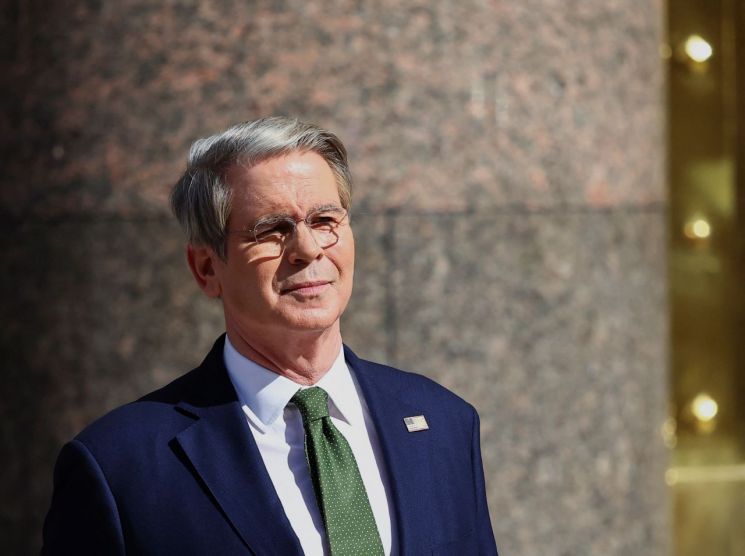
U.S. President Donald Trump appointed U.S. Treasury Secretary Scott Vestent as the representative for tariff negotiations with Japan, sparking increased interest in Secretary Vestent within Japan. Known for having made significant profits by analyzing the 'Abenomics' policy (a portmanteau of Abe and economics) during his days as a hedge fund manager, Secretary Vestent is regarded as someone who 'knows Japan well.'
Japan's Nihon Keizai Shimbun (Nikkei) forecasted on the 16th that the U.S.-Japan tariff negotiations would serve as a testing ground for the 'Vestent Initiative,' which aims to restructure the international economic system, as reported on the 14th.
In a speech last fall, Secretary Vestent stated, "The Bretton Woods system is being restructured. I have studied international economic policy throughout my life and want to be involved in this restructuring," after which he was nominated as Treasury Secretary for President Trump's second term administration. Since World War II, the U.S. has maintained global order as a hegemon based on a 'strong dollar' and a 'security umbrella,' but at the cost of bearing massive trade and fiscal deficits. His theory is that an economic policy to reverse this is necessary.
For this reason, the main goals of the upcoming U.S.-Japan negotiations are expected to be: ▲strengthening U.S. manufacturing ▲maintaining the dollar's status as the key currency while adjusting the strong dollar ▲sharing security burdens with allied countries.
The Trump administration has consistently advocated for strengthening U.S. manufacturing even before its inauguration. Regarding Japan, Nikkei pointed out that the U.S. has been steadily demanding investment in the shipbuilding industry. In his March joint session of Congress speech, President Donald Trump publicly mentioned the construction of the Alaska natural gas pipeline, saying, "Japan, South Korea, and other countries want to become our partners by investing trillions of dollars."
Another major goal is to maintain the dollar's key currency status while mitigating the current strong dollar. A strong dollar is an inevitable factor causing trade deficits. Nikkei noted, "Vestent's goal is to find a narrow path that maintains the dollar's key currency status while adjusting the strong dollar."
Secretary Vestent has stated, "The two are not contradictory," and emphasized the need for international currency coordination as was done in the 1980s and 1990s. For example, he envisions macroeconomic policy coordination involving central banks, similar to the 1985 'Plaza Accord.' At that time, the U.S. agreed with Japan, the UK, France, and West Germany to weaken the dollar to resolve the 'twin deficits' in trade and fiscal accounts.
Steven Miran, a former hedge fund manager and Treasury economist who chairs the White House Council of Economic Advisers, holds even more radical plans. He envisions countries selling U.S. Treasury bonds to induce a weaker dollar, among other aggressive strategies. However, such international cooperation cannot be realized without the collaboration of China and the European Union (EU). It is presumed that the 'tariff card' will be used as leverage to draw out international cooperation during this process.
From the Japanese government's perspective, Secretary Vestent's deep understanding of Japan's weaknesses is a disadvantage. Nikkei explained, "Japan has traditionally approached negotiations with the U.S. by separating security issues from trade and currency matters," adding, "This is because if security becomes a negotiation issue, Japan may be forced to make additional concessions in talks with the U.S." It is pointed out that Vestent, who is well-versed in Japan, could exploit this in negotiations.
Secretary Vestent, a former hedge fund manager from the southern U.S., graduated from Yale University in 1984 with a degree in political science. In 1991, he joined the London office of the Quantum Fund, founded by 'hedge fund legend' George Soros. He is also known for thoroughly analyzing Abenomics, the core economic policy of former Prime Minister Shinzo Abe, and making substantial profits amid the weak yen environment. He has experience teaching economic history at Yale University. He is classified as a 'moderate' among the Trump administration's tariff advisors. After the announcement of reciprocal tariffs on April 2, amid volatility in the U.S. stock and bond markets, he recently reemerged as a key figure in tariff policy by persuading President Trump to grant a 90-day suspension of reciprocal tariffs.
© The Asia Business Daily(www.asiae.co.kr). All rights reserved.
![Clutching a Stolen Dior Bag, Saying "I Hate Being Poor but Real"... The Grotesque Con of a "Human Knockoff" [Slate]](https://cwcontent.asiae.co.kr/asiaresize/183/2026021902243444107_1771435474.jpg)















