Semiconductors and AI: Speed of Institutional Design Matters More Than Technology
Defense and Shipbuilding: The U.S. Demands a Combination of Technological Capability and Production Capacity
Hydrogen, Nuclear Power, and LNG: Shift Needed Toward Joint Investment and Joint Export
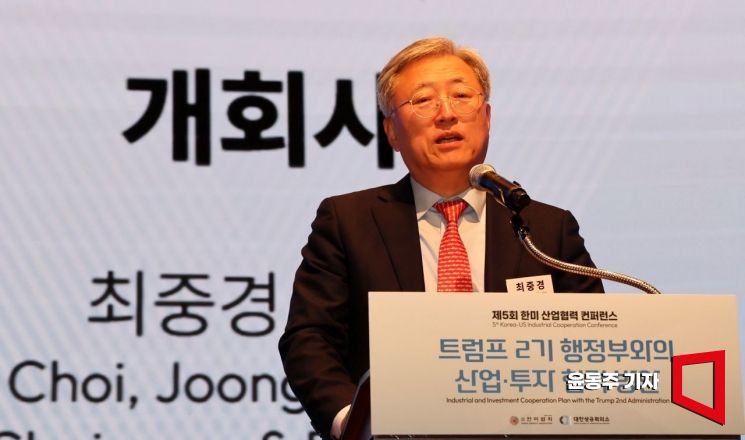 Choi Joong-kyung, Chairman of the Korea-America Association, is delivering the opening remarks at the Korea-U.S. Industrial Cooperation Conference held at the Korea Chamber of Commerce and Industry in Jung-gu, Seoul on the 15th. 2025.04.15 Photo by Yoon Dong-joo
Since the launch of the second Trump administration in the United States, Korea-US industrial cooperation has been shifting towards a more practical direction. The 5th Korea-US Industrial Cooperation Conference held on the 15th at the Korea Chamber of Commerce and Industry in Seoul clearly demonstrated this. It was an event that discussed not just the simple declaration of the 'need for cooperation,' but which fields to combine with what technologies and systems. The on-site remarks from private experts and companies played a role in presenting a blueprint for government-to-government dialogue first.
Choi Joong-kyung, Chairman of the Korea-US Association, emphasized the need to expand cooperation between the two countries beyond security to the entire industry. In his opening remarks, he said, "Korea is a country with global competitiveness in new energy, shipbuilding, and advanced manufacturing sectors," adding, "If Korea's manufacturing capabilities combine with America's advanced technology, the two countries can enjoy a powerful synergy effect." He also added, "The second Trump administration will continue to recognize Korea as an important economic and industrial partner."
Following the opening remarks, practical cooperation tasks were presented in three fields: semiconductors and AI (artificial intelligence), defense and shipbuilding, and energy. Participants commonly emphasized that changes in U.S. industrial policy are rapidly transforming the industrial supply chain structure itself, and that Korea must move beyond simple responses to act as a 'subject of cooperation.'
Semiconductors and AI: The Time to Prioritize 'Structural Design' over 'Technological Capability'
The first session started from the realistic recognition that the speed of institutional and structural design is more important than technology. Given that U.S. semiconductor support policies encompass not only production bases but also the entire supply chain, technology export controls, and workforce restructuring, the timing of Korea's participation decisions was analyzed as crucial.
In particular, Martin Chorzempa, Senior Fellow at the Peterson Institute for International Economics, explained the direction of U.S. semiconductor and technology security policies amid prolonged U.S.-China technological competition. He said, "A multi-layered strategy involving export controls, supply chain restructuring, and R&D investment is underway, requiring coordination with allies such as Korea."
Ko Jong-wan, Head of Strategic Planning at the Korea Semiconductor Industry Association, emphasized the importance of parallel development not only in semiconductor technology but also in systems and workforce training frameworks. He suggested that to enhance the effectiveness of Korea-US cooperation, complex factors such as supply chain stability, policy alignment, and securing local experts must be considered.
Mike Ye, Head of Policy Cooperation for Asia at Microsoft, highlighted the importance of data movement, accountability, and the establishment of international norms due to the spread of artificial intelligence, proposing joint governance cooperation between Korea and the U.S. to address these issues.
Defense and Shipbuilding: Expansion of a Technology Alliance Based on Shipbuilding Capabilities
The second session addressed the need for technological cooperation in shipbuilding and defense between Korea and the U.S. amid changes in U.S. defense strategy. It was highlighted that the U.S. demands a combination of technological capability and production capacity when selecting strategic allies.
Robert Peters, Senior Fellow at the Heritage Foundation, pointed out vulnerabilities in the U.S. shipbuilding and defense supply chains and evaluated that Korea, as an ally with unique shipbuilding capabilities, has high potential for strategic cooperation.
Kim Da-young, Senior Research Fellow at the Institute for Foreign Strategy, introduced Korea's advanced shipbuilding technology and suggested the need to expand cooperation early in areas such as U.S. Navy ship maintenance (MRO).
Actual corporate cases were also shared. Jung Woo-man, Executive Director at HD Hyundai Heavy Industries, explained that HD Hyundai began maintenance services for U.S. Navy non-combatant ships (MSC) in 2023 and is considering future entry into the combat ship sector through coordination among shipyards. Seok Jun-hyung, Executive Director at Hanwha Aerospace, introduced plans to localize defense parts and expand maintenance hubs, mentioning the expansion of the production base for the Korea-US technology alliance.
Potential Cooperation Linking Hydrogen, Nuclear Power, and LNG
In the energy session, a trend was sensed to move beyond the 'importer-supplier' relationship toward joint investment and joint exports.
Jung Ji-ho, Team Leader at Doosan Enerbility, shared experience in manufacturing main components for SMRs (Small Modular Reactors) in collaboration with NuScale Power, saying, "Korea and the U.S. can leverage their respective technological strengths to pursue exports to third countries." Professor Yoo Seung-hoon of Seoul National University of Science and Technology also emphasized that Korea's design and construction capabilities must combine with the U.S.'s regulatory and policy infrastructure to create competitiveness.
Joo Young-geun, Senior Researcher at POSCO Research Institute, pointed out that Korea is the world's largest LNG importer and suggested that cooperation with the U.S. could expand beyond simple imports to investment and strategic linkage.
Based on the discussions at this conference, the government plans to establish the 'Korea-US Industrial Cooperation Joint Plan 2.0 (2025?2027)' within the year. Moving beyond the first phase plan focused on policy cooperation, the second phase plan will include practical cooperation tasks such as establishing an early warning system for supply chains, linking technology demonstrations, setting international standards, and joint export strategies.
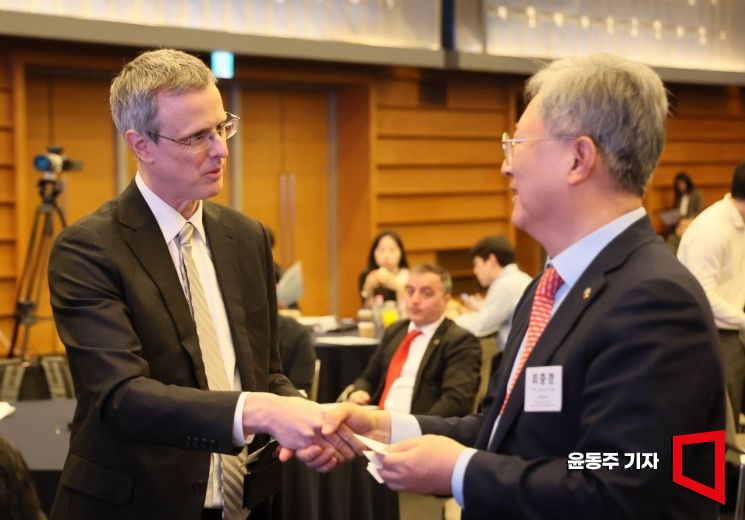 Choi Joong-kyung, Chairman of the Korea-America Association, and Andrew Gately, Charg? d'Affaires at the U.S. Embassy in Korea, are exchanging greetings at the Korea-U.S. Industrial Cooperation Conference held on April 15 at the Korea Chamber of Commerce and Industry in Jung-gu, Seoul. 2025.04.15 Photo by Yoon Dong-ju
© The Asia Business Daily(www.asiae.co.kr). All rights reserved.


















