Near Foundation Holds Special Forum on 100 Days of Trumpism
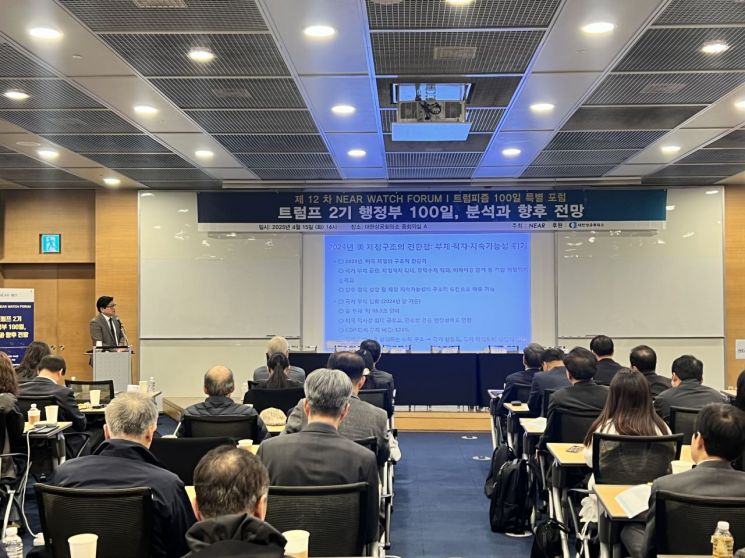 On the 15th, the Near Foundation is holding a special forum at the Korea Chamber of Commerce and Industry on the theme "100 Days of the Second Trump Administration: Analysis and Future Prospects."
As President Donald Trump approaches his 100th day in office, having wielded the sword of tariffs against the world, countries are grappling with strategies to respond. South Korea, which recorded a $66 billion trade surplus with the United States last year, is also within the Trump administration's sights. However, trade and economic experts predict that if the Trump administration’s high-tariff policy continues, it will rather reduce the productivity of American manufacturing and inevitably lead to inflation. They foresee that the feared Trump-originated tariff policy will go through negotiations and ultimately reach a compromise. They advised the South Korean government to actively pursue a comprehensive package negotiation with the U.S. linking security, economy, and industry.
On the 15th, the Near Foundation held a special forum at the Korea Chamber of Commerce and Industry titled "100 Days of the Trump Second Administration: Analysis and Future Prospects." Established in 2007, the Near Foundation is a private think tank researching international political issues, studying not only South Korea’s East Asia strategy but also international politics, diplomacy, and security in various fields.
On that day, Jung Deok-gu, director of the Near Foundation, diagnosed that "recently, Trump-style tariff weaponization policy seems to have reached a delicate phase." Director Jung said, "The ripple effects of the high-tariff policy are leading to great confusion in the trade order, which is critically impacting financial markets and striking at the Achilles’ heel of the U.S., the government bond market." He emphasized, "One thing is certain: the U.S. will lose some of the important assets it has accumulated over time."
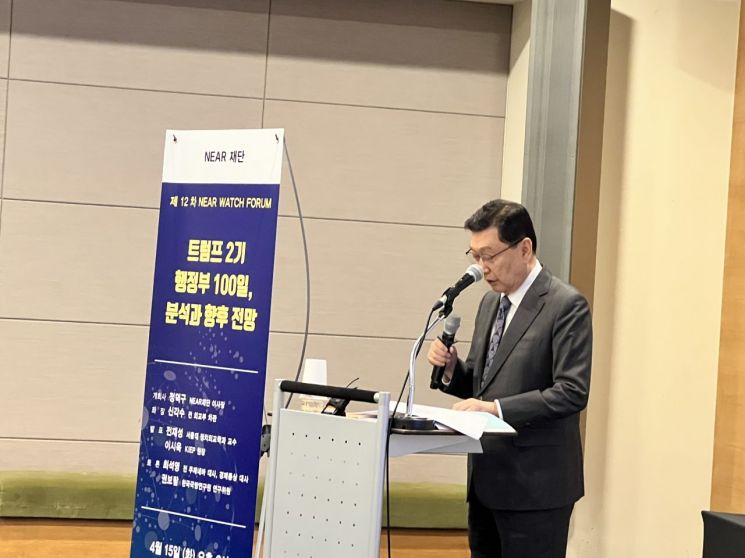 On the 15th, Jeong Deok-gu, Chairman of the Near Foundation, delivered the opening remarks at the forum titled "100 Days of the Trump Second Administration: Analysis and Future Prospects," hosted by the Near Foundation.
Specifically, Director Jung viewed that the U.S. tariff policy will ultimately further weaken the foundation of American manufacturing. He pointed out, "High tariff barriers will further reduce the productivity of U.S. manufacturing and lower its international competitiveness. The greatest benefit the U.S. gained from free trade was the reduction and stabilization of core inflation, but if the Trumpism-style high-tariff policy continues, American citizens will lose this advantage they have enjoyed."
Former Ambassador to Geneva Choi Seok-young diagnosed that Trump’s tariff measures show a pattern of "fear first, negotiation later," meaning that after obtaining initial concessions from counterpart countries, further pressure is applied. Ambassador Choi said, "Even if Trump’s tariff policy goes through fear and negotiation, it is difficult to maintain a hostile relationship with key allies like South Korea." He advised, "South Korea needs to establish a strong control tower and, led by the government, cooperate between public and private sectors to conduct pre-exemption negotiations and post-exception negotiations on tariffs, as well as comprehensive package negotiations with the U.S."
The South Korean government plans to soon start a working-level video conference on the "Alaska Liquefied Natural Gas (LNG) Development Project," a long-standing wish of President Trump. Minister of Trade, Industry and Energy Ahn Deok-geun plans to visit the U.S. as early as next week to conduct negotiations focusing on tariffs in sectors such as shipbuilding and energy.
At the forum, there was also a suggestion that the crisis triggered by the Trump second administration should be turned into an opportunity to strengthen South Korea’s industrial competitiveness. Lee Si-wook, president of the Korea Institute for International Economic Policy, said, "Over the past decades, South Korea’s major conglomerates, which have led the global market, have recently failed to achieve sufficient competitive advantages or innovation and have seen their market dominance eroded by technologies from emerging companies like those in China." He added, "This crisis should be viewed from a mid- to long-term perspective as an opportunity to capture new industrial and technological opportunities and to design and implement systematic policies for strengthening industrial competitiveness through close communication and cooperation between the public and private sectors."
President Lee urged strengthening cooperation with countries holding key resources such as Germany, Japan, Taiwan, as well as India and Latin America, which face similar situations to South Korea. He said, "Considering recent international changes emphasizing nationalism, it is necessary to strengthen public-private cooperation systems with countries facing similar situations like Germany, Japan, and Taiwan. It is also essential to further enhance cooperation with India, Southeast Asian countries, Latin American countries, and key resource-holding countries in the global South, which are emerging as bridge countries in the global supply chain."
© The Asia Business Daily(www.asiae.co.kr). All rights reserved.


















